
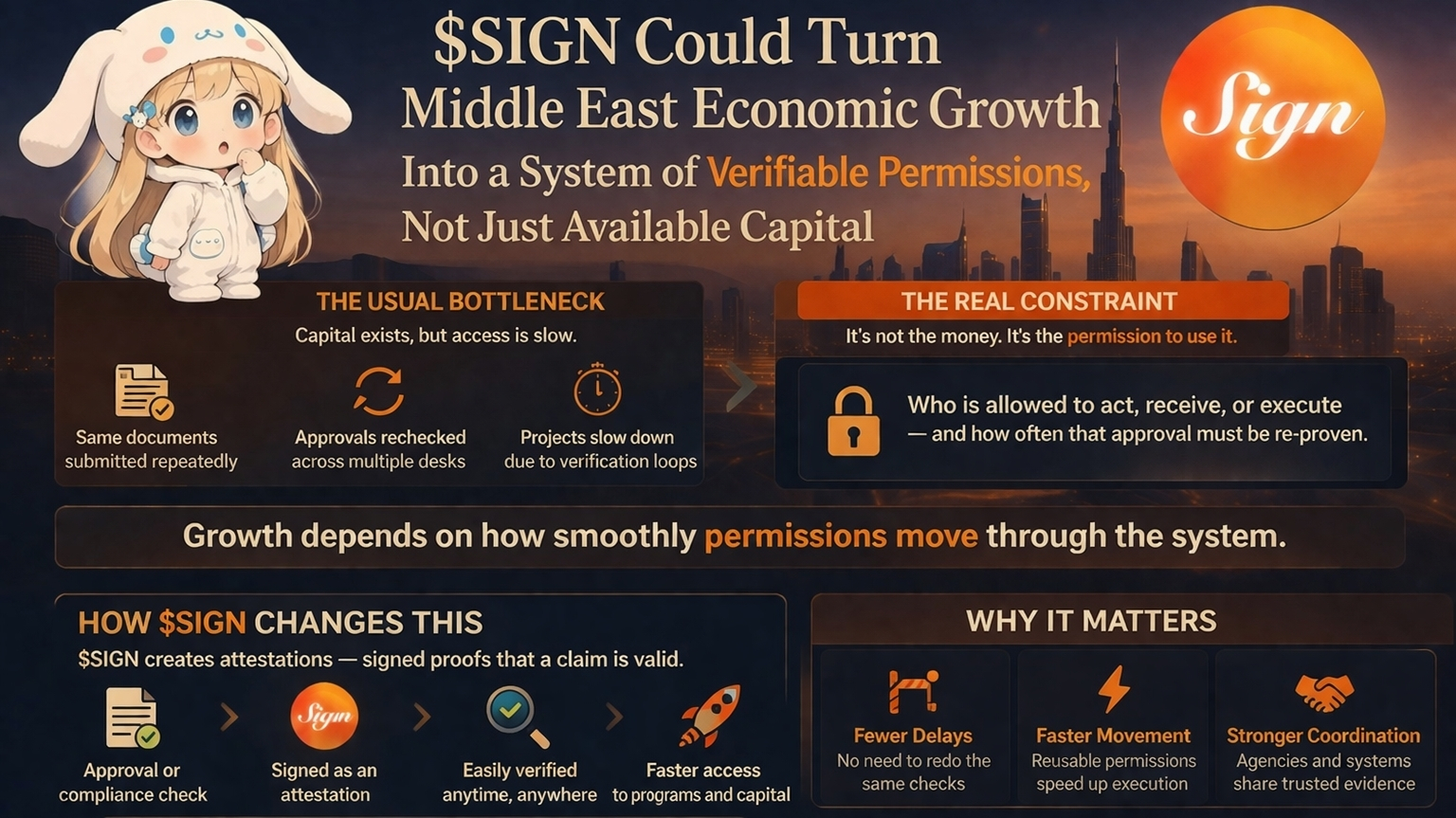
I didn’t think much about permissions until I started noticing how often they quietly decide outcomes. Not in an obvious way. More like a pattern you catch late. Two businesses can be in the same sector, similar funding, similar plans… and still move at completely different speeds. One gets approvals lined up early and keeps going. The other keeps circling back, proving the same things again and again.
It’s easy to describe that as bureaucracy and move on. But after a while it starts to feel more structural than accidental. Especially in regions where large-scale growth is already funded. The Middle East isn’t short on capital. That part is clear. What’s less visible is how access to that capital actually works once you step inside the system.
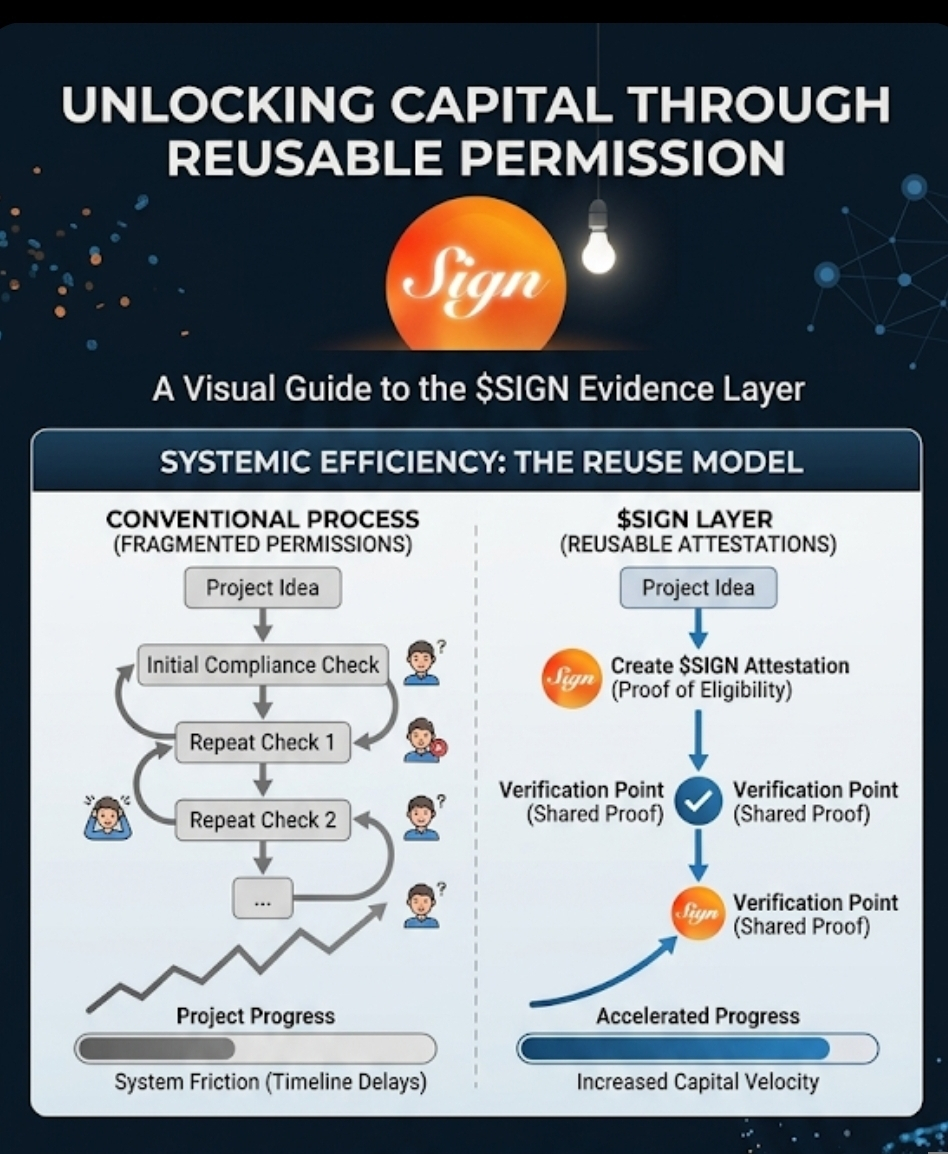
There’s a layer in between that doesn’t get discussed much. It’s not money, not policy, not even infrastructure in the usual sense. It’s permission. Who is allowed to receive, to execute, to participate. And more importantly, how often that permission has to be rechecked.
That’s where $SIGN starts to look different, at least from how most crypto infrastructure is framed. It’s not trying to move capital faster in the usual way. It’s trying to make the conditions around capital easier to verify and reuse. The system uses something called attestations, which sounds technical but isn’t that complicated. It’s basically a signed proof that a claim is valid. A compliance check, an approval, an eligibility condition. Once created, it can be checked again without starting over.
The interesting part isn’t that these proofs exist. Systems already create records all the time. The difference is whether those records actually travel. In most cases, they don’t. A compliance approval in one system doesn’t automatically mean anything in another. So the same process gets repeated. Not because it has to, but because there’s no shared way to trust what already exists.
And that repetition adds up. Not immediately. It’s not like a visible fee. More like friction that spreads across timelines. A delayed approval here, a revalidation there. Projects don’t stop, but they slow down. Over time, that slowdown shapes who succeeds and who doesn’t.
I’ve started thinking of it less as a capital problem and more as a verification problem. Capital is often ready. What’s not ready is the system’s confidence that you’re allowed to use it. That confidence has to be rebuilt again and again.
$SIGN seems to be built around reducing that loop. It acts as an evidence layer, which is just a way of saying it keeps track of what was approved, by whom, and under what conditions, in a way that others can check later. Not perfectly, not universally, but more consistently than fragmented systems.
If that works, even partially, the effect isn’t dramatic. It’s gradual. Permissions start behaving differently. They stop being one-time gates and start becoming reusable signals. And once that happens, the advantage shifts slightly. Not toward who has more capital, but toward who can carry their eligibility forward without resetting it every time.
There’s something similar happening, in a much smaller way, on platforms like Binance Square. You can post consistently, but if the system doesn’t recognize your signals—engagement, relevance, timing—you stay invisible. The people who move faster aren’t always the most skilled. They’re the ones who understand how the system verifies credibility. It’s not about effort alone. It’s about alignment with how proof is interpreted.
Scale that idea up to sovereign systems, and it gets more complicated. Different agencies, different rules, different levels of trust. Getting them to rely on shared proofs instead of isolated checks isn’t just a technical shift. It changes how responsibility is distributed. Who trusts whose approval. Who is accountable if something goes wrong.
And that’s where I’m still unsure. Because the system only works if those proofs are actually reused. If attestations are created and then ignored, nothing really changes. You just end up with more data, not less friction. The whole model depends on repetition, not of the checks, but of the usage.
There’s also a timing issue. The benefits here don’t show up immediately. Saving one verification step doesn’t feel like much. Saving hundreds across interconnected systems starts to matter, but only after the network is already in motion. Getting to that point requires adoption that isn’t always easy to coordinate.
Still, the direction makes sense in a quiet way. Economic growth isn’t just about injecting capital. It’s about how smoothly that capital can move through layers of permission. And those layers are getting more complex, not less.
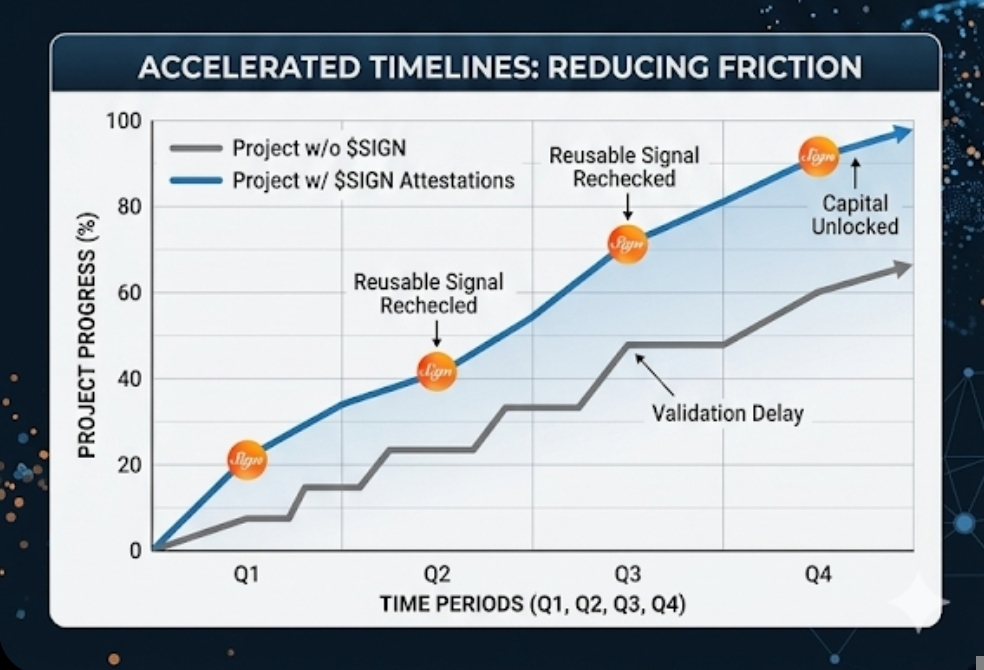
What I keep coming back to is this: we tend to think of capital as the main driver of growth because it’s visible, measurable, easy to track. But permissions are harder to see. They sit in processes, approvals, conditions. Yet they shape the path just as much, sometimes more.
If $SIGN works, even partially, it doesn’t replace capital. It changes how capital is unlocked. And that shift is subtle enough that most people might not notice it at first. But over time, it could be the difference between systems that move because they’re funded, and systems that move because they’re allowed to.