
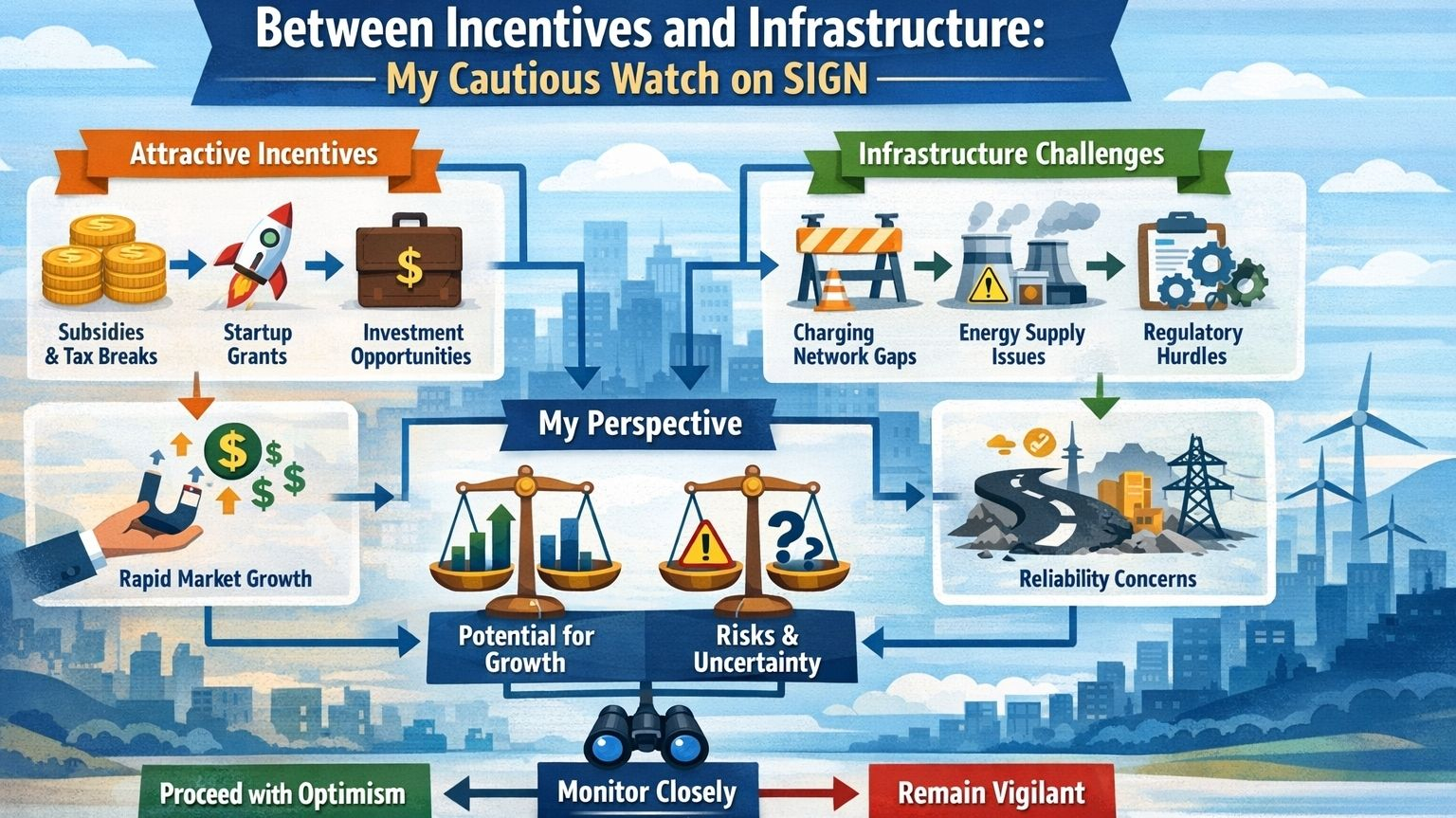

I’ve been looking at SIGN for a while now, and honestly, what caught my attention wasn’t the chart—it was the positioning. Calling something “global infrastructure for credential verification and token distribution” sets a very high bar. I’ve seen plenty of projects lean into identity and reputation narratives, but very few manage to move beyond short bursts of incentive-driven activity. So my first reaction wasn’t excitement—it was cautious curiosity.
At a basic level, the idea makes sense. Web3 still struggles with identity. Wallets are anonymous, reputation is fragmented, and every app ends up rebuilding its own system from scratch. SIGN tries to fix that through on-chain attestations—verifiable credentials that can be issued once and reused across different applications. Strip away the buzzwords, and it’s really about standardizing trust. One entity issues a credential, and others can verify it without needing to rely on that issuer directly.
What makes the design more interesting is how it pairs this with TokenTable, a system for managing token distributions, vesting schedules, and airdrops. That combination feels intentional. If a protocol can define who qualifies for something and also control how rewards are distributed, it sits right in the middle of incentive design. That’s a powerful place to be, but it also comes with a pattern I’ve learned to approach carefully.
When I look at the numbers, I immediately shift into a different mindset. A max supply of 10 billion with only around 1.2 billion circulating means roughly 12% of tokens are currently in the market. The market cap sits somewhere in the mid tens of millions, while the fully diluted valuation is several times higher. That gap tells me we’re still early in the emission cycle, and future unlocks will matter more than current demand.
The allocation looks familiar—heavy on community incentives, which usually sounds great on paper. But I’ve learned that allocation percentages don’t tell the full story. What really matters is how quickly tokens enter circulation. With SIGN, early inflation is aggressive. A large portion of supply gets distributed in the first couple of years before slowing down later. That shifts the nature of the asset. It’s not scarcity-driven at this stage—it’s distribution-driven. And that changes how I interpret every spike in activity or price movement.
This is where I start questioning the usage metrics. Millions of attestations and large-scale token distributions sound impressive, but I always ask what’s underneath those numbers. Distribution platforms naturally generate a lot of activity—airdrop claims, wallet interactions, batch transfers. These things look like adoption on-chain, but they don’t always translate into long-term engagement.
I’ve seen this cycle play out many times. A project runs a campaign, activity surges, wallets interact, tokens move quickly, and everything looks alive. Then incentives fade, and so does the usage. So when I see daily trading volume in the millions, I don’t just see liquidity—I see the possibility that much of it is tied to distribution events rather than consistent demand.
Still, I think it’s important to acknowledge that the underlying design is actually solid. Separating credential verification from token distribution is a smart architectural choice. It allows systems to verify something once and reuse that proof instead of repeating expensive processes. That’s how you build something scalable. It reduces redundancy and makes integration easier for developers.
The real question isn’t whether the system works. It’s whether people keep using it when they’re not being incentivized to do so.
That’s where narrative and reality start to diverge. The identity and reputation angle is easy to market, and it fits neatly into the broader story of Web3 maturing. But narratives don’t sustain networks—habit does. I keep asking myself whether developers are integrating this because they truly need it, or because there are incentives attached. Whether users are actually reusing credentials across apps, or just showing up to claim rewards and leave.
Identity protocols depend heavily on network effects. If only a few apps adopt them, they don’t provide much value. But if they become widely integrated, they turn into invisible infrastructure. SIGN feels like it’s somewhere in that transition phase—not early enough to ignore, but not established enough to fully trust.
From a market perspective, it behaves like many early infrastructure tokens. There’s a decent narrative, moderate liquidity, and clear signs that activity can spike around distribution events or exchange exposure. But without consistent, organic usage, those spikes tend to fade. Price action becomes cyclical rather than trending.
There is real upside if things go right. If larger applications, enterprises, or even regulated systems start using a shared credential layer, something like SIGN could become deeply embedded. And once infrastructure is embedded, it’s hard to replace. But the risks are equally clear. High inflation in the early phase puts pressure on price. Activity that depends too much on incentives doesn’t last. And there’s still an open question around how value flows back to the token itself.
There’s also a quieter risk that doesn’t get talked about enough. If identity becomes a standardized, commoditized layer, the value might not accumulate where people expect. The protocol could be widely used, but the token might not capture that usage in a meaningful way.
So for now, I sit in the middle. I don’t see SIGN as hype, but I also don’t see it as proven infrastructure yet. It’s in that uncomfortable stage where the idea is real, the system works, but the usage might still be partially manufactured.
What I’m watching is simple, but important. Are credentials being reused across different applications, or just issued once? Does activity remain stable when there are no new campaigns? Are developers building on top of it without needing grants? And most importantly, does demand for the token come from actual usage rather than speculation?
If those signals start to show up consistently, my view changes. Until then, I treat it the way I treat most early-stage infrastructure plays—not something to ignore, but not something to blindly trust either. The interesting part is that if it does work, it probably won’t be obvious right away. It’ll show up quietly, in small signs of real dependency, long before the market fully prices it in.
@SignOfficial #SignDigitalSovereignInfra $SIGN
