
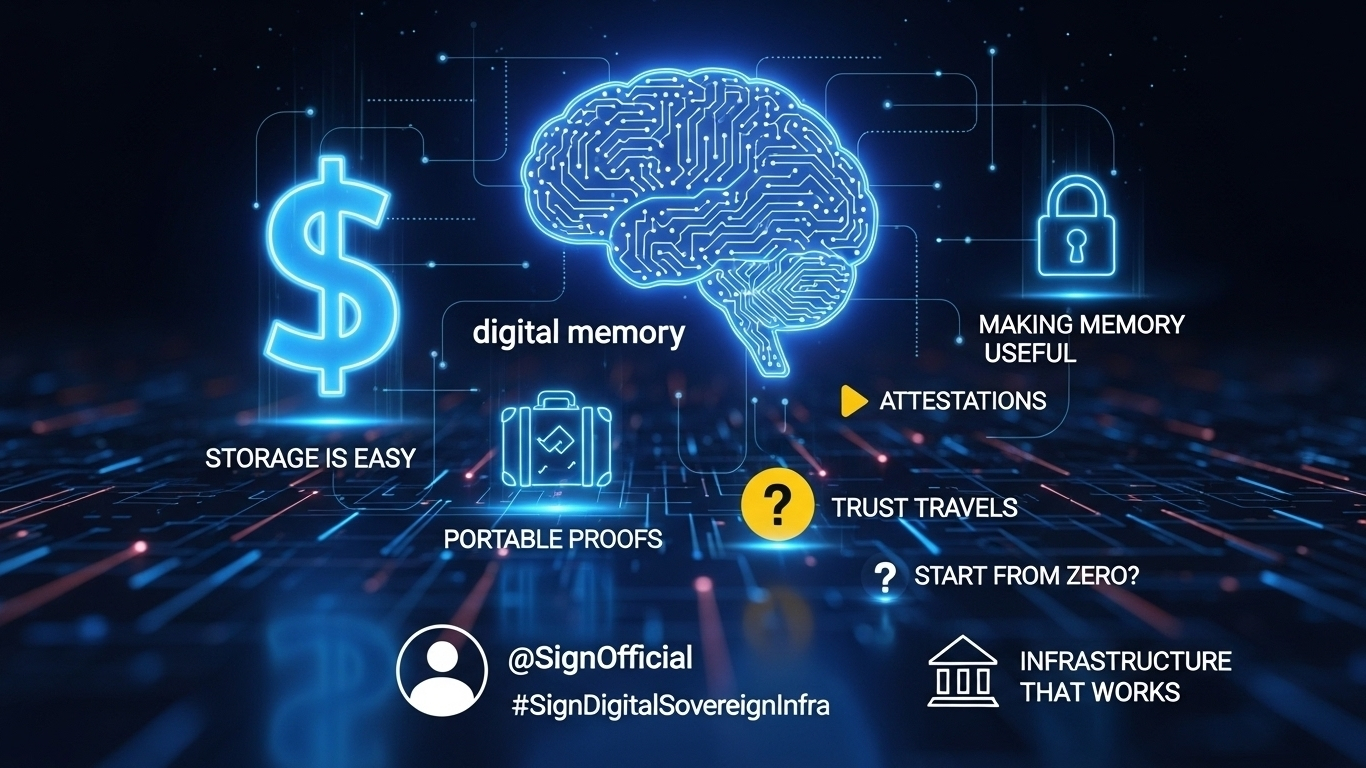
$SIGN , you know what’s funny? i used to think digital memory was just about storage. like, as long as something was recorded somewhere, that was enough. but the more time i spend in this space, the more i realize storage is the easy part. the hard part is making that memory useful when you actually need it 😂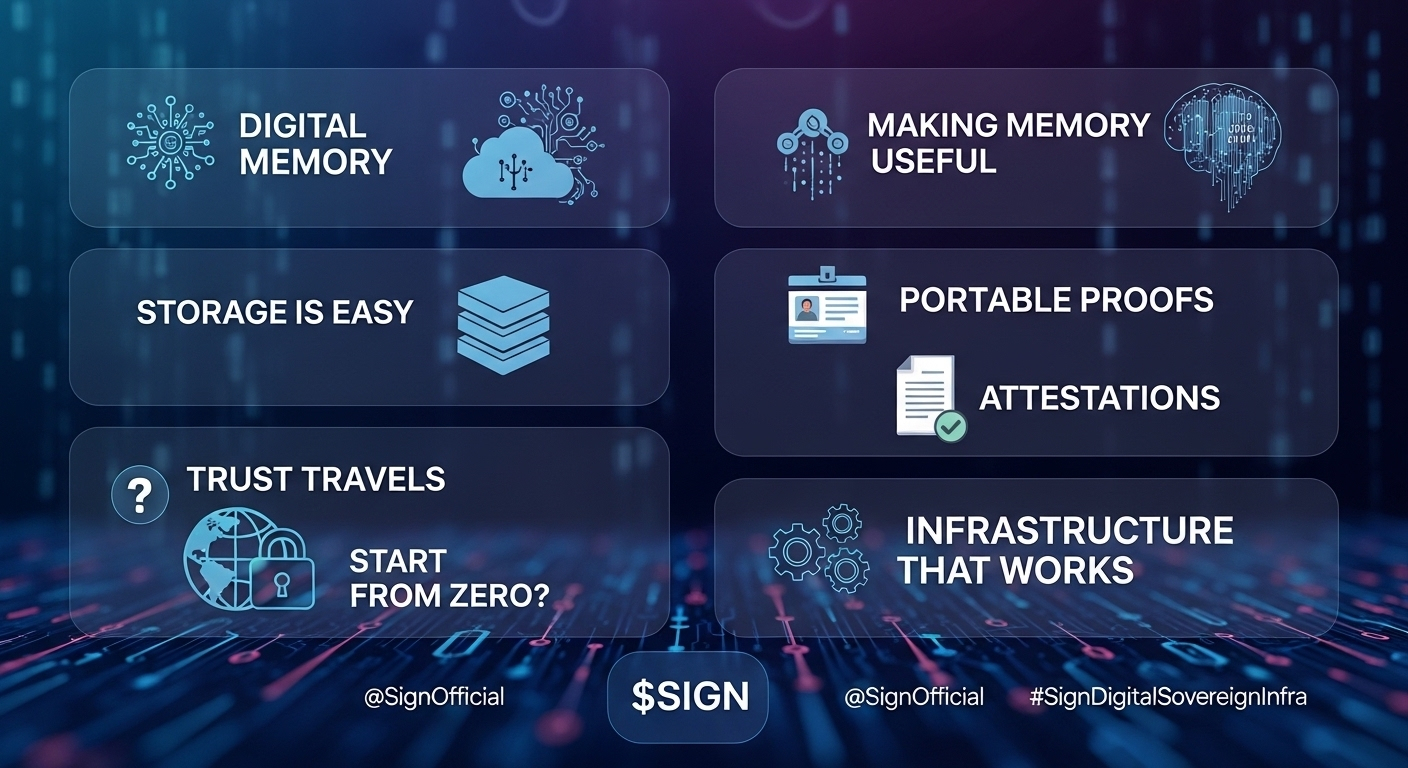
think about it. your entire digital life is scattered across a million places. wallets, accounts, platforms, credentials, participation records, transaction histories. all of it stored. all of it technically “remembered.” but try taking a piece of that memory and using it somewhere else. try proving to a new platform that you were an early contributor somewhere. try showing a protocol that you’ve already completed a verification step. suddenly all that stored memory feels stuck. it’s there, but it can’t move. it can’t speak. it can’t prove anything outside the exact place where it was created.
that’s the gap sign protocol steps into. and honestly? it’s a beautiful thing to watch.
$SIGN doesn’t just record facts. it gives them legs. it takes something that happened , a contribution, a verification, a qualification ,and turns it into a portable, verifiable, still‑meaningful piece of proof that can travel across systems, across time, across contexts. without you having to explain yourself over and over. without you having to rebuild trust from scratch every single time.
i remember a friend of mine who was trying to participate in a token distribution last year. he’d done everything right , early involvement, active participation, all the boxes checked. but when the distribution happened, none of that history counted because it lived in a different ecosystem. he had to start over. prove himself again. that stuck with me. because it’s not his fault. it’s the infrastructure’s fault for not making memory portable.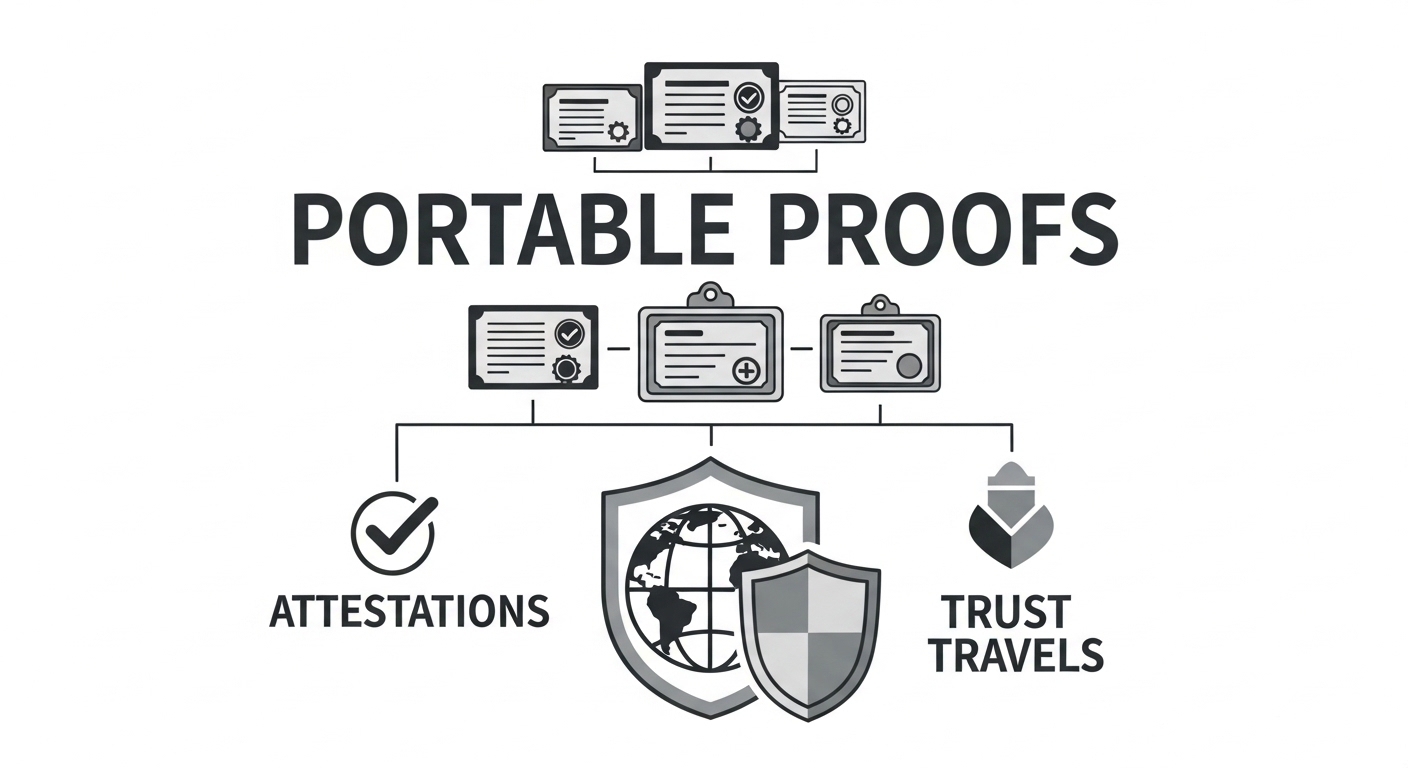
that’s what sign solves.
when you complete something on a platform that uses sign, that completion becomes more than a line in a database. it becomes an attestation , a signed, timestamped, revocable, portable claim that can travel anywhere the infrastructure goes. later, when you’re applying for access somewhere else, or claiming a reward, or proving eligibility, you don’t have to dig up screenshots and beg someone to believe you. the proof just works.
and here’s the part that gets me excited: sign is building this across multiple chains, across both public and permissioned environments, across use cases that actually matter. identity verification, government systems, token distributions, credential management, participation tracking. it’s not just theoretical. they’re running hackathons where people are shipping real apps. they’re working with national identity programs. they’re making attestations cheap enough to use at scale.
the privacy side is thoughtful too. retail namespaces with zero‑knowledge proofs so your transactions aren’t just blasted out for everyone to see. programmable payments. offline capability for places where internet is spotty. financial inclusion baked into the design. that’s not just tech for tech’s sake , that’s tech built for real human needs.
and the cost? negligible. using layer 2s, off‑chain storage for heavy data, keeping only the essential proofs on-chain. that means it can scale without pricing out the very people it’s trying to serve. that’s the kind of intentional design that tells me they’re thinking about adoption, not just announcements.
there’s also something quietly powerful about how sign approaches standardization. they’re pushing for shared formats, clear schemas, consistent ways of expressing what a proof actually means. that matters more than people realize. because when every system speaks the same language, trust stops being a negotiation. it becomes infrastructure. something that just works in the background.
most people won’t know they’re using sign. that’s the goal. the best infrastructure is invisible. you don’t think about the plumbing when the water flows. you don’t think about the roads when you’re driving. sign wants to be the invisible layer that makes digital memory actually useful — so you don’t have to repeat yourself, don’t have to beg for recognition, don’t have to rebuild your reputation every time you step into a new system.
from a trader’s perspective, i like things that reduce friction. less friction means more adoption. more adoption means more utility. and when infrastructure becomes essential, it doesn’t disappear , it just becomes the standard. that’s the kind of long‑term trajectory that gets my attention.
but honestly, beyond the charts and the tech, there’s something deeper here. it’s about respect for people’s time and effort. it’s about making sure that what you’ve already done continues to count. it’s about building a digital world where you don’t have to start from zero every time you walk through a new door.
sign is quietly, steadily building that world. and i’m here for it.
#SignDigitalSovereignInfra $SIGN
