
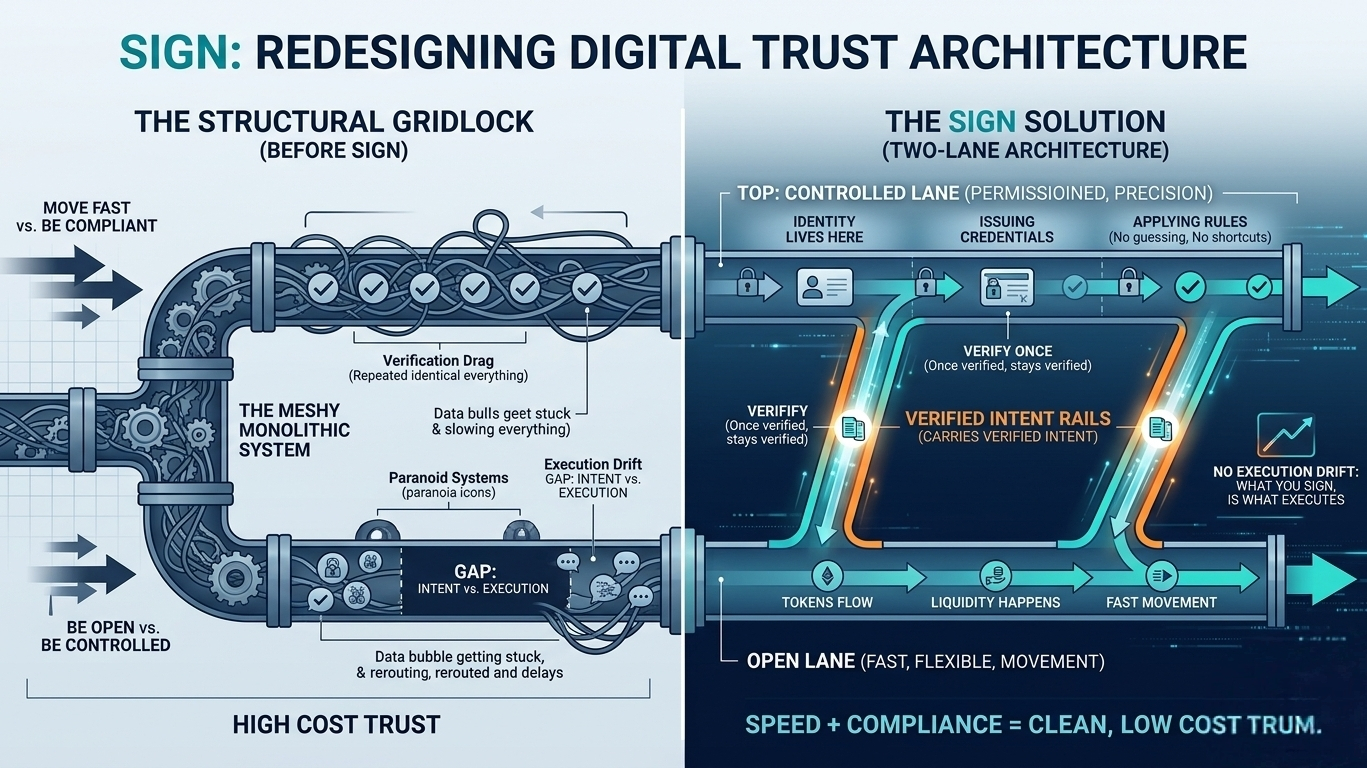
I’ll be honest, most digital systems don’t break because the tech is bad. They break because they’re trying to do two opposite things at once.
Be open. Be controlled.
Move fast. Be compliant.
Pick one, right?
But no—everything tries to do both. And that’s where it all starts to feel… stuck. Like pushing against a wall that doesn’t move no matter how hard you try.
Here’s the thing.
On one side, you’ve got open networks. Fast, flexible, anyone can plug in, value moves around like it should. That’s the dream everyone sells. On the other side, you’ve got reality—identity checks, rules, audit trails, regulators breathing down your neck. Not optional stuff.
Both matter. A lot.
But they don’t naturally fit together. And people don’t talk about that enough.
So what happens?
Things drift.
A transaction says one thing, ends up doing something slightly different. A credential exists, but every system wants to double-check it like it doesn’t trust anyone. Payments go through, sure—but the meaning behind them? Kinda lost in translation.
I’ve seen this before. Over and over.
It’s not a bug. It’s structural.
And this is where SIGN actually gets interesting.
Instead of forcing everything into one messy system, it splits the problem into two lanes. Simple idea, but it changes everything.
The first lane is controlled. Tight. Permissioned. This is where identity lives, where credentials get issued, where rules actually mean something. It’s slower, yeah—but that’s the point. You want it to be precise.
No guessing. No shortcuts.
The second lane? Completely different vibe.
It’s open. Fast. Built for movement. This is where tokens flow, transactions happen, liquidity does its thing. It doesn’t waste time re-checking everything because that work already happened somewhere else.
That separation is clean. And honestly, overdue.
Because trying to do both in one place? That’s how you end up with systems that are slow and unreliable. Worst of both worlds.
But splitting things isn’t enough. You still need them to talk to each other.
And this is where most projects fall apart.
SIGN doesn’t.
It builds rails between the two lanes. Not just pipes moving data around—but actual infrastructure that carries verified intent from one side to the other.
That’s important, so let me say it straight:
Once something gets verified, it stays verified.
No repeating the same checks. No second-guessing. No “just to be safe” delays.
That kills verification drag. Completely.
Because normally, every system acts like it’s the first one seeing the data. So it redoes everything. Again and again. Waste of time.
SIGN cuts that loop off at the root.
And then there’s the deeper issue—execution drift. This one’s subtle, but it matters more than people think.
It’s that gap between what you meant to happen and what actually happens after your transaction passes through five different layers.
Yeah. That gap.
SIGN locks intent at the start and carries it all the way through.
So what you sign… actually gets executed.
No reinterpretation halfway through. No silent changes.
It just works. Period.
Now, let’s ground this a bit, because otherwise it sounds like theory.
Take government subsidies. Messy system. You’ve got eligibility checks, multiple departments, delays, leakages—you name it. Money gets assigned, but tracking where it actually goes? Not always clean.
With SIGN, eligibility gets handled in the controlled lane. Real identity, real checks, clear criteria. Once someone qualifies, the funds move through the open lane instantly.
And only to the right person.
No duplicates. No random detours. No confusion.
That’s a big deal.
Same story with cross-border payroll. Companies deal with compliance in one place, payments in another, and friction everywhere in between. Slow, expensive, annoying.
SIGN simplifies it.
Verify the employee once—properly—in the controlled lane. Then pay them through the open lane without repeating the whole process every time.
Fast and compliant. That combo is rare.
And yeah, I know what you might be thinking—“this sounds obvious.”
Exactly.
That’s kind of the point.
Sometimes the best infrastructure fixes aren’t flashy. They just remove the nonsense everyone got used to.
What SIGN is really doing is breaking down silos.
Right now, identity sits in one system. Payments in another. Verification somewhere else entirely. And stitching them together? Painful.
SIGN lines them up without forcing them into the same box.
Trust happens in one place. Movement happens in another. And the connection between them just… works.
Clean.
It also changes how expensive trust is. Because right now, trust isn’t cheap—you keep paying for it every time you verify something again.
Here, you verify once.
That’s it.
From there, systems can interact without acting paranoid all the time. And yeah, that unlocks a different level of interoperability—not just between apps, but across entire industries.
Look, I don’t see this as some hype cycle thing.
It’s not trying to go viral. It’s not chasing attention.
It’s fixing a pretty old problem: how do you move value without losing meaning along the way?
And honestly? That’s harder than it sounds.
SIGN’s answer is pretty straightforward when you strip everything else away:
Keep control where you need it.
Keep speed where you want it.
And connect them without breaking either side.
That’s it.
No magic. Just good structure.
And if they actually pull this off at scale, it won’t feel like some big breakthrough moment. It’ll just quietly become the way things should’ve worked all along.
Those are the systems that win.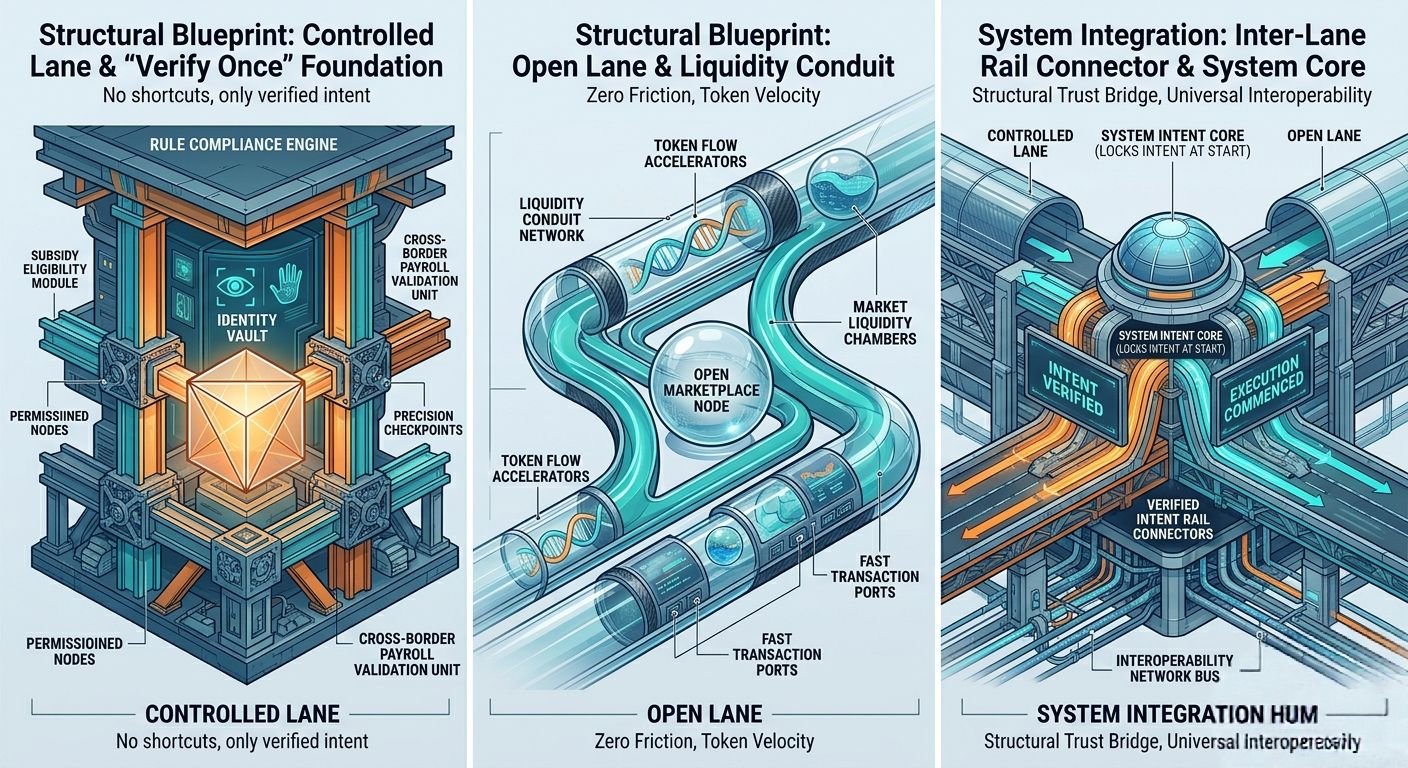
@SignOfficial #SignDigitalSovereignInfra $SIGN
