
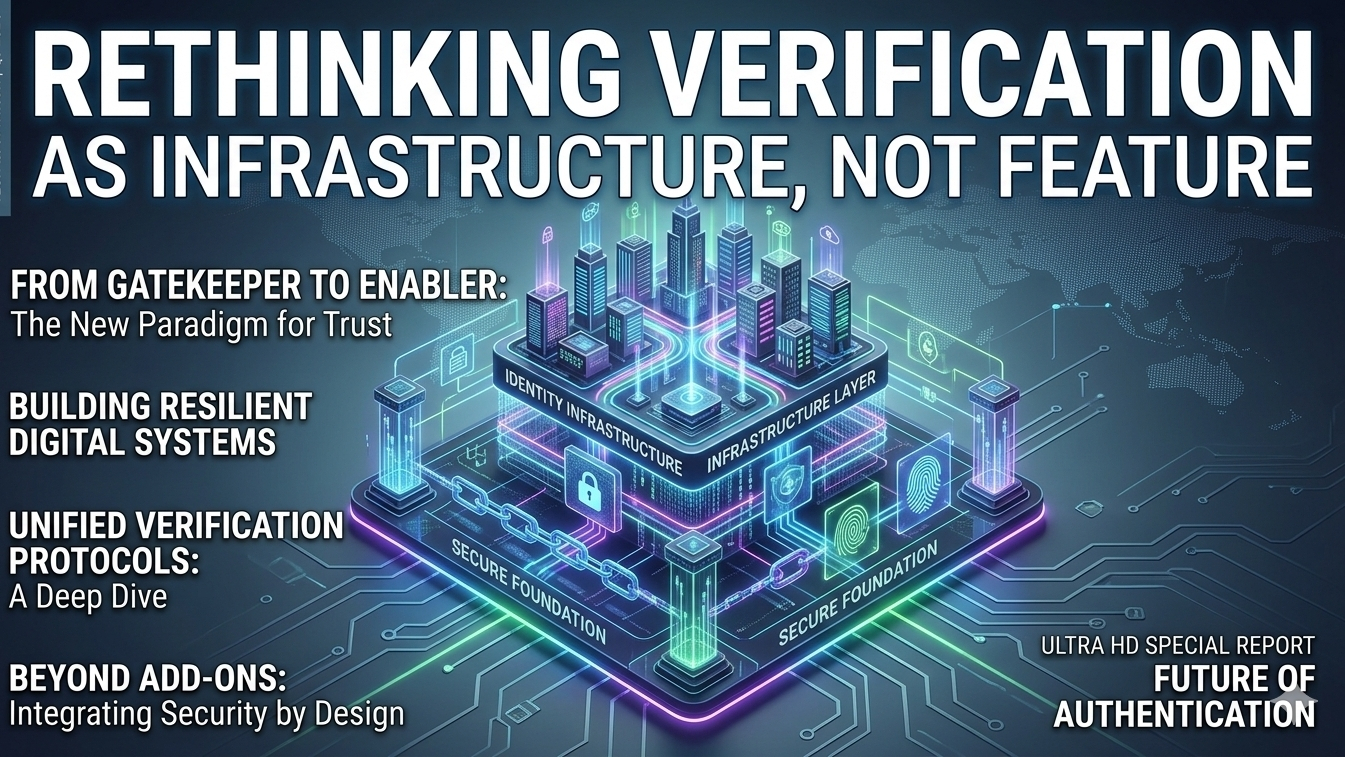
I’ve been looking at SIGN not as a product, but as infrastructure, and that shift changes how I interpret its role. When a system positions credential verification and token distribution at this level, the expectations around it become quieter but more demanding. I’m less concerned with what it enables at the surface and more focused on how it behaves when conditions are not ideal—when audits are routine, when compliance requirements are strict, and when the system has to remain stable over time.
What stands out to me first is the expectation of reproducibility. Verification is not treated as a one-time check; it carries the assumption that every decision may need to be revisited. I find myself thinking less about correctness in the moment and more about whether that correctness can be demonstrated later. In regulated environments, I’ve seen how this becomes a baseline requirement. A system that cannot reconstruct its decisions introduces friction, not because it fails technically, but because it becomes difficult to trust operationally.
I also notice how much weight is placed on record handling. Verification outcomes are only part of the picture. What matters just as much is how those outcomes are stored, how they can be retrieved, and whether they remain interpretable over time. I’ve come across systems where data exists but cannot be meaningfully used because it lacks structure. Here, the difference between storing information and making it usable becomes important. Logs, in this context, are not just archives; they are tools for inspection.
There is also a subtle emphasis on predictability. I find myself paying attention to the smaller details—consistent APIs, stable defaults, and observable system behavior. These are not the parts that are usually highlighted, but they are the ones that reduce operational friction. When systems behave predictably, they require less interpretation from the people managing them. Over time, this consistency builds a form of quiet trust.
From a compliance perspective, I see how the design leans toward traceability. It’s not just about whether a credential is valid, but whether the path to that validation is visible and structured. I’ve noticed that in environments where audits are frequent, the ability to explain a decision often matters more than the decision itself. This shifts the design priorities. Speed and flexibility become secondary to clarity and consistency.
I also think about developer ergonomics in this context. When infrastructure is expected to operate under scrutiny, the interfaces around it need to reduce ambiguity. Clear APIs, predictable responses, and well-defined behaviors are not conveniences; they are necessary conditions for reliable integration. I’ve seen how unclear interfaces can introduce subtle errors that only surface later, often during audits or reconciliation processes.
Privacy and transparency seem to exist in balance here. I don’t see them treated as opposing forces, but as constraints that shape how information is handled. Transparency is necessary for inspection and trust, while privacy limits what can be exposed. The system appears to navigate this by focusing on structured outcomes rather than unnecessary detail, allowing verification without overexposure.
What I find most notable is how much of this is built around long-term operation rather than immediate impact. There is a sense that the system is designed to be revisited, inspected, and relied upon repeatedly. I’m not seeing an emphasis on novelty or expansion, but on stability and continuity. These are not always visible qualities, but they are the ones that tend to matter when systems are placed under sustained pressure.
In the end, I don’t arrive at a strong conclusion so much as a shift in perspective. I start to see SIGN less as something that introduces new capabilities and more as something that quietly supports existing ones, but under stricter expectations. The design choices seem to reflect an understanding that infrastructure is not judged by what it promises, but by how it holds up when it is examined closely.
#SignDigitalSovereignInfra @SignOfficial $SIGN
