
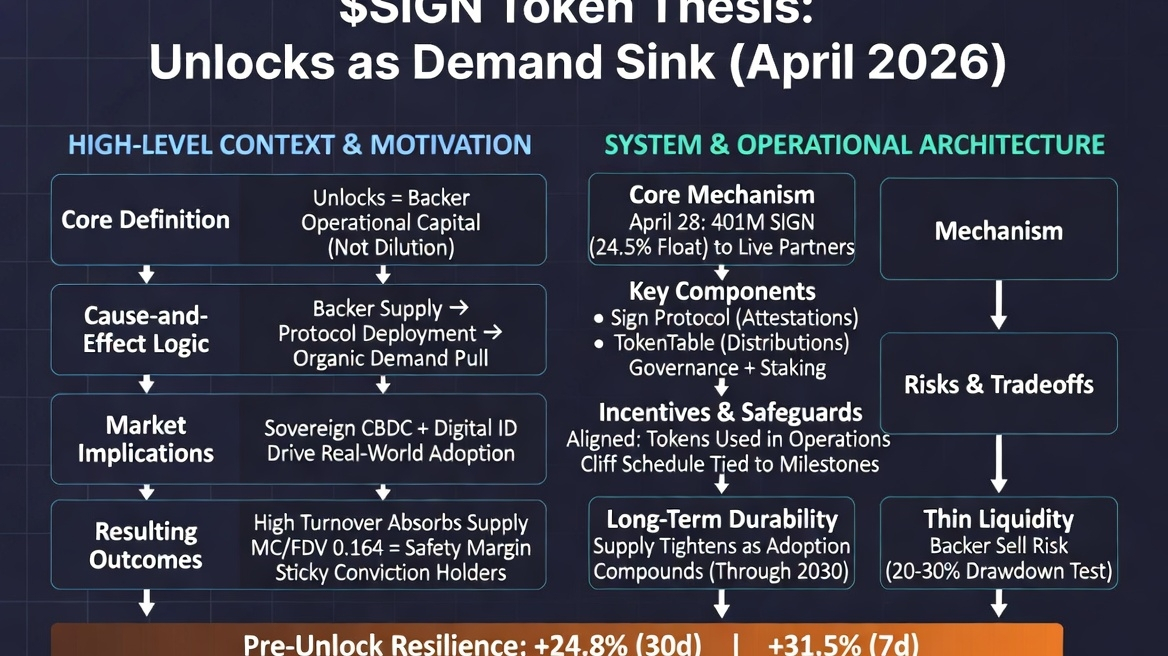

I’ve been watching $SIGN for a while now, the kind of project that doesn’t scream for attention but keeps pulling me back because the numbers tell a story most charts miss. Right now, with the April 28 unlock staring everyone in the face, the crowd is pricing it like another tired dilution event same old script, same old fear. But the more I sit with the data, the more convinced I am the market has this one backwards. Those 401 million tokens hitting wallets next month aren’t exit liquidity. They’re about to become the quietest, most effective demand sink this token has seen yet.
Let me walk you through how I landed here, because it’s not some spreadsheet epiphany it’s the slow accumulation of details that started clicking over the last few weeks.
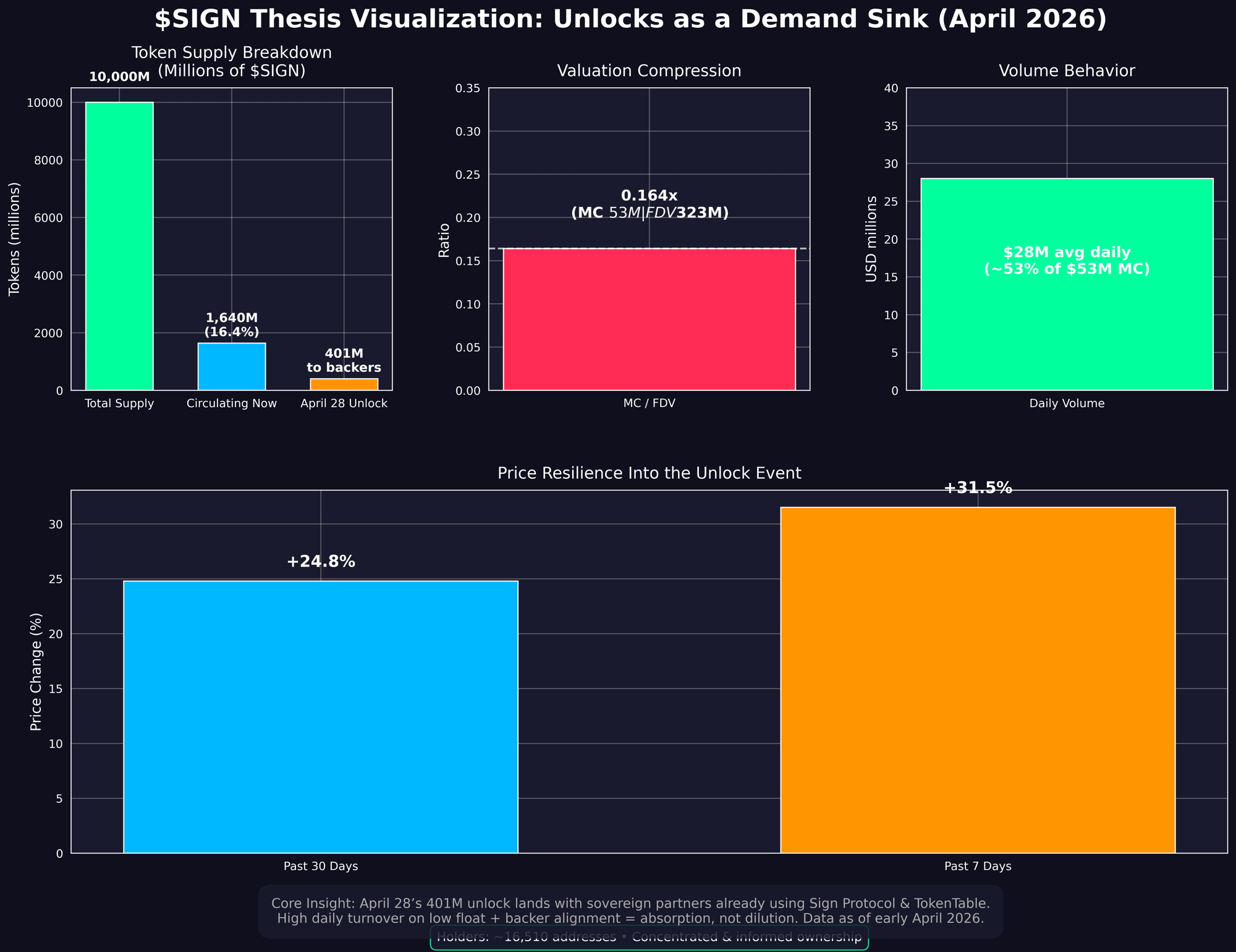
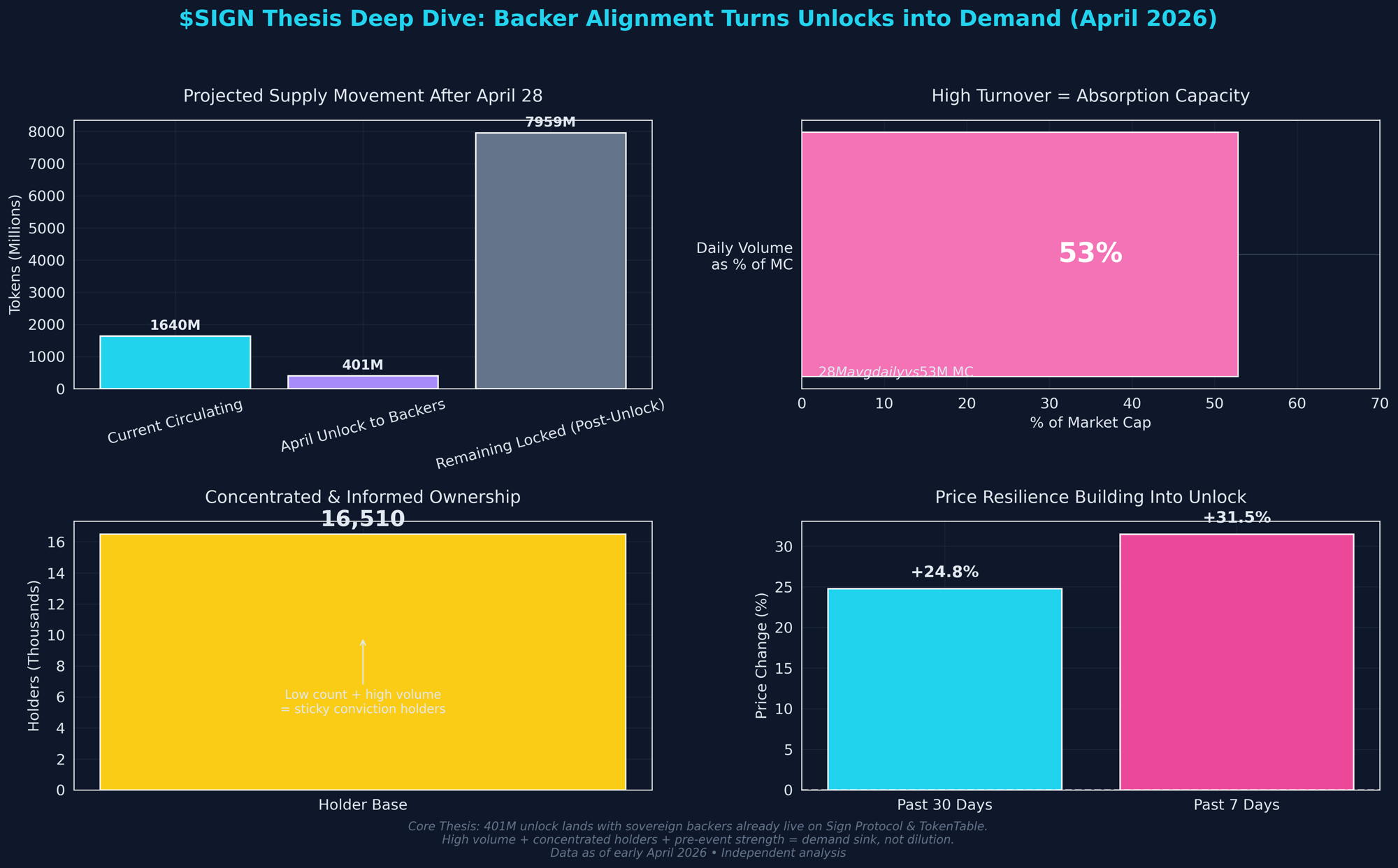
First, the setup itself is unusual. We’re sitting at roughly 1.64 billion tokens in circulation out of a 10 billion total supply. That’s still only about 16.4% unlocked, which keeps the fully diluted valuation north of $320 million while the actual market cap hovers just over $52 million. The MC/FDV ratio is compressed to around 0.164. On paper that screams “watch out,” but when you trace where the next tranche is going straight to backers who are already live with the protocol on real sovereign deployments it stops looking like overhang and starts looking like incoming operational capital. These aren’t flippers chasing a quick 3x; they’re the same partners using Sign Protocol for national credential systems and TokenTable for compliant distributions. In my experience, when tokens land in wallets tied to actual usage, they tend to get staked, deployed, or held rather than liquidated.
Then there’s the volume behavior, which has been telling its own story. We’re seeing $25–32 million in daily trading against a $52–53 million market cap basically 50–60% turnover every single day. That’s not retail noise or wash trading in a vacuum; that’s real capital showing up in size on a still low-float name. I’ve seen this pattern before in other infra tokens where high velocity on thin supply preceded absorption rather than collapse. The market is already testing whether it can swallow supply without breaking price has held relatively steady into the event window despite everyone knowing the date.
Holder distribution adds another layer. Only about 16,510 addresses own any SIGN at all. That’s not a massive crowd, which means ownership is still fairly concentrated among people who likely understand the product deeply. When those backer wallets receive their April allocation, the effective liquid float won’t expand nearly as much as the headline number suggests many of those tokens will simply move from locked to strategically held. I keep thinking about how rare it is to have alignment like this: supply events landing with the very entities driving protocol adoption.
Price structure over the past month has been another quiet tell. Even with the unlock widely discussed, we haven’t seen the classic pre-event bleed everyone expects. Instead, the token has shown resilience, grinding through the awareness phase without the usual retail capitulation. That accumulation into catalyst dynamic is rare, and in my view it’s the market already leaning toward the “unlocks tighten rather than flood” thesis.
Of course, I’m not blind to the counterargument that keeps me honest. The elevated volume to market cap ratio could just be thin CEX liquidity attracting opportunistic market makers rather than organic conviction. If those backers decide to treat the unlock as a liquidity event instead of long-term capital, the combination of suddenly larger float and still narrow order books could spark a sharp leg lower. I’ve watched it happen in other names where the narrative sounded aligned on paper but the incentives didn’t hold in practice.
Still, the forward path feels testable and asymmetric. Over the next three to six months, I’ll be watching three things above all. If price holds or re-accelerates through and after April 28 on steady or rising volume, if on-chain flows show minimal selling from the newly unlocked backer wallets, and if protocol metrics credential schemas deployed, attestations processed, or TokenTable distributions executed keep compounding alongside token demand, then the thesis graduates from interesting to confirmed. The opposite would invalidate it fast: a 20–30%+ immediate drawdown with heavy sell-side volume skew, or flat to declining usage that leaves the token without real utility pull.
Look, I’m not here to hype or predict moonshots. I just keep coming back to $SIGN because the mechanics feel genuinely misread right now. The market sees dilution math. I see a controlled supply event that could quietly tighten the trade instead of blowing it up precisely because the recipients are the ones building the demand in the first place. That’s the kind of edge I actually get excited about: rare, data backed, and still under the radar. Whether it plays out or not, the next few weeks should make it crystal clear.
@SignOfficial #SignDigitalSovereignInfra $SIGN
