
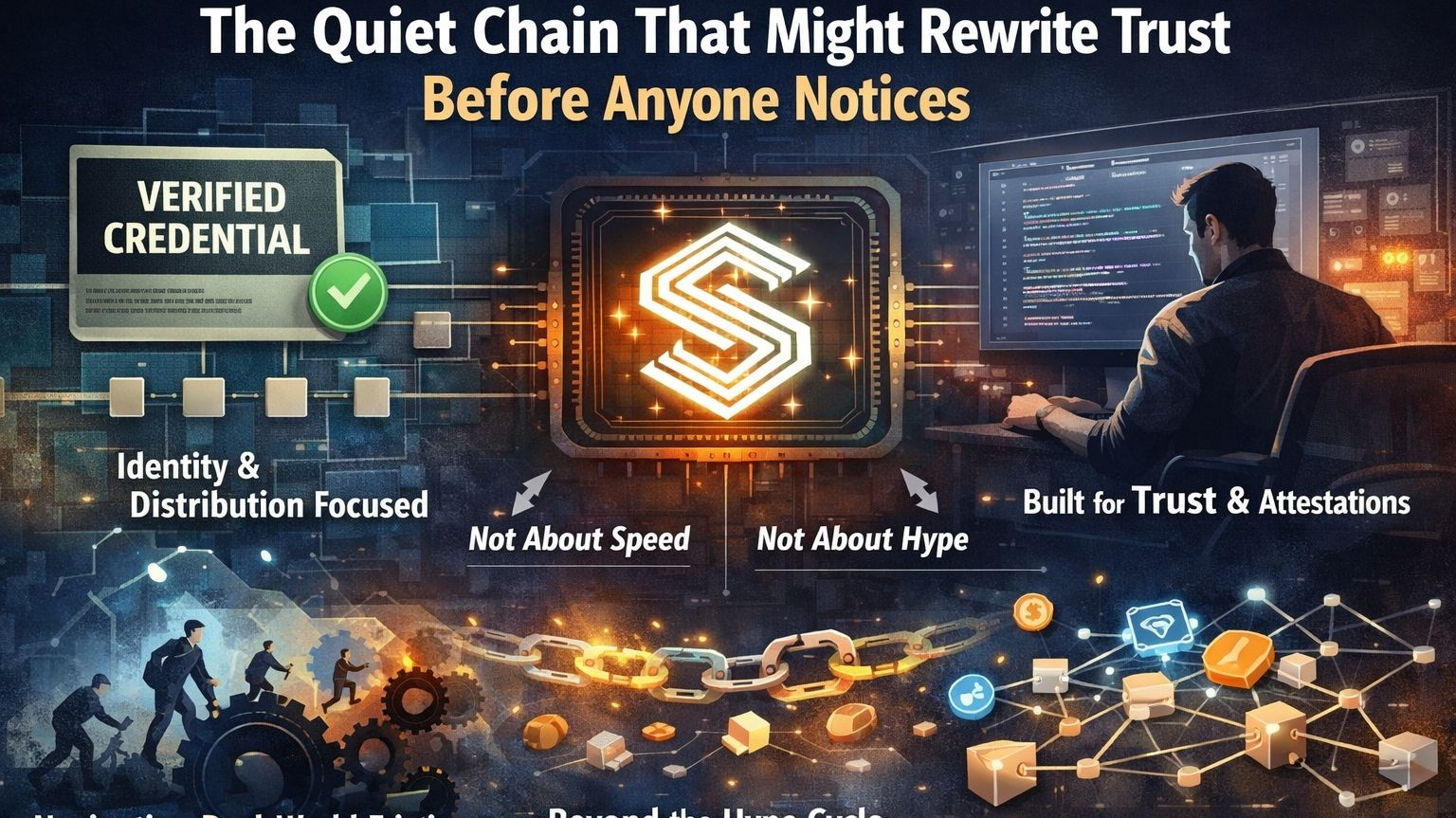
@SignOfficial I didn’t come across SIGN in the usual way. No loud launch thread, no dramatic claims about rewriting the internet, no carefully edited demo showing perfect conditions. It was quieter than that. Almost like it wasn’t trying very hard to be noticed. Just people talking about credentials, attestations, token distribution flows… the kind of things that usually sit in the background of bigger narratives. At first it didn’t even register as a Layer 1 in the way we’ve been trained to think about them. It felt more like infrastructure that accidentally ended up becoming a chain.
And maybe that’s why it sticks a little.
Because after a few years in this space, “new Layer 1” doesn’t trigger curiosity anymore. It triggers pattern recognition. You start expecting the same structure before you even read it. Better throughput, cleaner architecture, some modular angle, maybe an AI integration if the timing is right. It’s not that these things are meaningless, it’s just that they rarely survive contact with reality. Most chains don’t fail in theory. They fail when people actually start using them.
That part never changed. Load is still the truth.
You can design something that looks elegant on paper, runs smoothly in controlled environments, benchmarks well in isolation. But real usage is messy. It’s uneven, unpredictable, sometimes irrational. Traffic spikes at the wrong time. Bots behave differently than expected. Users do things nobody modeled. That’s where systems either hold together or start showing cracks.
We’ve seen it play out more than once. Solana, for example, feels incredibly fast when conditions are right. Transactions flow, UX feels almost web2-like. And then pressure builds, and suddenly the conversation shifts from speed to stability. Not as a criticism, just as a reminder that performance and resilience don’t always scale together. Every design decision carries weight somewhere else.
So when something like SIGN shows up, the question isn’t really “is it better.” It’s more specific than that. What exactly is it trying to handle that others either ignored or patched over?
And the answer, at least from the outside, seems to revolve around something less flashy than execution speed or consensus novelty. It’s about trust surfaces. Credentials. Who can verify what, and how that verification moves across systems. Token distribution tied to that logic, instead of just being an isolated economic event. It’s not the kind of problem that gets attention early, because it doesn’t break loudly. It just creates friction everywhere.
Most chains treat these things as layers on top. External services, add-ons, something you integrate later if needed. But SIGN feels like it’s trying to bring that logic closer to the base layer. Not in an aggressive way, more like it’s quietly assuming that identity and distribution are not optional features anymore.
That’s interesting, but it also raises questions.
Because focusing on one part of the stack usually means de-emphasizing something else. You can’t optimize everything at once. If SIGN is leaning into credential verification and structured distribution, then what did it intentionally simplify? Where does it choose not to compete? Is it raw execution flexibility? Is it developer freedom in certain areas? Is it composability in the broader sense?
Those trade-offs don’t show up immediately. They show up later, when developers try to build things that weren’t part of the original mental model.
And then there’s the harder part, the part that has nothing to do with design.
Adoption doesn’t follow logic. It follows gravity.
People don’t move just because something is cleaner. Liquidity doesn’t migrate because a system makes more sense architecturally. There’s inertia everywhere. Existing ecosystems are deeply embedded now. Tooling, habits, integrations, even culture. Moving means friction. And most users, even in crypto, avoid friction unless there’s a very clear reason not to.
So even if SIGN is solving something real, even if it’s addressing a gap that others left open, there’s still that quiet question sitting underneath everything. Who actually uses it? And why would they switch?
Maybe the answer isn’t switching at all. Maybe this is where the whole “multi-chain” idea starts to feel less like a theory and more like a necessity. Not one dominant chain, but multiple systems handling different types of load, different types of logic. But even that sounds cleaner than it actually is. Coordination across chains is still clunky. Standards drift. Bridges introduce risk. The idea works better in diagrams than in practice.
Still, something about SIGN doesn’t feel like it’s trying to win the usual race. It’s not positioning itself as the fastest or the biggest or the most everything. It’s narrower than that. More specific. Almost like it noticed a part of the system that kept being worked around instead of properly built.
That doesn’t guarantee anything. Plenty of correct ideas never turn into real systems people use.
But it does make it harder to dismiss.
There’s a version of this where it quietly becomes useful. Not dominant, not everywhere, but embedded in places where this kind of verification and distribution actually matters. And there’s another version where it stays exactly where it is now, interesting on paper, referenced occasionally, but never quite crossing into real usage.
Right now it sits somewhere in between. Not overhyped, not fully proven.
It might work. Or nobody shows up.
#SignDigitalSovereignInfra @SignOfficial $SIGN
