
$SIGN #SignDigitalSovereignInfra @SignOfficial

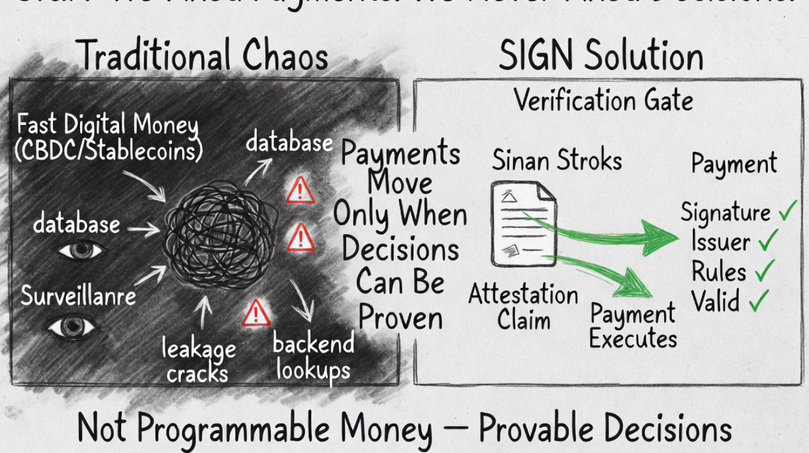
Something feels off about how this whole shift is happening right now.
Governments are pushing forward with digital money.
CBDCs are being tested. Payment networks are quietly experimenting with stablecoin settlement.
Everything is accelerating on the surface.
But underneath, the part that actually decides whether money should move hasn’t really changed.
And that’s where the system starts to feel incomplete.
You can already see it in real deployments.
Systems get faster but leakage doesn’t disappear.
Or control tightens and every transaction starts turning into a monitoring event.
That tension isn’t accidental. It’s structural.
The uncomfortable part is this.
We didn’t actually have a payment problem to begin with.
We had a decision problem that we kept hiding inside payment systems.
We automated payments. We never automated judgment.
We didn’t digitize welfare. We digitized the interface and left the decision engine untouched.
And now that money is getting faster, that hidden problem is starting to show.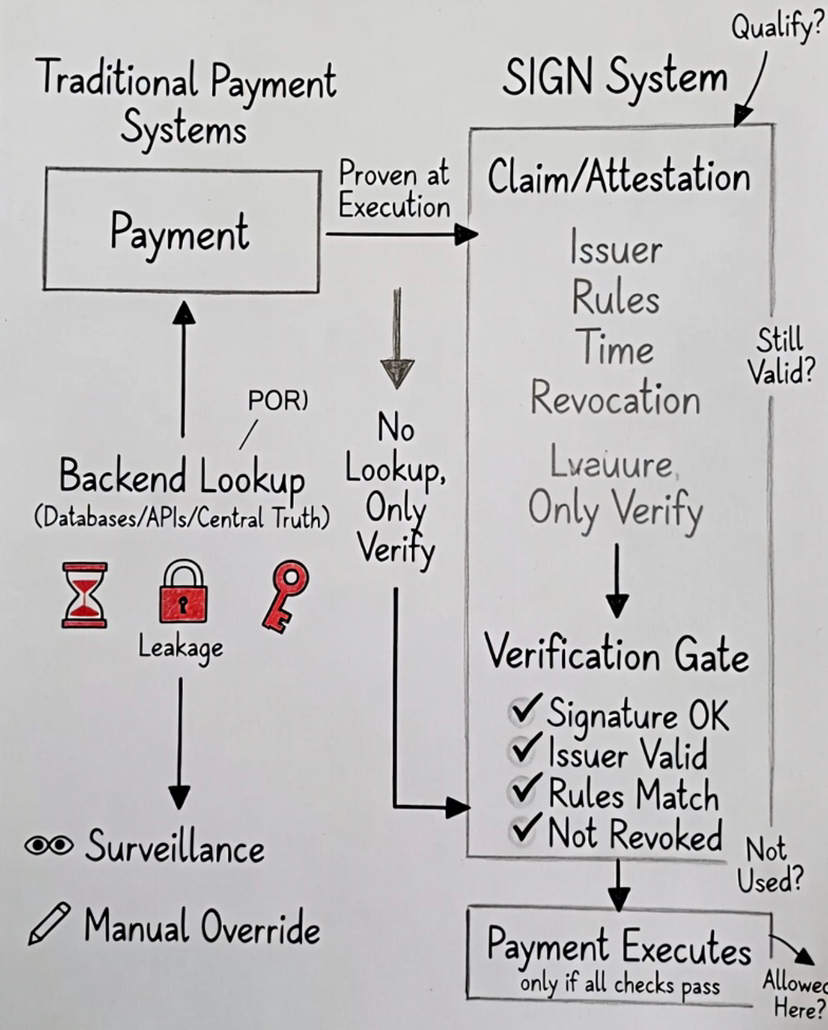
SIGN only makes sense once you look at it from that angle.
Not as “programmable money.”
But as a system that forces one thing:
a payment cannot exist unless the decision behind it can be proven at execution.
Not assumed.
Not checked in a backend.
Proven.
Money doesn’t fail systems. Unprovable decisions do.
I didn’t fully get this until I stopped thinking about balances and started looking at what actually happens before a transaction clears.
Because before any value moves, the system needs to know:
does this person qualify
is this still valid
has this already been used
is this allowed here
And today, almost every system answers those questions the same way.
It looks things up.
Databases.
APIs.
Central systems that quietly hold the truth.
That’s the real dependency.
And most of the time, no one questions it.
The system works until it doesn’t. Then everything becomes manual again.
SIGN removes that behavior entirely.
The system is no longer allowed to “look things up.”
It can only verify what is presented to it.
That’s a hard constraint.
And that’s where attestations stop being a concept and start becoming the system itself.
An attestation here isn’t just a record.
It’s a bounded claim that carries authority, structure, and time inside it.
Not “data about you.”
But something closer to:
a statement that can survive verification… without exposing everything behind it.
This is where it clicked for me.
Most systems store truth.
SIGN doesn’t store truth.
It stores proof that something was true under defined conditions.
That’s a very different object.
And these claims are not static.
They behave more like live constraints.
Each one carries:
who issued it
what rules define it
when it is valid
whether it has been revoked
So when a transaction happens, nothing is trusted by default.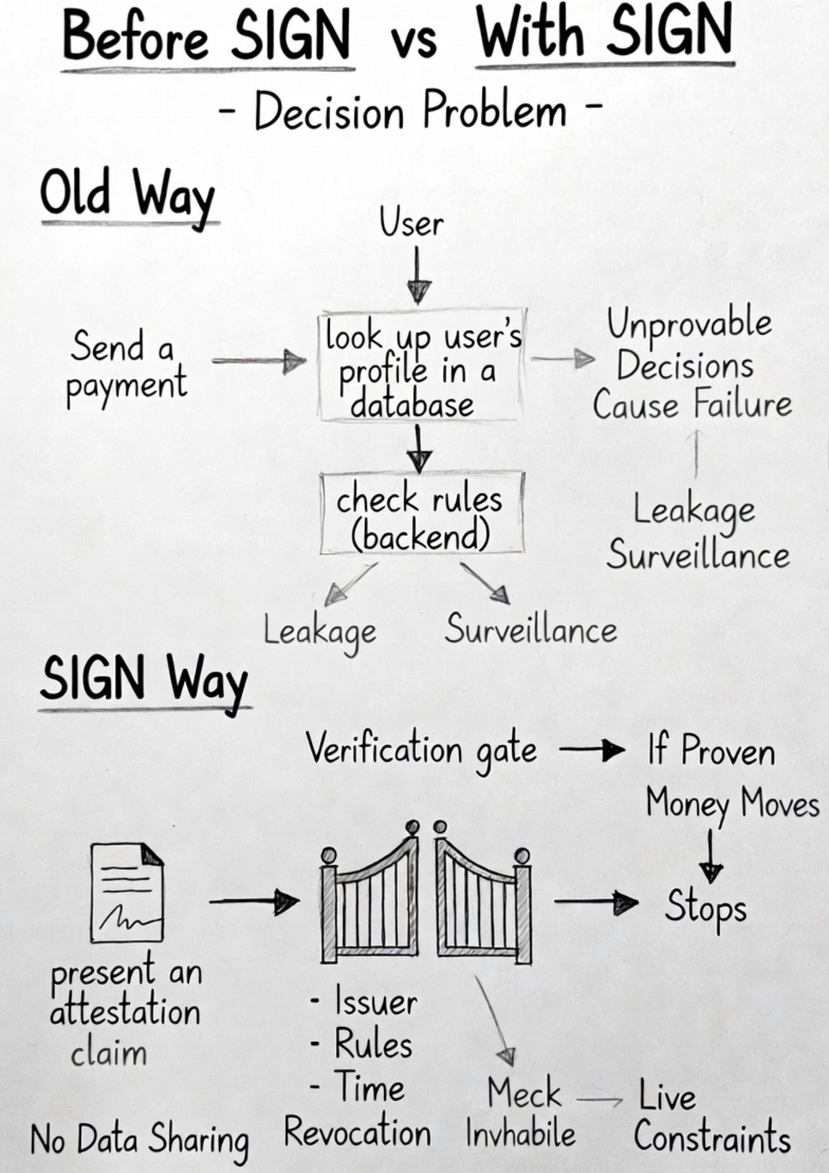
Everything is challenged.
Instead of asking:
“what do we know about this user?”
The system asks:
“what can be proven right now, under this exact rule?”
You can almost see the difference in a single moment.
A user tries to spend.
The system doesn’t open a profile. It checks a claim.
If the claim survives → payment clears.
If it’s expired or revoked → nothing happens.
No escalation. No manual override. Just constraint.
No full data sharing.
No replicated records.
No silent backend authority.
Just:
a claim
an issuer
a context
And then the system runs through verification like a gate.
Signature holds.
Issuer checks out.
Rules match the context.
Still valid. Not revoked.
Usage fits.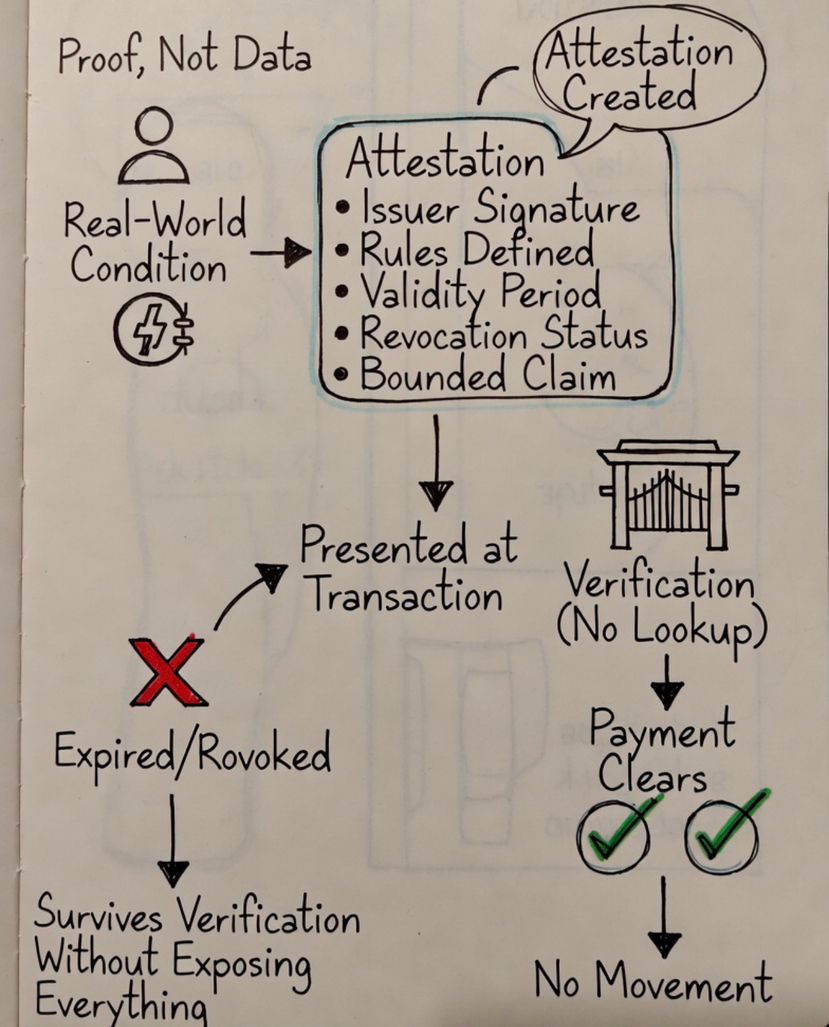
If all survive → execution happens.
If not → nothing moves.
That’s when money stops behaving like a flexible tool…
and starts behaving like something that only moves when reality can be proven inside the system.
Now place this back into how most public systems operate.
They’ve always had a problem.
They can enforce rules…
or they can protect privacy…
but doing both at the same time usually breaks something.
So they compensate.
Either:
loosen control → leakage, duplication, inefficiency
or
tighten control → central visibility, over-collection, surveillance
That tradeoff has been sitting there for years.
SIGN doesn’t “balance” that tradeoff.
It makes it irrelevant.
Because enforcement is no longer coming from visibility.
It’s coming from verifiable constraints.
A merchant doesn’t need to know who you are.
It needs to know this transaction is valid.
A system doesn’t need your history.
It needs a claim that survives verification.
An auditor doesn’t need to watch everything.
It needs evidence tied to execution.
And that’s where the timing starts to matter more.
We’re already rolling out digital money systems.
But most of them still rely on off-chain decision logic.
So what you get is this mismatch:
clean execution layer
fragile decision layer
And as these systems scale, that mismatch doesn’t stay hidden.
It starts creating pressure.
More checks.
More data exposure.
More central control just to maintain confidence.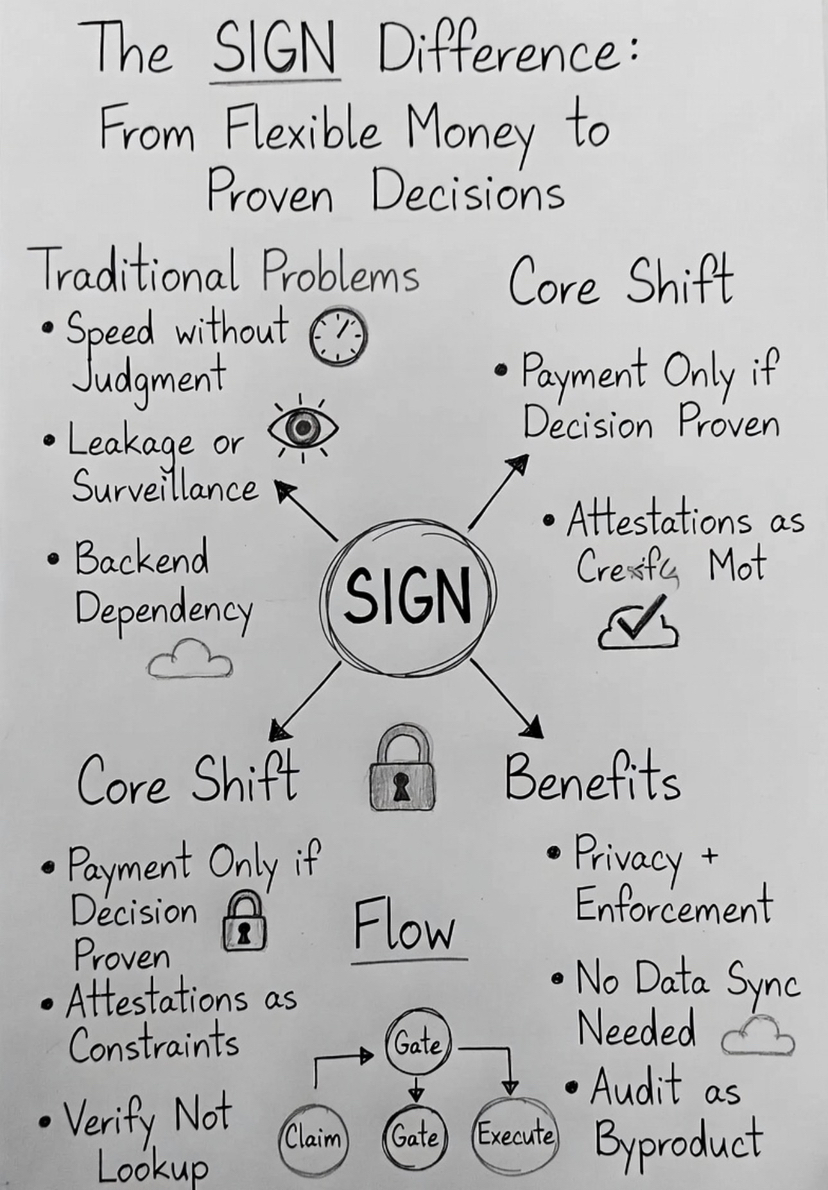
Traditional systems try to synchronize data across institutions.
This model doesn’t. It verifies claims instead.
SIGN sits exactly in that pressure point.
Not improving money.
Not redesigning identity in isolation.
But forcing systems to answer one question properly:
why is this payment allowed to exist right now?
As digital money expands, systems that can’t prove decisions won’t scale.
That’s exactly where this model becomes unavoidable.
And once that question is enforced at execution…
something collapses.
You don’t need to rebuild identity for every program.
You don’t need to sync databases across institutions.
You don’t need to reconstruct events after they happen.
Because the decision, the execution, and the evidence…
all happen at the same moment.
That last part changes how systems behave over time.
Because audit is no longer something you do later.
It’s something the system produces as it runs.
Each action leaves behind:
which claim was used
who issued it
what rule applied
what constraint passed
Not logs.
Proof.
At that point, it stops looking like identity infrastructure.
It starts looking like something more fundamental.
A system that doesn’t store people…
but verifies conditions.
And that’s probably the cleanest way to see where this is going.
Everyone is trying to digitize money.
Very few are rebuilding how decisions are enforced.
SIGN starts from that missing layer.
And once you see it there…
it becomes hard to ignore how incomplete most current systems actually are.
Because money was never the hard part.
The hard part was always this:
how do you enforce rules
without exposing everything
and without trusting everything
That’s where this model lands.
Not by making systems more visible.
But by making them precise enough that visibility stops being necessary.
And once that precision exists…
the system stops asking who you are.
It only asks one thing.
Can this be proven right now?
If yes → it moves.
If not → it doesn’t exist.
That’s the line most systems still can’t enforce.
And the more we digitize money without fixing it…
the more visible that gap becomes.