

Look, I’ve been around long enough to see this cycle repeat. Every few years, crypto promises to “fix trust,” and every time, we end up rebuilding the same messy systems just with better branding and more complicated dashboards. People get excited, institutions nod politely, and then… nothing really changes where it actually matters.
Because here’s the thing institutions don’t hate decentralization. They hate uncertainty. Big difference.
What they actually want is simple. Or at least it sounds simple: stop making them verify the same thing over and over again. Identity, eligibility, compliance it’s the same headache everywhere. Different systems, same repetitive grind. And honestly, people don’t talk about this enough.
That’s kind of where SIGN comes in. And no, it’s not trying to be another token story. At least, that’s not the interesting part.
It’s trying to answer a much less flashy question:
How do you prove something once… and make it usable everywhere?
So what does it actually do?
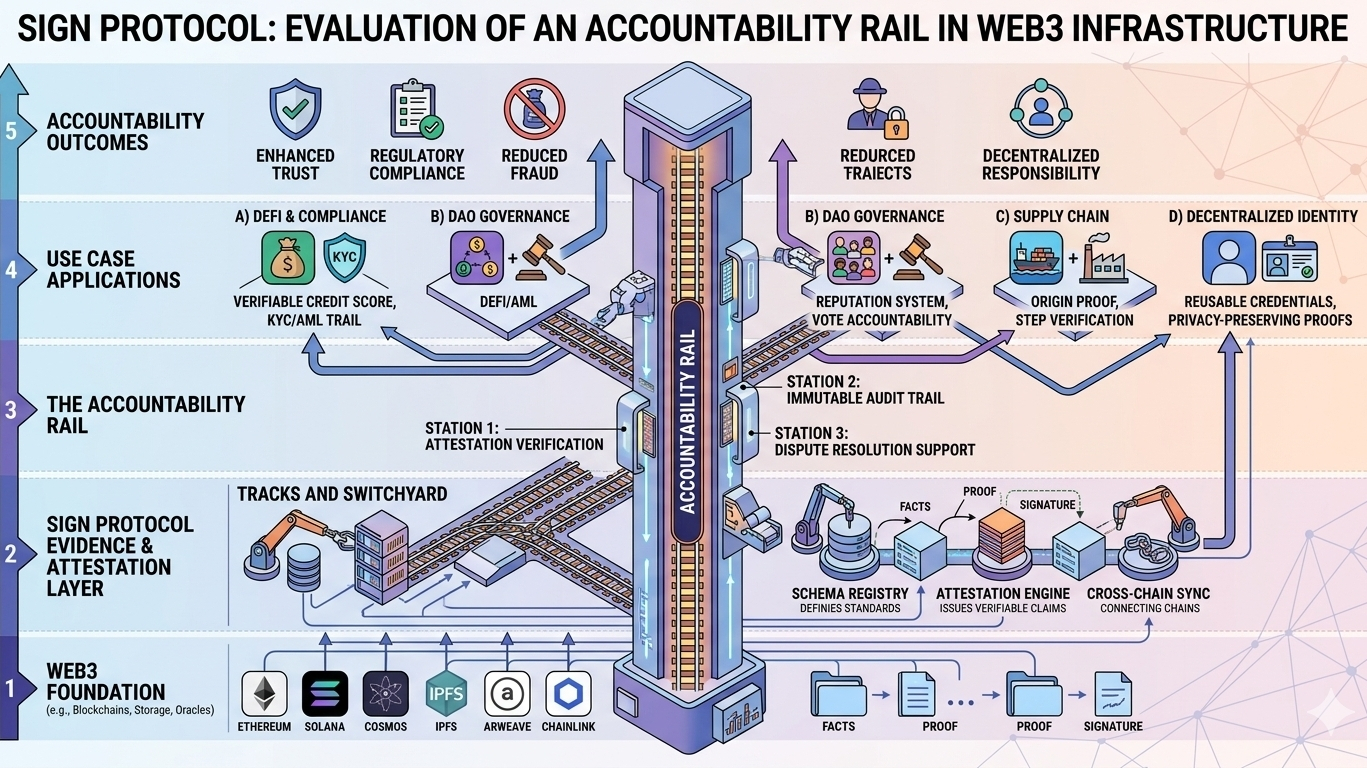
At its core, SIGN is about attestations. That’s just a fancy word for structured claims. Someone says something about someone else, but instead of it being loose or vague, it’s locked into a defined format a schema.
Think of it like this: instead of saying “this wallet is eligible,” you say why it’s eligible, under what rules, based on what data. That context matters. A lot.
And SIGN splits this into two layers, which I actually think is one of its smarter moves.
First, you’ve got the on-chain part. This is where they anchor proofs hashes, timestamps, that kind of thing. It’s not storing everything. It’s just saying, “this record exists, and nobody can mess with it now.” Clean. Minimal. That’s how blockchains should be used, honestly.
Then there’s the off-chain layer. That’s where the real stuff lives the schemas, the metadata, the logic behind the claim. All the messy, detailed context that would be way too heavy (and expensive) to shove on-chain.
So yeah, it’s hybrid. And that’s not a compromise it’s reality. Anyone still trying to put everything on-chain hasn’t worked with real systems.
Now here’s the bigger idea, and this is where it gets interesting.
SIGN isn’t just storing data. It’s trying to preserve meaning.
And yeah, that sounds abstract. But stick with me.
A lot of credentials don’t actually “fail.” They just… lose context. You look at a record six months later and think, “okay, but what does this actually mean?” Who issued it? Under what rules? Do those rules still apply?
It’s like finding an old document with no explanation. Technically valid. Practically useless.
SIGN tries to fix that by tying everything to schemas and conditions. So when you look at an attestation later, you don’t just see the result you see the reasoning behind it.
That’s a big deal. Especially for audits, compliance, or anything that requires explaining decisions after the fact.
Let’s talk about the real-world problem for a second.
Institutions redo verification constantly. It’s inefficient, it’s expensive, and honestly, it’s kind of ridiculous at this point.
You pass KYC in one system. Great. Now do it again somewhere else. And again. And again.
Same with eligibility checks. Grants, airdrops, subsidies it’s always the same pattern. Every system builds its own logic, runs its own checks, and trusts its own results.
No reuse. No shared layer. Just repetition.
SIGN’s pitch is simple: what if those checks could be turned into reusable attestations?
Verify once. Use many times.
That’s it. That’s the whole idea. And yeah, it sounds obvious but implementing it without breaking everything? That’s the hard part.
There’s another angle here that I think matters even more.
Distribution.
People love talking about token distribution, but let’s be honest most of it is either opaque or oversimplified. You either get black-box decisions (“trust us, it’s fair”) or lazy logic like wallet snapshots.
Neither is great.
SIGN tries to connect the dots:
credential → eligibility logic → distribution outcome
So instead of just seeing who got what, you can trace why they got it.
It doesn’t magically make things fair. But it makes them inspectable. And for institutions, that’s huge.
Now, let’s not pretend this becomes infrastructure overnight. That’s where most projects fall apart.
If SIGN wants to matter long-term, it has to disappear into workflows. Not literally but functionally.
People shouldn’t have to think, “I’m using SIGN.”
It should just… work in the background.
That means tight integrations. Good APIs. Systems that generate and consume attestations automatically.
If a university or a government agency uses it without even mentioning it that’s success.
Anything more visible than that? Probably friction.
But yeah, there are real risks here. Serious ones.
First, schema fragmentation. This is a big one.
If everyone defines their own schemas, the whole thing breaks. No shared meaning, no interoperability just isolated islands of data pretending to be connected.
And fixing that? It’s not technical. It’s governance. Coordination. Agreement.
Good luck with that.
Second, value capture. Honestly, this part feels underexplored.
Who actually benefits in this system?
The issuer? The verifier? The protocol itself?
If incentives don’t line up, people won’t contribute properly. Or worse they’ll centralize control quietly. That happens all the time in “decentralized” systems.
Third, adoption speed.
Institutions move slowly. Painfully slowly.
They care about compliance, liability, legal frameworks all the stuff crypto usually ignores until it’s too late. So even if SIGN is technically ready, adoption might lag by years.
And in that gap, momentum can fade. We’ve seen that before.
Fourth, control trade-offs.
Institutions like control. Clear boundaries. Defined responsibilities.
Open systems don’t always fit neatly into that. There’s tension there, and it’s not trivial.
And then there’s the long-term problem meaning decay.
Even with schemas, things change. Standards evolve. Context shifts. Issuers disappear.
So how do you keep old attestations meaningful years later?
That’s not solved. Not really.
So where does this leave us?
Is SIGN just another story?
Honestly, it depends.
If it relies on incentives to drive usage, it probably fades. If schemas fragment, same outcome. If institutions treat it like optional tooling, it won’t stick.
But if it gets embedded deeply embedded into workflows? If removing it actually creates friction?
Then yeah, it starts to look like infrastructure.
Not exciting infrastructure. Not visible. But real.
And that’s the weird part.
If SIGN works, you won’t notice it.
You’ll just see fewer repeated checks. Cleaner audit trails. Systems that agree on things without constant back-and-forth.
No hype. No noise.
Just… less friction.
And honestly? That’s probably the strongest signal there is.
#SignDigitalSovereignInfra @SignOfficial $SIGN
