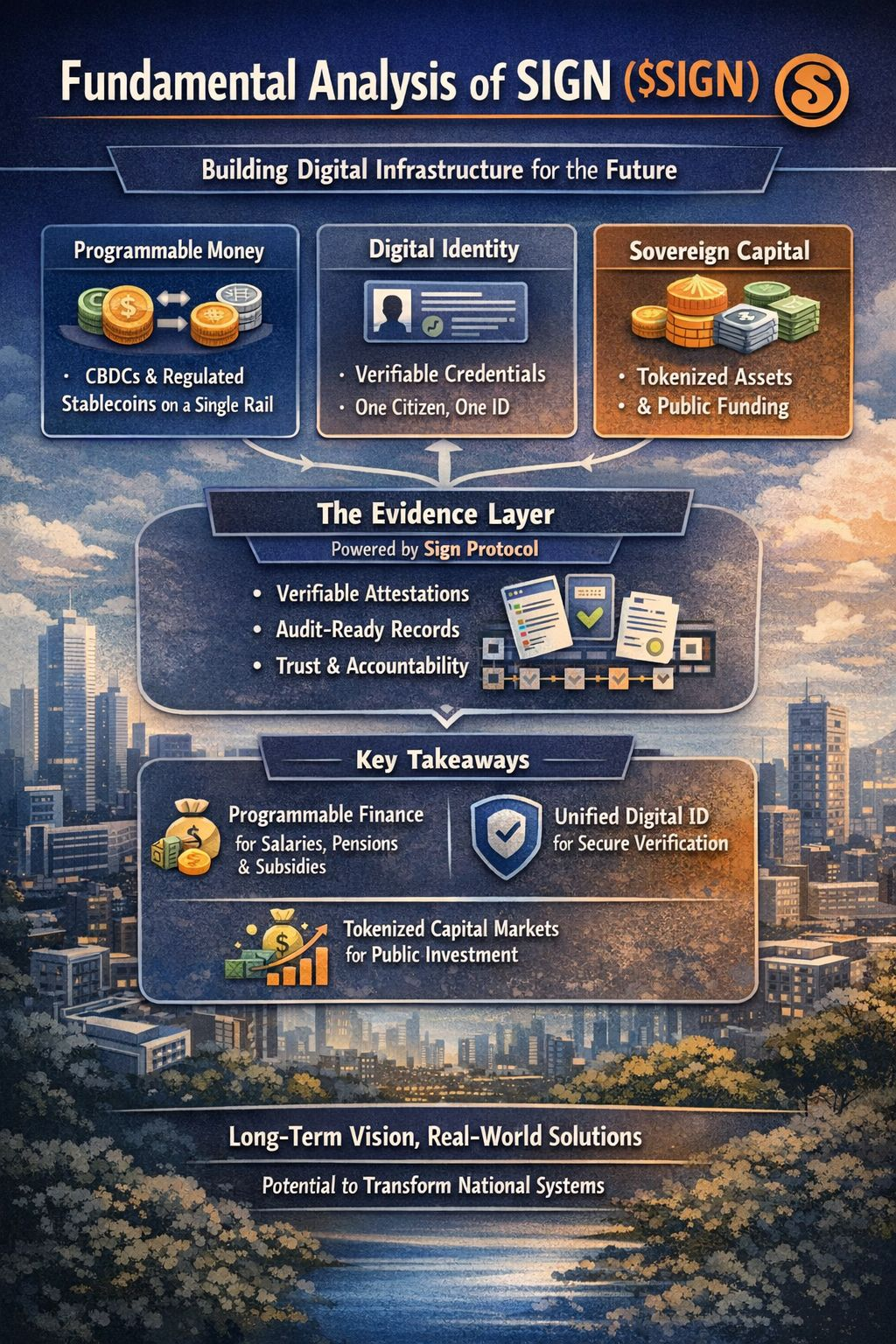
From what I’ve studied, SIGN is not just another cryptocurrency project focused on hype or short-term gains. Instead, it feels like a serious attempt to build real digital infrastructure that can operate at a national or even global level. The idea behind S.I.G.N. is to combine three major systems—money, identity, and capital—into one unified, verifiable framework.
Starting with the programmable money system, SIGN is working on infrastructure that supports both CBDCs and regulated stablecoins on a single rail. I think this is a strong concept because financial systems today are moving toward real-time transactions and better transparency. SIGN’s approach allows governments to control policies like limits, approvals, and usage conditions directly within the system. This could be very useful in areas like salary payments, pensions, and subsidies, where funds can be distributed with clear rules and full auditability. In my opinion, this kind of programmable finance can reduce inefficiencies and improve trust in public systems.
Another important part is the digital identity system, which focuses on verifiable credentials. What I find interesting is the idea of “one citizen, one digital identity” that can be reused across multiple platforms. Instead of repeatedly submitting documents, users can prove their identity through secure, on-chain attestations. At the same time, privacy is maintained because only required information is shared, not the full data. I think this balance between privacy and verification is very important, especially in today’s digital world where data misuse is a major concern. This system can also help in areas like border control, banking access, and government services.
The third component is the capital system, which is designed to make public and private capital more efficient and transparent. SIGN enables tokenization of assets like bonds and funding programs, allowing them to operate on-chain. From my perspective, this creates new opportunities for both governments and citizens. For example, people could directly invest in national projects, while authorities can track how funds are allocated and used in real time. It also supports programmable distributions, meaning payments like incentives or returns can be automated based on predefined rules.
What connects all these systems is the evidence layer powered by Sign Protocol. This is probably the most critical part of the entire ecosystem. Every action—whether it’s a transaction, identity verification, or fund distribution—is recorded as a verifiable attestation. I personally think this is what makes SIGN different, because it focuses on proof and accountability rather than just functionality. In large-scale systems, especially at a sovereign level, having clear and auditable records is essential.
Looking at the token side, $SIGN also plays an active role in the ecosystem. It is used for governance, staking, and powering different applications. The OBI (Orange-Based Income) model encourages users to hold and stake tokens to earn rewards over time. I think this approach supports long-term participation instead of short-term speculation, which is a positive sign for sustainability.
However, there are still some challenges. Large-scale adoption, especially at the government level, can take time and depends on regulatory support. Also, the success of SIGN depends on whether digital identity and programmable finance become widely adopted in the future.
Overall, I feel that SIGN is more focused on building long-term value rather than chasing trends. It combines strong concepts like programmable money, digital identity, and verifiable data into one system. In my opinion, if these ideas gain real-world adoption, SIGN has the potential to become an important part of future digital economies.