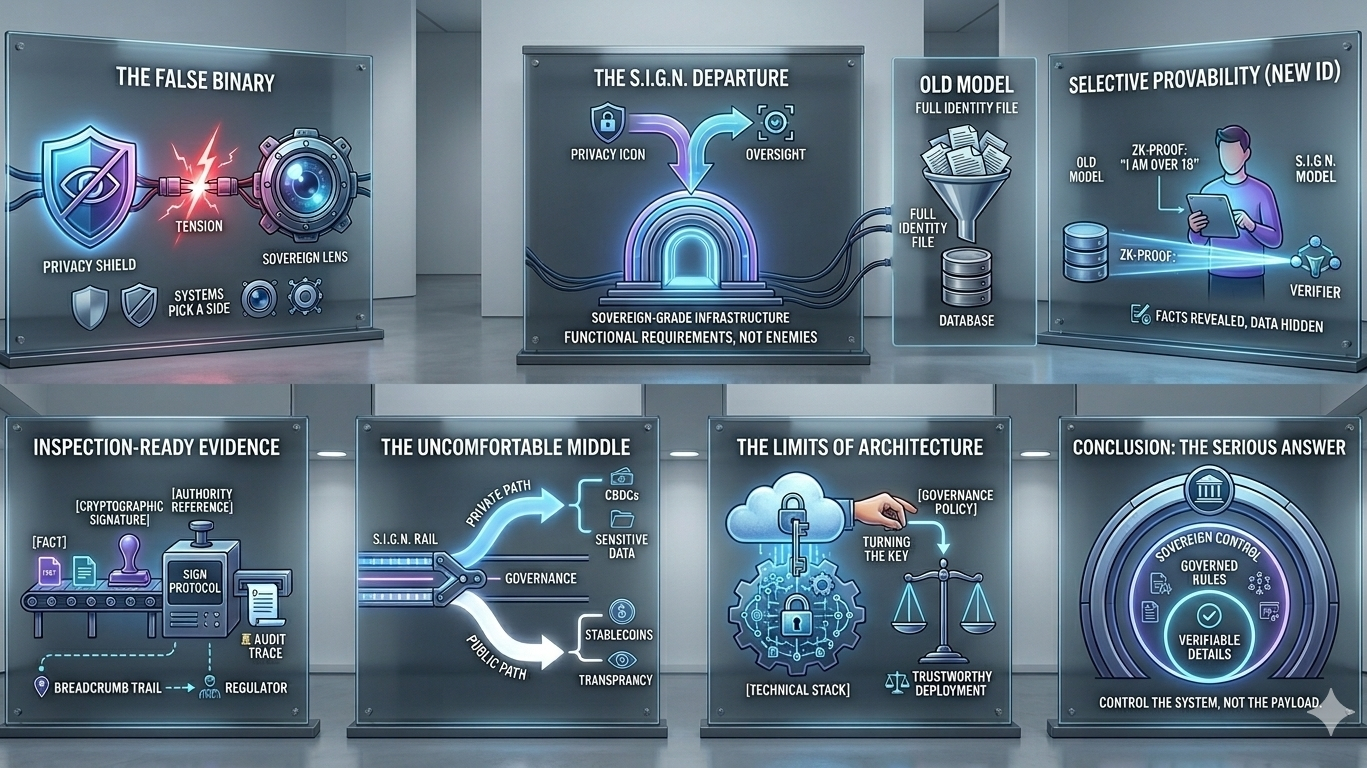
In the ongoing discourse surrounding digital infrastructure, we have long been trapped in a zero-sum game. On one side, the privacy advocates champion total invisibility, often at the expense of institutional accountability. On the other, proponents of "sovereign control" lean so heavily into oversight that verification becomes indistinguishable from surveillance. Most systems pick a side far too early, resulting in architectures that are either allergic to regulation or hostile to the individual.
However, a closer look at the S.I.G.N. (Sovereign Infrastructure for Government and Nations) stack suggests a departure from this exhausted binary. It does not treat privacy and state oversight as enemies to be awkwardly reconciled; instead, it treats them as functional requirements of a high-stakes, "sovereign-grade" system. By separating disclosure from verification, S.I.G.N. offers a blueprint for how states can govern without needing to see everything, and how citizens can remain private without becoming illegible to the law.
The Architecture of Selective Provability
The core innovation of the S.I.G.N. framework lies in its New ID framing. Rather than relying on the traditional model—where a central database is queried every time a fact needs to be checked—the system utilizes Verifiable Credentials (VCs) and Decentralized Identifiers (DIDs).
In this model, the goal is not raw data exposure, but selective disclosure. If a citizen needs to prove they are eligible for a benefit, they do not need to hand over their entire identity file. They simply present a privacy-preserving proof—often utilizing Zero-Knowledge (ZK) technology—that confirms the specific claim in question.
The Verification Layer
This shift is fundamental. It moves the needle from "tell me who you are" to "prove you meet the criteria." This allows privacy to stay alive in the most sensitive layers of the money, identity, and capital stacks. But where S.I.G.N. differentiates itself from the "crypto-fantasy" of total anonymity is its insistence on inspection-ready evidence.
Moving From "Vibes" to Evidence
A common critique of privacy-first systems is that they leave institutions blind when things go wrong. S.I.G.N. addresses this by positioning Sign Protocol as the system’s dedicated evidence layer. This isn't "ceremonial" proof or "trust me" architecture; it is a standardized way to answer the hard questions:
Who approved this transaction or credential?
Under which legal authority was it issued?
What specific ruleset version was applied at the time?
Is the underlying claim still valid, or has it been revoked?
By using schemas and attestations that can be public, private, or hybrid, S.I.G.N. ensures that the "sovereign" side of the equation has governed access to audit references. The sovereign does not need permanent omniscience (the ability to see every private payload in real-time). Instead, it requires governed authority: the power to accredit issuers, define trust boundaries, enforce revocations, and perform lawful inspections when policy dictates.
The "Uncomfortable Middle" of Institutional Reality
Most blockchain projects operate in a world of extremes. One camp believes privacy fixes everything, ignoring the reality of operational accountability. The other believes public transparency is the only way to ensure trust, ignoring how modern states actually handle sensitive citizen data.
S.I.G.N. intentionally sits in the "uncomfortable middle." This is most visible in its dual-path approach to the money stack:
The Private Path: Permissioned CBDC flows designed for confidentiality-first programs.
The Transparent Path: Regulated stablecoin rails for high-visibility domestic utility.
Both paths exist under a single infrastructure governed by policy-grade controls. This allows a supervisor to retain reporting visibility and rule enforcement without collapsing the privacy of every domestic payment into a public ledger.
The Limit of Architecture: Technology vs. Virtue
On paper, the logic of S.I.G.N. is impeccable. It treats verification as a disciplined, narrow action rather than a broad disclosure of raw data. It understands that to preserve state authority, you don't need to destroy privacy; you need to make claims structured, signed, and attributable.
However, a technical stack—no matter how well-designed—cannot manufacture institutional virtue. While the S.I.G.N. architecture makes privacy-preserving verification compatible with sovereign control, the actual boundary of "lawful auditability" will always depend on the quality of governance in the real world. The system provides the tools for restraint, but it cannot guarantee that a sovereign will exercise that restraint.
Feature,Traditional Surveillance, Pure Crypto Anarchy And S.I.G.N. Framework
Data Access: Full Raw Access,No Access,Selective Disclosure
Auditability: Immediate/Total, Impossible,Evidence-Based / Governed
Authority: Centralized,None, Policy-Grade / Distributed
Privacy: Minimal, Maximum, Contextual / Protected
Conclusion: A Serious Answer to Sovereign Needs
The reason S.I.G.N. continues to command attention is its refusal to simplify the problem. It recognizes that for a system to be truly "sovereign-grade," it must be legible to the state while remaining protective of the citizen.
By defining privacy as selective provability and control as governed authority, S.I.G.N. offers a more mature, systems-level framing than the industry has seen in years. It understands that when the stakes are real, nations don't just need "trustless" execution—they need a way to verify what is true, hide what is sensitive, and keep the law legibly in charge.