

I have spent a lot of time thinking about why public programs become harder to trust exactly when they become more important. On paper, benefits and incentive systems are supposed to be straightforward: define who qualifies, approve the claim, move the funds, keep the record.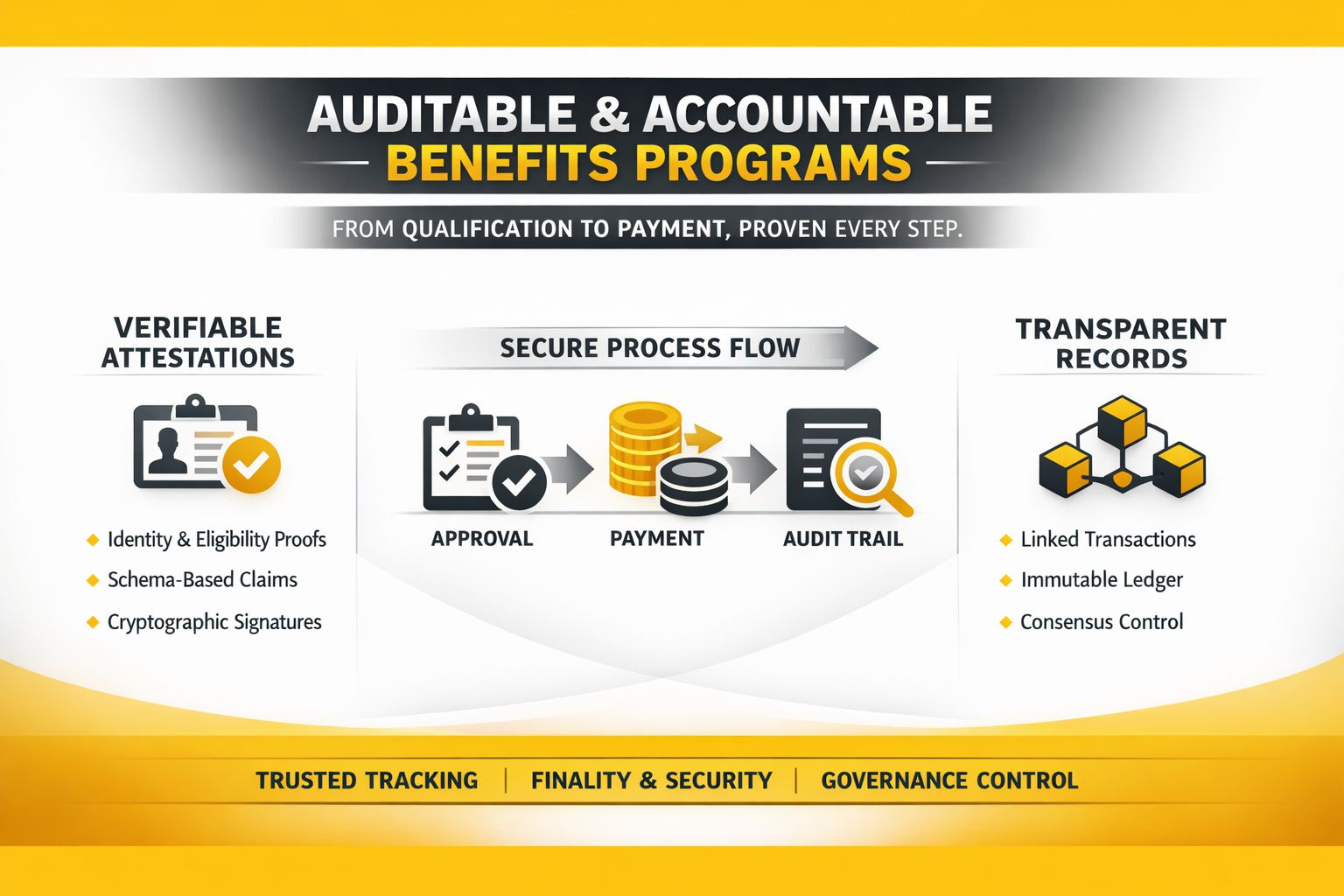
In practice, that sequence usually breaks apart under scale. The payment may happen, but the proof around it often feels thin, delayed, or scattered across too many places to inspect cleanly.
That is why S.I.G.N. holds my attention. Not because it turns distribution into a louder process, but because it tries to turn it into a more accountable one.
I think that matters more than most people admit. A system does not become trustworthy just because money arrives at the right destination once.
It becomes trustworthy when someone can later verify who qualified, which rule was applied, which authority approved it, whether the transfer really matched the decision, and whether the evidence still holds together when examined again.
Most benefit and incentive programs do not fail only at the moment of payment. They fail in the record trail around payment.
One database stores eligibility, another stores identity, another logs approvals, and the final transfer is handled somewhere else entirely. By the time an auditor, regulator, or agency operator needs to reconstruct what happened, the system is no longer behaving like one system. It is behaving like fragments that must be interpreted by trust, not by proof.
It starts feeling less like administration and more like chasing receipts through a storm.
That friction is not only bureaucratic. It is structural. If a record can be changed without a clear chain of authorization, if approval logic is not tied to a verifiable schema, or if payment execution is separated from the evidence that justified it, then accountability becomes a manual exercise. Manual accountability always looks acceptable at small volume.
Then participation expands, dispute cases increase, exceptions pile up, and suddenly the program is depending on institutional memory instead of cryptographic certainty.
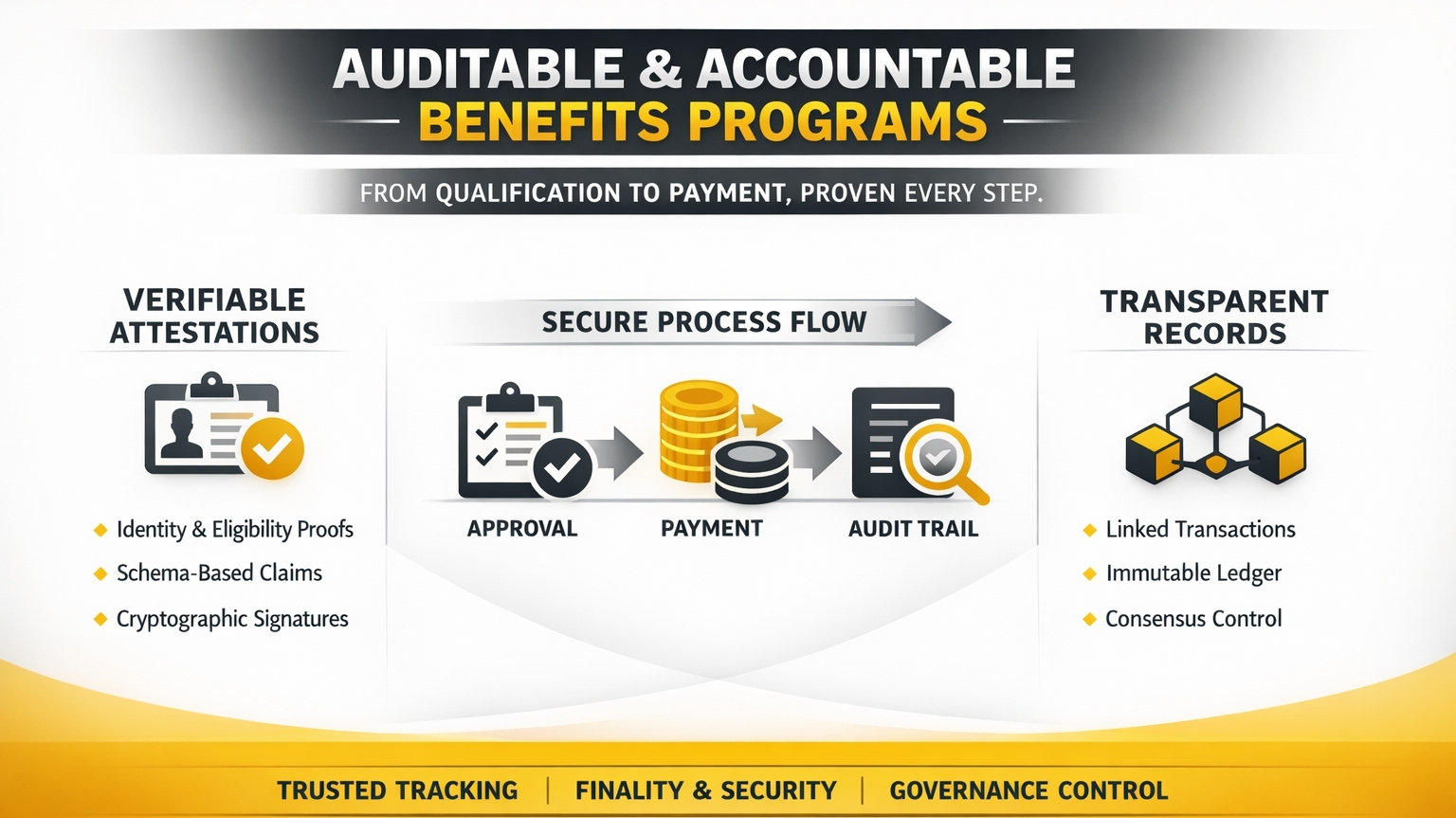
What I find interesting here is that the network approaches the problem as a layered coordination issue. Identity, eligibility, attestation, approval, and settlement are not treated as loose steps that happen nearby.
They are treated as linked state transitions that need durable evidence between them. That changes the tone of the whole system. Instead of asking operators to remember why something happened, the chain tries to preserve the proof in a structured form from the beginning.
The attestation layer is where this starts to become concrete. A claim is not just written as free-form text or buried in a private workflow. It is defined through a schema, then issued as a verifiable attestation that can be checked against that schema later.
That matters because auditability depends on repeatable structure. If every agency, issuer, or program expresses qualification logic differently, oversight becomes interpretive. When claims follow defined schemas, the evidence becomes easier to validate across institutions without reducing everything to vague summaries.
I also think the cryptographic flow matters more than the headline idea. An issuer signs a claim according to a declared schema.
That attestation can then be retrieved, verified, referenced by later actions, and linked to execution records without forcing every participant to trust one database administrator or one intermediary platform. The result is not magic.
It is simply stronger sequencing. First the qualification proof exists, then the authorization trail exists, then the execution reference exists, and each step can be tied back to signed evidence rather than to a loosely worded log entry.
The state model here is important too. For benefits and incentives, the real challenge is not only storing final balances.
It is preserving the relation between decision state and payment state. Who was eligible. Under which version of the rule. Issued by whom. Revocable or not. Settled or pending. Appealed or closed.
A good state model keeps those distinctions explicit instead of flattening everything into “sent” or “not sent.” That is where accountability usually either survives or disappears.
Consensus selection also matters, even if people rarely talk about it when discussing public programs. A network used for accountable distribution cannot rely only on speed narratives.
It needs finality properties that make administrative review practical. If the system supports public, private, or hybrid deployment modes, then consensus design becomes a governance choice as much as a technical one. Public environments favor broader verifiability. Private environments favor controlled participation and policy-grade confidentiality.
Hybrid arrangements let sensitive workflows remain permissioned while still exposing enough evidence or checkpoints for external assurance. I think that flexibility is one of the more realistic parts of the design, because real institutions almost never live entirely at one extreme.
This is also where the chain becomes more than an archive. It becomes coordination infrastructure. Attestations can express eligibility, approval authority, and compliance conditions.
The capital layer can then execute distribution against those verified conditions instead of treating payment as an isolated event. In other words, proof does not sit beside the payment process as documentation added later.
It sits inside the flow that determines whether payment should happen at all. That is a much stronger model for audit readiness.
I do not see this as removing governance. I see it as making governance more legible. The token utility fits into that picture in a practical way.
Fees matter because every verification, issuance, and state transition needs a predictable cost model to stay operational. Staking matters because network security cannot be separated from trust in the records being preserved.
Governance matters because schemas, permissions, upgrade paths, and policy logic are never neutral forever; they require controlled change. Even price negotiation, in the deeper sense, is not only market speculation here.
It reflects how the market values the right to secure the system, participate in its rule-setting, and pay for the record infrastructure that keeps distribution accountable.
What stays with me is not the promise of efficiency by itself. Plenty of systems promise that. What feels more important is the attempt to make public distribution inspectable without making it unworkable.
If the network can keep eligibility proofs, approval paths, and execution records linked in a way that remains verifiable under pressure, then benefits and incentive programs become harder to manipulate quietly and easier to defend honestly. To me, that is the more serious idea underneath all of this.
@SignOfficial #SignDigitalSovereignInfra $SIGN
