


Sign is one of those projects I didn’t dismiss right away, which already says something.
I’ve seen too many of these things come through the market wrapped in clean branding, big promises, and the same recycled language about the future. Most of them fade. Some die slowly. Some never even really begin. So when I look at something like Sign, I’m not looking for the perfect pitch anymore. I’m looking for weight. I’m looking for whether there’s actually something underneath all the noise.
And I think that’s why it stayed on my radar.
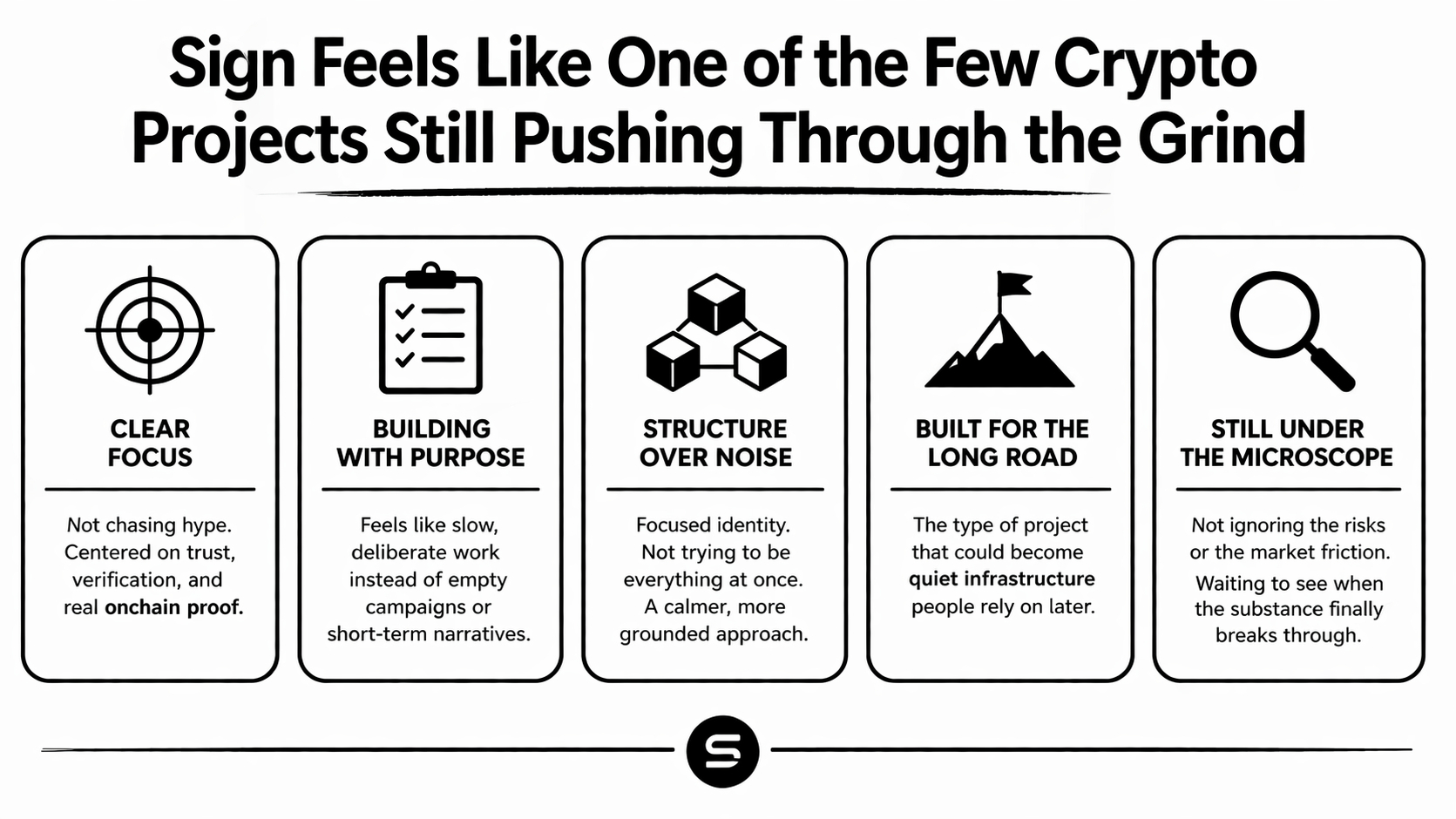
It doesn’t feel like a project trying to scream its way into relevance. It feels more like it’s grinding through a problem that actually matters, even if that kind of work rarely gets instant attention. There’s a difference between a project that wants to be seen and a project that wants to hold up when the market finally gets tired of its own nonsense. Sign leans more toward the second one.
What I keep coming back to is the focus.
A lot of projects start out saying one thing, then a few months later they’re doing three other things because the first story didn’t stick. That drift usually tells you everything. Sign doesn’t give me that feeling. At least not yet. The core idea still feels intact. Trust, proof, verification, records. Not the sexiest lane in crypto. Probably one of the more necessary ones, though.
That matters to me more now than it used to.
I’m just tired of watching the market reward empty motion. Tired of the same token-first setups pretending to be products. Tired of teams building for attention first and utility later, if ever. So when I see a project that seems more interested in structure than spectacle, I notice it. Maybe that says more about how exhausted this cycle has become than it does about Sign itself. Still.
There’s also something about the way the project carries itself that feels more grounded than most. Not perfect. Just less desperate. It doesn’t feel like it’s trying to become everything at once. And in this space, that alone is a compliment.
But I’m not romanticizing it either.
I’ve been around long enough to know that having a serious idea is not the same thing as surviving. Plenty of smart projects get buried under friction, bad timing, weak adoption, or just the slow grind of a market that would rather chase noise than sit with anything that takes more than ten seconds to understand. That’s always in the back of my mind here.
The real test, though, is whether Sign can become something people actually rely on instead of just something they mention when they want to sound thoughtful. That gap is where a lot of projects break. They look solid from a distance. Then you get closer and realize the market never really needed them, or never cared enough to integrate them into anything real.
I’m watching for that.
Because if Sign works, it probably won’t be in some loud, cinematic way. It’ll be slower than that. Quieter. More like the kind of infrastructure people ignore until they suddenly realize they’ve been using it the whole time. That’s a hard road. Maybe the right one. Still hard.
And maybe that’s why I haven’t written it off.
I don’t think of it as a quick narrative. I don’t even think of it as something that needs defending. I just think it has more substance than most of the stuff passing through this market right now, and after enough cycles, that starts to stand out on its own.
I’m still watching for the moment where that substance actually shows up in a way the market can’t keep shrugging off.
Or maybe it just keeps grinding in the background, waiting for a market that’s less addicted to recycling the same old noise.