
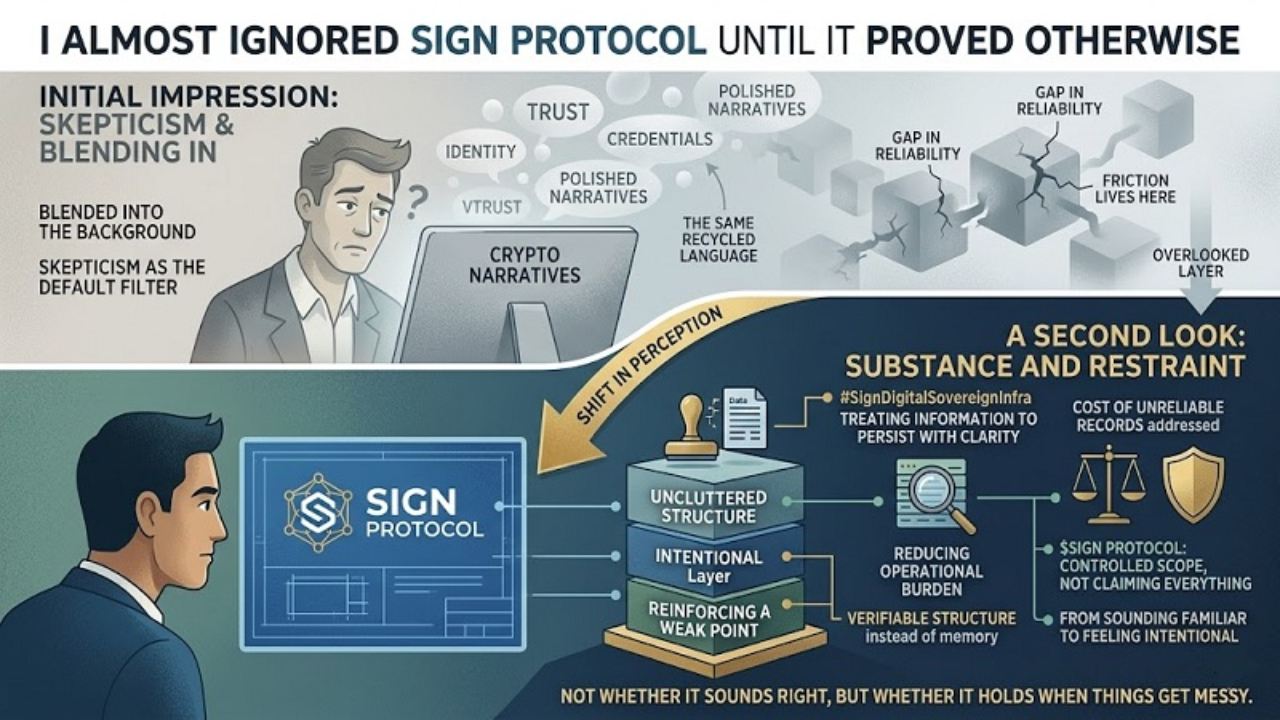
At first glance, Sign Protocol blended into the background.
Not because it looked weak, but because it looked too familiar. The same cluster of words that has been recycled across crypto for years. Trust. Identity. Verification. Credentials. It is the kind of language that no longer signals depth. It signals caution.
After a while, you stop reacting to it.
That is not just about one project. It is what repeated cycles do to attention. You see polished narratives come and go, each one promising structure, each one fading when real usage exposes the gaps. Over time, skepticism becomes the default filter.
That was my position here.
Then I slowed down and actually looked.
Not deeply at first. Just enough to see whether there was substance behind the surface. And that is where things started to shift. What stood out was not ambition, but restraint. It did not feel like a system trying to impress. It felt like something trying to hold together under pressure.
That difference matters.
Because most failures in crypto do not happen where people expect. It is rarely just the code or the transaction layer. It is everything surrounding it. The unclear records. The inconsistent criteria. The reliance on memory instead of verifiable structure. The quiet gaps where coordination breaks down.
That is where friction lives.
And Sign Protocol seems to be built with that in mind.
It treats information as something that needs to persist with clarity, not just exist. That sounds simple until you consider how often data in crypto becomes unreliable over time. Who qualified. Who approved. What standards were used. Whether any of it can still be verified without retracing everything manually.
That problem is bigger than most people admit.
#SignDigitalSovereignInfra appears to be targeting that exact weakness.
What changed my view was not a single feature. It was the absence of unnecessary noise. The structure felt intentional. Instead of projecting a massive vision, it focused on making one layer more reliable. That narrow focus makes it more credible.
Still, this is where caution remains.
A design can look clean in theory and still fail under real conditions. That is always the test. Whether it holds up when complexity increases. Whether it reduces friction in practice, not just in explanation.
I am still watching that closely.
But even at this stage, it is clear that Sign is operating in a part of the stack that has been overlooked for too long. While most conversations revolve around scale and speed, fewer projects address the cost of unreliable records and fragmented trust.
That gap is not small.
It compounds over time.
@SignOfficial seems to understand that trust is not just a concept. It is an operational burden. And when systems grow without fixing that layer, the inefficiencies multiply quietly until they become unavoidable.
That is why this stood out.
Not because it promises to solve everything. It does not. And that is a good sign. The scope is controlled. It focuses on reinforcing a weak point instead of claiming ownership over the entire system.
That makes it worth paying attention to.
$SIGN is still early in proving itself under real pressure. That part cannot be skipped. But it has already done something most projects fail to do. It shifted from sounding familiar to feeling intentional.
That is rare.
In the end, the question is simple.
Not whether it sounds right.
Whether it still holds when things get messy.
Because that is where most systems fall apart. And that is exactly where this one is trying to operate.