
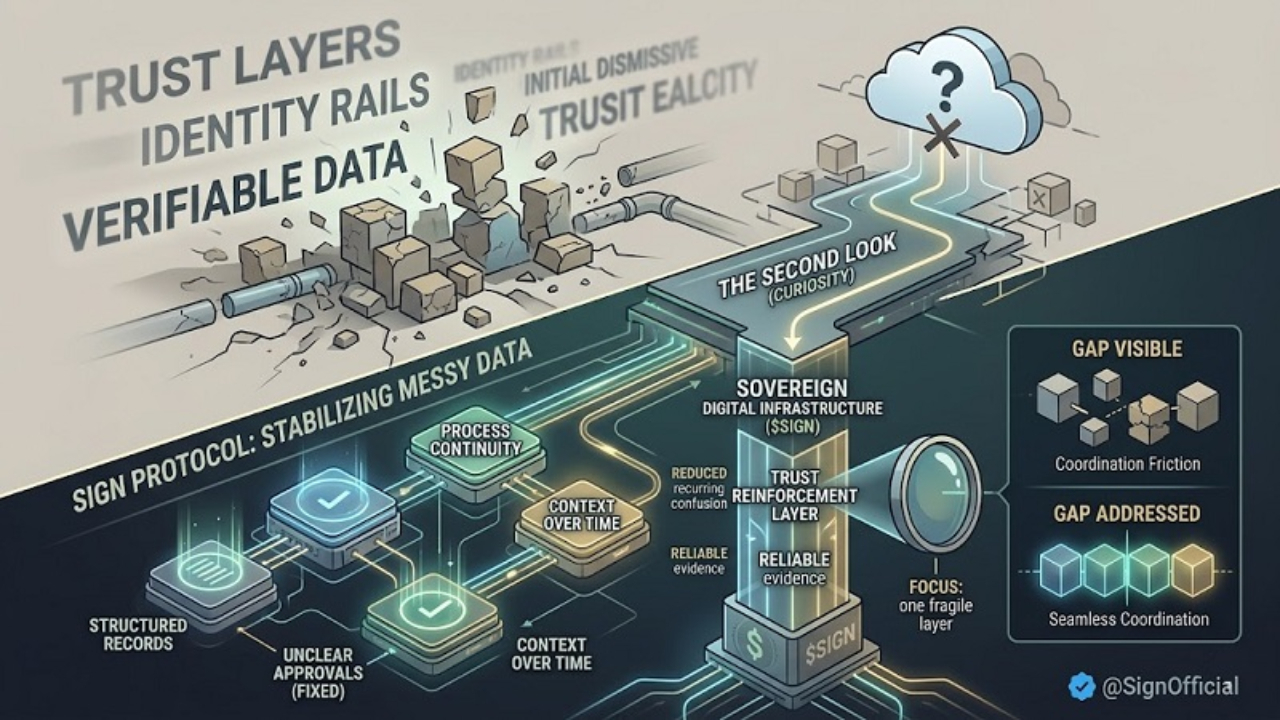
At a glance, Sign Protocol felt like something I had already seen.
Not identical, but close enough to trigger that same instinct. The usual language that floats around crypto infrastructure. Trust layers. Identity rails. Verifiable data. It all starts to blur after a while.
You stop questioning it.
You just move on.
That reaction is not random. It comes from watching too many polished ideas collapse once they meet real conditions. Clean narratives, unclear execution. Strong words, weak follow-through. It trains you to filter aggressively.
That is exactly what happened here.
I dismissed it without much thought.
Then I circled back.
Not out of excitement, just curiosity. I wanted to check whether there was anything beneath the surface language. And surprisingly, there was. Not in a loud or obvious way, but in how the system seemed to approach a problem most projects quietly avoid.
It is not trying to impress.
It is trying to stabilize something messy.
That stood out.
Because the real issues in crypto rarely sit in the spotlight. They exist in the background. In scattered records. In unclear approvals. In processes that depend more on memory than verification. In the silent gaps between steps where things start drifting.
That is where things break.
And most teams either ignore that layer or oversimplify it.
Sign Protocol seems to take it seriously.
Instead of treating data like an afterthought, it treats it like infrastructure. Something that needs structure, continuity, and context over time. That alone shifts how you look at it. It is less about making bold claims and more about reducing recurring confusion.
#SignDigitalSovereignInfra touches that exact nerve.
What changed my perspective was the discipline in its design. It does not try to cover everything. It focuses on one fragile layer and tries to make it reliable. That kind of restraint is rare in a space driven by oversized promises.
Still, skepticism is necessary.
A system can feel coherent on paper and still fail when pushed. Real usage always exposes weaknesses. That is the part that cannot be judged early. Whether it holds up when complexity increases. Whether it actually removes friction instead of just describing it better.
I am still watching that.
But even now, it is clear that this project is not chasing attention. It is addressing a structural gap. And that gap becomes more visible as systems grow and coordination becomes harder.
@SignOfficial seems to understand that trust is not free. It becomes expensive when processes are unclear and records cannot hold their shape over time.
That cost builds quietly.
$SIGN is positioning itself around that pressure point. Not as a solution to everything, but as reinforcement where things usually start to weaken. That narrower focus gives it weight.
In the end, the shift for me was simple.
It went from feeling like another recycled idea
to something that might actually reduce friction where it matters.
That does not mean it has proven itself yet.
It means it earned a second look.
And in this market, that already says a lot.