
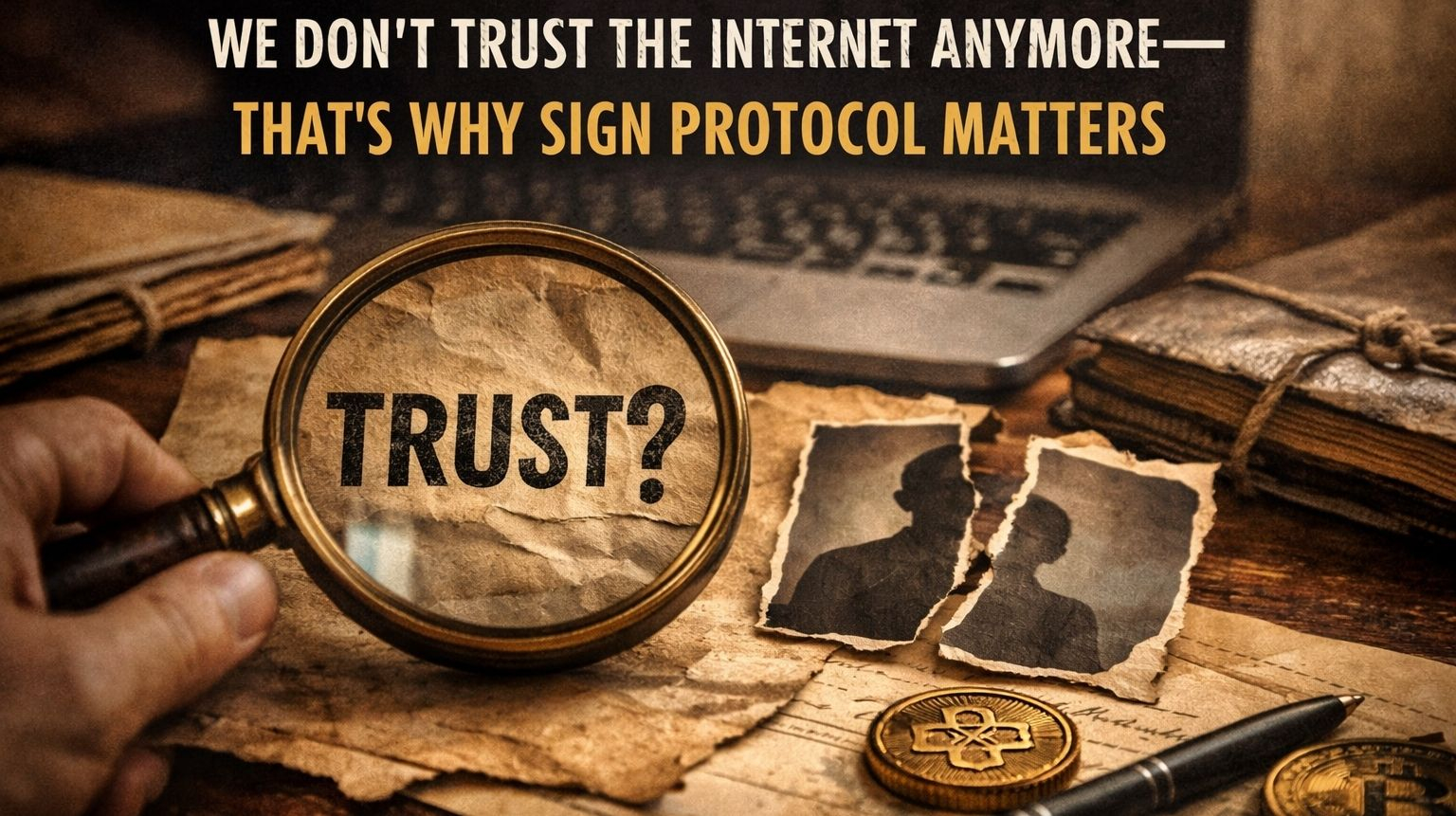
Sometimes I think this whole conversation around Sign Protocol is not really about technology at all. It feels more like it’s about how we, as humans, deal with trust… and honestly, how bad we’ve become at it.
I’ve noticed something in real life. We don’t fully trust anything anymore. Not screenshots, not documents, not even videos. Every time something important shows up, there’s always that small voice in the back of the mind asking, Is this real or edited? That feeling didn’t exist this strongly before. Now it’s everywhere.
And the strange part is we’ve adapted to it.
We double check things. We ask for confirmation. We rely on platforms to verify for us. But deep down we know those systems are not perfect. They can be changed controlled or manipulated. So trust became… temporary. Not solid. Just good enough for the moment.
That’s why something like @SignOfficial with $SIGN hits differently for me.
It doesn’t feel like another crypto tool trying to impress people. It feels like an attempt to fix something very human our discomfort with uncertainty. Instead of asking people to trust a company or a server it shifts the idea toward proof that stands on its own.
And if I’m being real…
That kind of system doesn’t just change tech. It changes behavior.
Because humans are used to operating in grey areas. We leave things unclear on purpose sometimes. We delay decisions we adjust narratives we rely on flexibility. That’s how society has always worked. Not everything is meant to be perfectly recorded or permanently visible.
So what happens when everything becomes provable?
That’s where it gets uncomfortable.
Imagine a world where every agreement every claim every distribution is backed by something that cannot be quietly changed later. No adjustments no backdated edits no hidden corrections. Sounds good on paper but in reality that kind of truth can feel heavy.
Even in crypto we’ve seen this gap clearly.
Token distributions, airdrops allocations… people always question them. Who really got what? Was it fair? Was something hidden? That doubt is normal now. And honestly, it’s why even legit projects get side-eyed.
What @SignOfficial is doing with systems like TokenTable is not just about transparency. It’s about removing that constant suspicion. Giving proof that doesn’t need explanation.
But again… humans are complicated.
We don’t just want truth. We want comfort too.
And sometimes too much transparency removes that comfort.
That’s why I don’t think this shift will be loud or dramatic. It will happen quietly. In the background. One system at a time. One use case at a time. Until one day, people stop questioning whether something is real not because they trust blindly but because they don’t need to question anymore.
That’s a very different kind of trust.
Not emotional. Not forced. Just… there.
I also find it interesting how this connects with the whole idea of digital sovereignty. When countries start paying attention to systems like this, it’s not random. It means they’re thinking beyond just infrastructure. They’re thinking about control over truth itself q who defines it, who stores it, and who can challenge it.
That’s a big shift.
But let’s not pretend everything is solved.
There are still real challenges. Scale, coordination, usability… these are not small things. Making something powerful is one thing. Making it simple enough for everyday people is another. If it doesn’t feel natural to use, it won’t matter how strong the tech is.
And honestly, that’s where most systems fail.
If Sign Protocol can reach a point where people use it without even realizing it’s there like sending a message or opening an app then that’s when it truly becomes part of life.
Until then, it’s still in that in-between stage. Not just an idea, not fully invisible yet.
And yeah… I can’t ignore how this even connects to the memecoin side of the market.
Look at something like Dogecoin or the random hype coins that explode overnight. People jump in based on vibes momentum community noise. No proof, no structure, just feeling.
That contrast says a lot.
On one side you have systems trying to anchor truth permanently. On the other you have markets running on emotion and speculation. And somehow, both exist at the same time.
Maybe that’s just human nature.
We don’t move purely on logic. We move on trust, fear, excitement, and sometimes… pure impulse.
So yeah, when I think about @SignOfficial and $SIGN I don’t see it as a magic solution.
I see it as a correction.
A slow attempt to bring balance back to a digital world that got too comfortable with uncertainty.
Will people fully accept that level of truth? I’m not sure.
But one thing feels obvious…
We can’t keep living in a system where everything can be questioned forever.
At some point something has to feel real again.
And maybe this is one of those steps.