
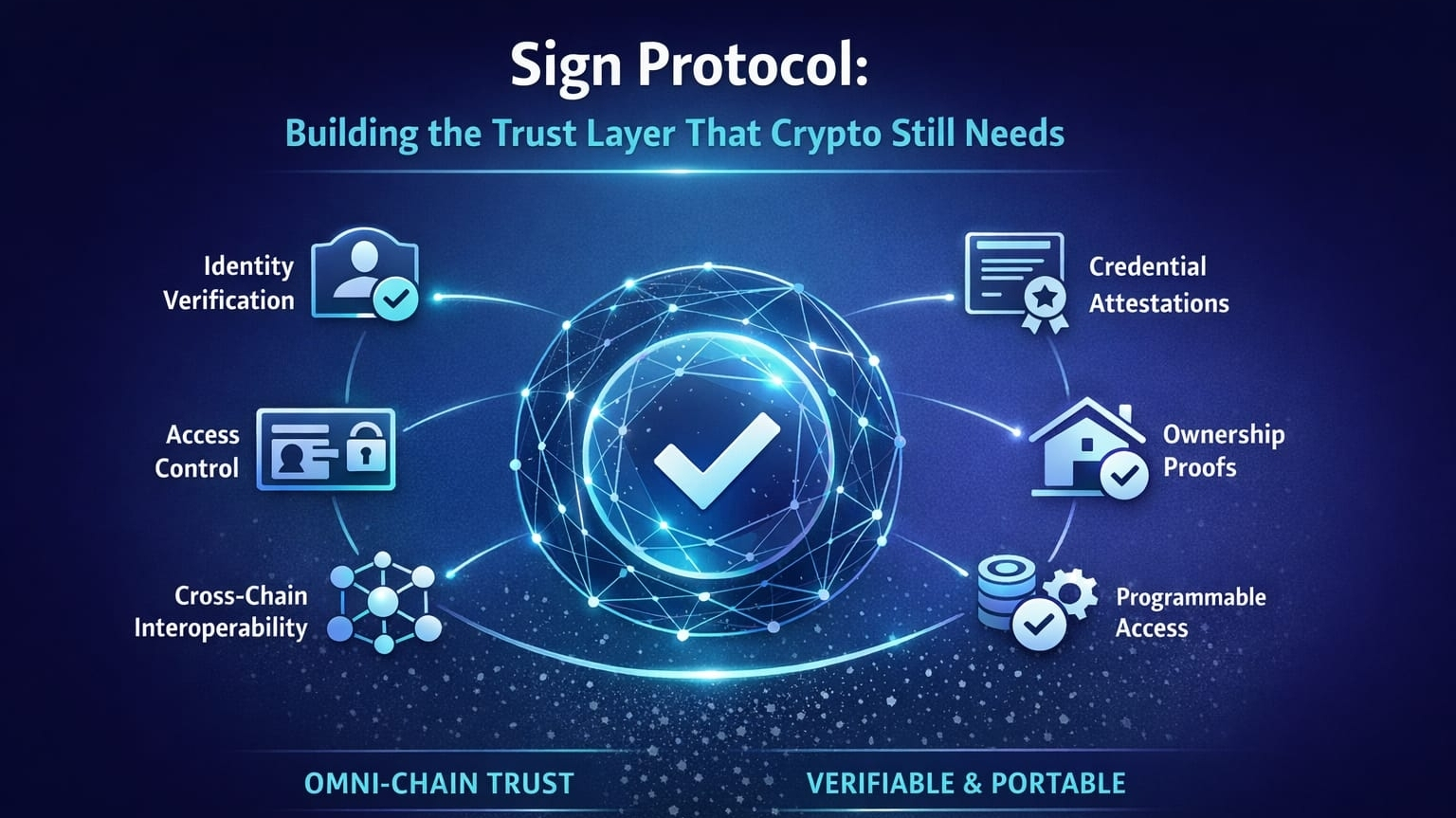

What draws me toward Sign Protocol is not hype. It is the layer underneath the hype. While a lot of the market gets distracted by price action, narratives, and short-term excitement, I tend to pay closer attention to the infrastructure that quietly makes the rest of the ecosystem more usable. That is exactly where Sign Protocol starts to matter to me. It is built around omni-chain credential verification, on-chain attestations, and trust infrastructure for identity, ownership, and programmable access across ecosystems. On the surface, that may sound technical. But when I slow down and really think about it, what it is actually trying to do is much more important than the wording suggests.
At its core, this is about making trust portable.
That matters more than many people realize.
I am watching this closely because one of the biggest problems in crypto is not a lack of innovation. It is fragmentation. Identity sits in one place, ownership sits somewhere else, credentials are often isolated inside separate systems, and access control is still clumsy in too many environments. Everything works, but too often it works in pieces. What stands out to me here is that Sign Protocol is trying to connect those pieces through attestations that can be verified on-chain and used across ecosystems. From my point of view, that is not just another feature. It is a structural improvement.
And structural improvements are usually where the real edge begins.
I think a lot about what happens when verification becomes easier, cheaper, and more programmable. The market changes. Communities can decide access based on proof instead of trust alone. Platforms can verify credentials without rebuilding the logic every single time. Ownership becomes more than a wallet balance. Identity becomes more than a profile. This is where Sign Protocol starts to feel meaningful to me, because it moves trust from something informal and fragmented into something that can actually be designed, measured, and reused.
This is the kind of signal I do not ignore.
What I find especially interesting is that this is not just about technology for the sake of technology. I always try to separate elegant ideas from useful ones. A protocol can sound impressive and still fail to matter if it does not solve a real coordination problem. But trust is a real coordination problem. It sits underneath identity, ownership, permissions, contribution, eligibility, and distribution. If crypto wants to support larger systems, more serious users, and more complex applications, then trust cannot remain improvised. It has to become infrastructure.
That is why I pay attention to projects like this differently.
I am not just asking whether the market likes the story. I am asking whether the story solves something fundamental. In this case, I think it does. Sign Protocol is trying to create a framework where credentials, attestations, and access logic are not trapped inside one chain or one app. That makes the whole idea bigger than a single product cycle. It becomes relevant to ecosystems, not just users. It becomes relevant to builders, institutions, communities, and distribution systems. And once something starts operating at that level, I become much more interested in how it develops over time.
Still, this is where I become more cautious.
Infrastructure plays are not always easy for the market to price correctly. In fact, most participants usually understand them late. The average eye is drawn to what is visible. A consumer app is visible. A meme is visible. A fast-moving token is visible. Backend trust infrastructure is not always visible until many systems start depending on it. So the challenge here is not just whether Sign Protocol is useful. The challenge is whether adoption can compound in a way that makes its importance undeniable. I am watching for that carefully.
Because usefulness alone is not enough. Embedded usefulness is what matters.
I pay attention to whether the protocol becomes part of actual workflows. I look for signs that attestations are not just possible, but necessary. I want to see whether developers use it because it is convenient, or because it becomes the obvious standard. That distinction matters. One creates temporary interest. The other creates staying power.
There is also a psychological side to this that I think many people overlook. In aggressive market phases, participants chase speed and simplicity. They want clear stories and immediate upside. But as the market matures, attention starts shifting toward systems that reduce friction, improve coordination, and create better trust assumptions. That shift is subtle, but it is powerful. And from my point of view, Sign Protocol fits directly into that category. It is not built for noise. It is built for function.
That is why I keep coming back to it.
What stands out to me is not that it promises to do everything. It is that it is focused on a problem the ecosystem keeps running into from different angles. Identity. Ownership. Access. Credentials. Distribution. These are not isolated themes. They are connected, and Sign Protocol seems to understand that. When a project is working on the trust layer across those categories, I do not see it as narrow. I see it as foundational.
So when I look at Sign Protocol, I do not just see a technical product. I see an attempt to formalize trust in a market that still relies too heavily on assumptions, patchwork systems, and manual coordination. That is why I am watching this closely. Not because it is loud, but because it is quiet in the right way. And often, the quiet systems are the ones that matter most later.
What I am paying attention to next is simple. I want to see whether this trust infrastructure keeps moving from concept into habit. If more ecosystems begin using it not as an experiment but as part of their default design, then its significance becomes much larger. That is when the market usually starts waking up. And by then, the people who were only watching the surface are already late.
@SignOfficial #SignDigitalSovereignInfra $SIGN
