
@SignOfficial #SignDigitalSovereignInfra $SIGN
In the world of blockchain, we often get caught up in big promises decentralization, transparency, and trustless systems that aim to remove control from centralized entities. Projects come and go, each claiming to push the boundaries further. Some deliver real innovation, while others quietly reintroduce the same old problems in new forms.
Lately, I’ve been thinking a lot about the Sign Protocol specifically, one part of its architecture that doesn’t get nearly enough attention: the indexing layer, sometimes referred to as SignScan or similar components.
At first glance, everything sounds great. The protocol talks about verifiable data, portability, and breaking down siloed trust systems. These are powerful ideas. They align with what blockchain technology is supposed to stand for. But when you look a little deeper, a question starts to form:
Who actually controls what data you can see, access, and use?
That’s where the concern begins.
The Part Nobody Talks About Enough
Most people focus on the surface—smart contracts, tokenomics, partnerships, and roadmap updates. But the real control in many blockchain systems doesn’t sit where people think it does.
It often sits quietly in the infrastructure layer—specifically in indexing.
Indexing is what makes blockchain data usable. Without it, raw on-chain data is just a massive, unstructured set of transactions. Indexers organize that data, making it searchable, readable, and accessible to applications and users.
In simple terms, indexers decide what you can easily find.
And that’s where things can get Decentralisation vs. Practical Control
Let’s be clear just because something is “on-chain” doesn’t automatically mean it’s fully decentralized in practice.
Yes, the data may exist publicly. Yes, transactions are recorded transparently. But if the tools you rely on to access that data are controlled by a small group, then the system still has a bottleneck.
It’s like having a public library where all books are technically available but only one librarian decides which books are placed on the front shelf.
Would you call that fully open access?
Probably not.
Why the Indexing Layer Feels “Off”
With Sign Protocol, the concern isn’t that the idea is flawed. In fact, the idea is quite compelling. The vision of verifiable credentials, portable data, and reduced reliance on centralized trust systems is something the ecosystem genuinely needs.
But the implementation matters just as much as the vision.
If the indexing layer whether it’s SignScan or any similar component remains controlled by the core team or a small, tightly managed group, then a subtle form of centralization creeps back in.
Not loudly. Not obviously.
But quietly.
And that’s often more dangerous.
Because when control is obvious, people question it. When it’s hidden behind technical layers, most users don’t even notice.
The Illusion of Openness
This is where many projects unintentionally (or sometimes intentionally) create an illusion of decentralization.
They say:
Data is verifiable ✔️
Data is portable ✔️
Everything is on-chain ✔️
But they don’t always emphasize:
Who runs the indexers?
Who decides how data is structured?
Who controls the primary access points?
Because that’s where the real leverage lies.
A system can be technically decentralized at the base layer while still being functionally centralized at the access layer.
And for most users, the access layer is the only part that matters.
A Pattern We’ve Seen Before
This isn’t a new concern.
If you’ve spent enough time in crypto, you’ve probably seen this pattern repeat itself:
A project launches with strong decentralization narratives
The tech looks impressive on paper
Early adoption grows
Over time, control consolidates in subtle ways
Eventually, the system behaves more like a semi-centralized platform
It doesn’t happen overnight. It happens gradually.
And by the time people realize it, the structure is already in place.
That’s why small details—like indexing—matter more than they seem.
Sometimes, a tiny design decision is enough to create a long-term dependency.
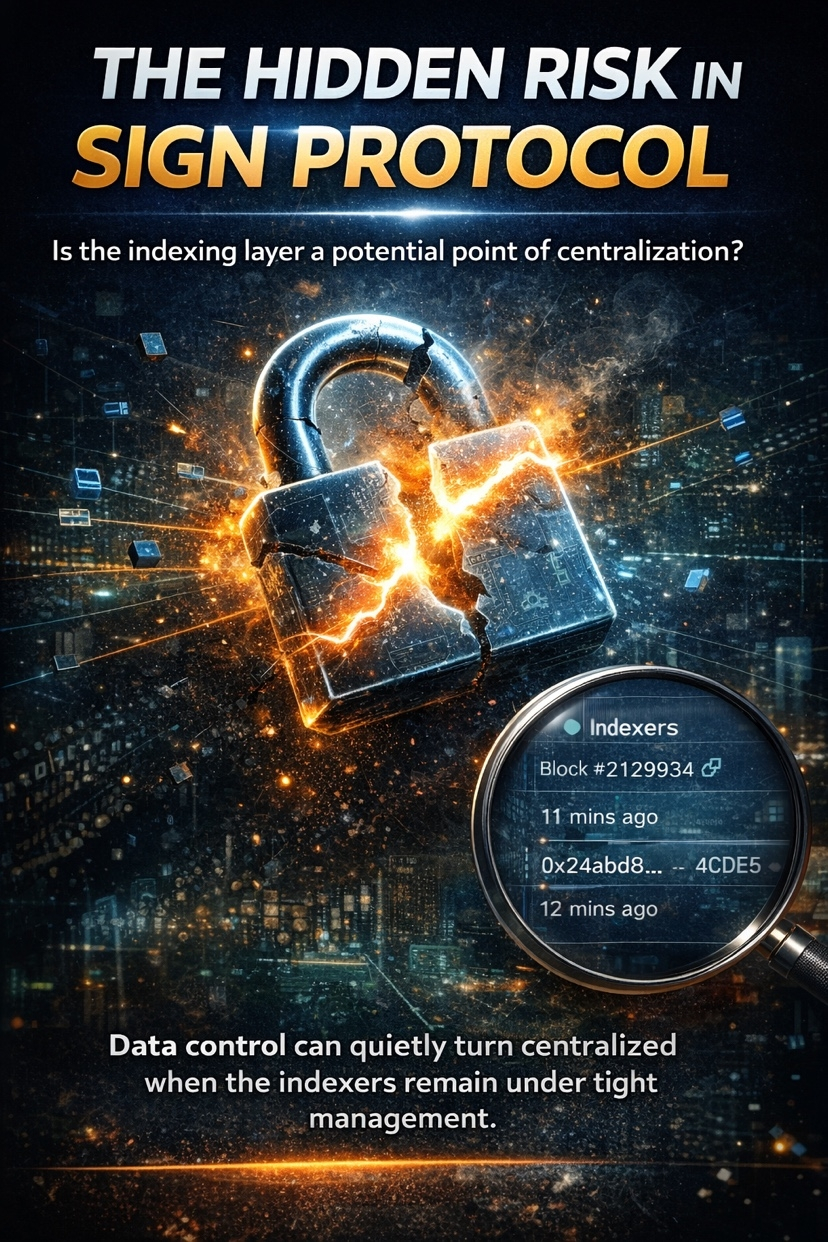
The “Small Needle, Big Crack” Effect
There’s a simple idea worth remembering:
It doesn’t take a massive flaw to weaken a system. Sometimes, a small point of control is enough to create a much larger problem over time.
Indexing might look like a technical detail. Something developers handle behind the scenes.
But in reality, it’s a critical choke point.
If access to indexed data is limited, filtered, or controlled—even slightly—it can shape the entire ecosystem:
What developers build
What users see
What data becomes relevant
What gets ignored
And once that influence exists, it compounds.
This Isn’t About Calling It “Doomed”
It’s important to be fair here.
Raising concerns about a project doesn’t mean dismissing it entirely.
The Sign Protocol still has strong potential. The idea of dismantling isolated trust systems and creating portable, verifiable data frameworks is powerful. It’s the kind of innovation that could genuinely push Web3 forward.
But potential doesn’t remove risk.
And ignoring structural concerns just because the vision sounds good is how people get caught off guard.
What Actually Matters: Real Behavior
One of the biggest lessons in crypto is this:
Promises are cheap. Behavior is everything.
Whitepapers can say anything. Roadmaps can look perfect. Marketing can highlight all the right keywords.
But the truth shows up in:
On-chain activity
Governance structures
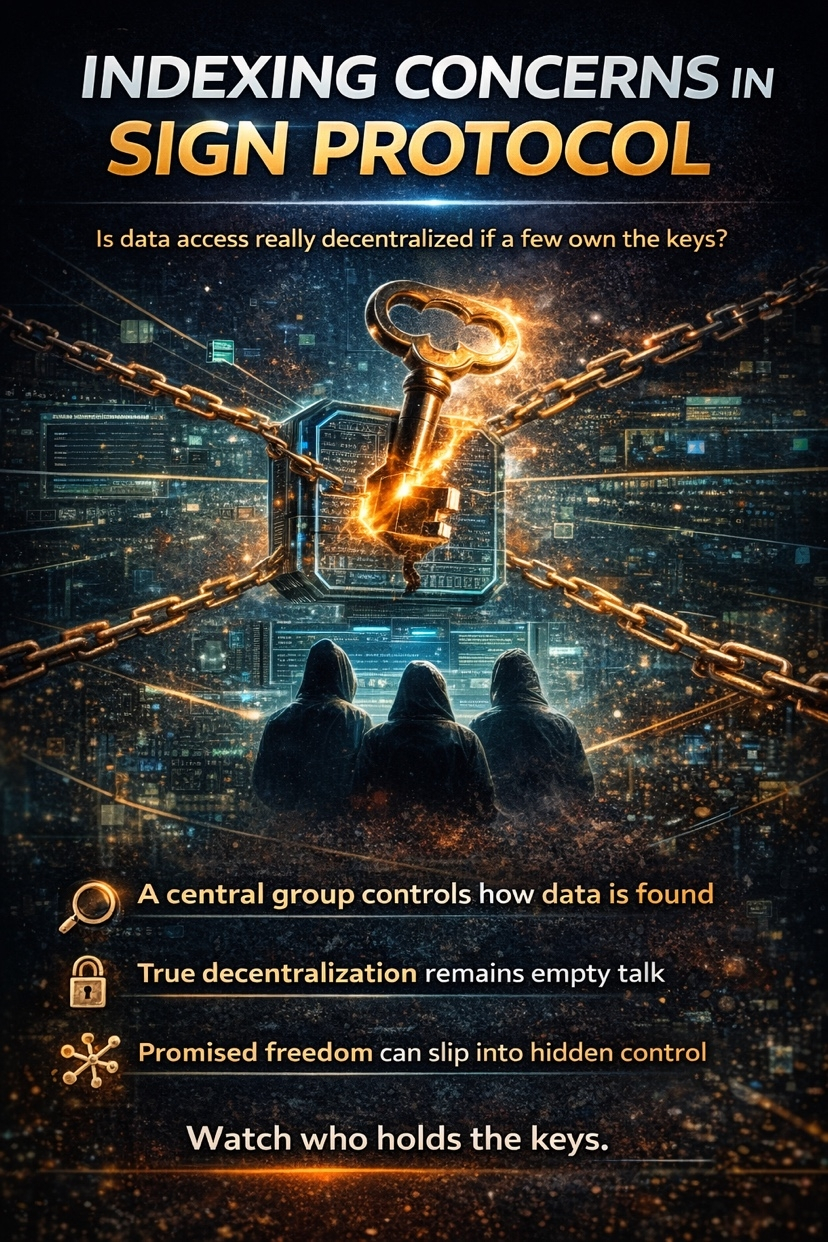
Who controls key infrastructure
How decisions are actually made
If you really want to understand a project, you don’t just read about it—you observe it.
Watch:
Who runs the indexing services
Whether third parties can participate
If the system allows permissionless access
How open the data layer truly is
Because that’s where the real story is.
The Responsibility of the Investor
Too many people invest based on narratives alone.
They hear:
“Decentralized”
“Trustless”
“Next-gen protocol”
And that’s enough.
But in reality, understanding a project requires more effort. It means asking uncomfortable questions and looking beyond the surface.
It means being willing to say:
“This looks good… but something doesn’t feel right here.”
That instinct matters.
The Bigger Picture
This isn’t just about one protocol.
It’s about a broader issue in the crypto space: the gap between theoretical decentralization and practical control.
As the ecosystem evolves, systems are becoming more complex. And with that complexity comes more places where control can hide.
Indexing layers, APIs, frontends these are all potential points of centralization.
If we ignore them, we risk rebuilding the same systems blockchain was meant to replace.
Stay Curious, Stay Critical
The goal isn’t to become overly skeptical or dismissive of every project.
The goal is balance.
Be open to innovation but also willing to question it.
Recognize potential but don’t ignore risk.
Because in this space, the difference between success and failure often comes down to the details most people overlook.
Final Thoughts
The Sign Protocol is interesting. It’s ambitious. And it’s tackling a real problem.
But the concern around its indexing layer is valid—and worth paying attention to.
If control over data access remains centralized, even partially, it could limit the very decentralization the protocol aims to achieve.
That doesn’t mean it will fail.
It means it needs to be watched carefully.
Keep Learning, Keep Growing
At the end of the day, crypto is still evolving.
The best thing you can do isn’t just invest it’s learn.
Study how systems work. Watch real activity. Question assumptions.
Because knowledge is one of the few advantages that’s still freely available in this space.
And the more you understand, the less likely you are to be misled by surface-level narratives.