
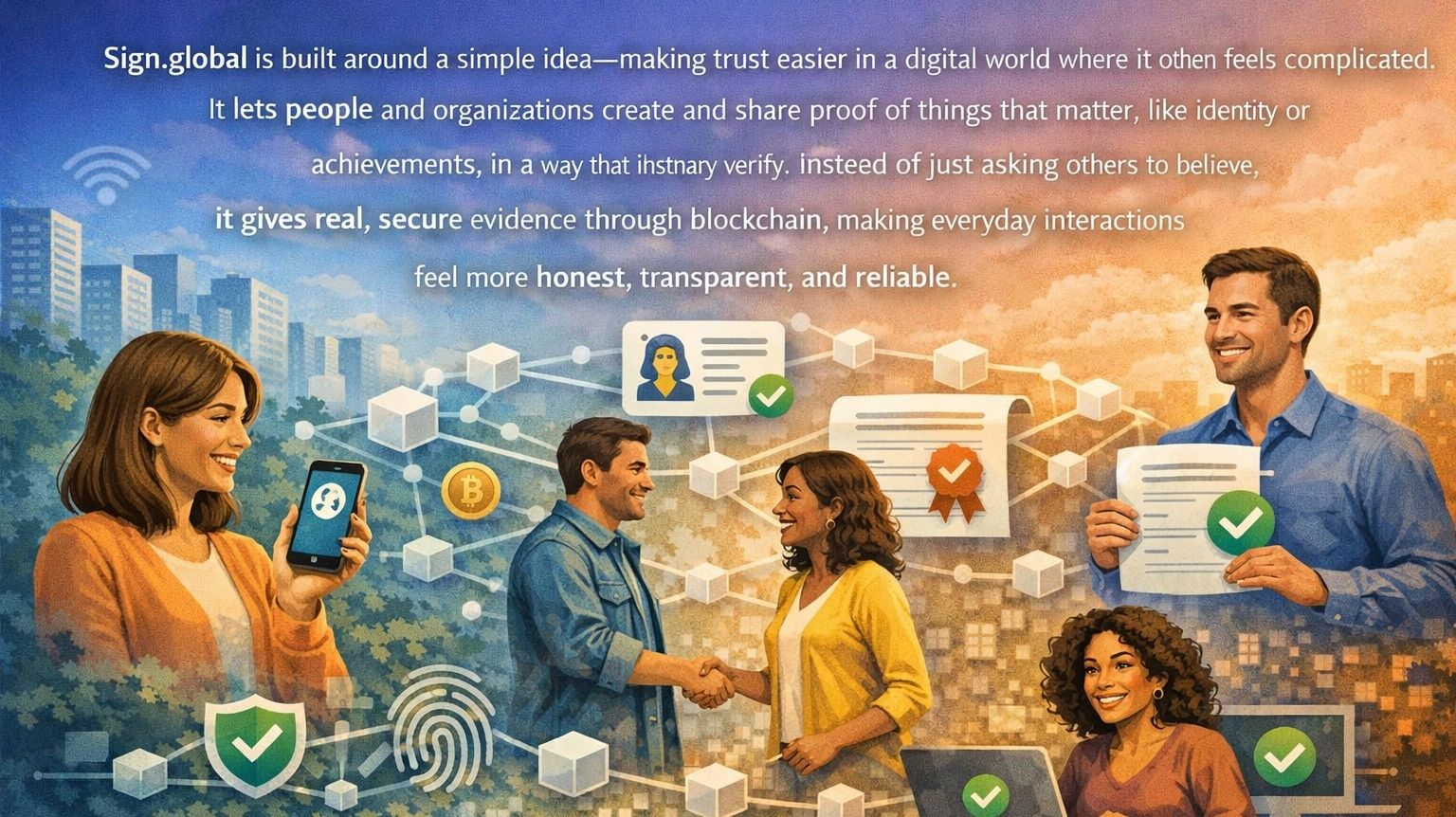
Trust has always been the invisible thread holding opportunities, relationships, and progress together, but in the digital world, that thread often feels thinner than it should. People share achievements, credentials, and identities across countless platforms, yet proving their authenticity still comes with friction. Screenshots can be edited, documents can be duplicated, and verification often depends on slow, manual processes. This growing gap between what is claimed and what can be trusted is exactly where Sign.global begins to make a meaningful difference, offering a way to bring clarity and confidence back into digital interactions without making things complicated.
At its heart, the idea is simple yet powerful. Instead of relying on scattered systems or temporary proofs, Sign.global enables credentials to be issued in a way that makes them permanent, verifiable, and easy to share. Whether it’s a certificate, a badge of achievement, or proof of participation, each credential becomes something that doesn’t just sit in an inbox or a profile but exists as a reliable record that anyone can verify instantly. This removes the usual back-and-forth that people experience when trying to prove something online and replaces it with a sense of immediacy and trust that feels natural.
Think about how often people find themselves collecting bits and pieces of their accomplishments from different places. A student might have certificates from multiple learning platforms, a freelancer may have proof of work scattered across projects, and a professional could have achievements locked inside company systems. Bringing all of that together in a credible way can feel overwhelming. Sign.global quietly solves this by creating a consistent layer where all these credentials can live, not just as static files but as verified proofs that carry their own authenticity wherever they go.
What makes this shift especially meaningful is the way it gives control back to individuals. Instead of depending on institutions to confirm or resend records, people can hold and share their own verified credentials whenever they need them. It transforms the experience from asking for permission to simply presenting proof. This sense of ownership is subtle but powerful because it changes how people engage with their achievements. They are no longer just stored somewhere; they become active, usable parts of a person’s digital identity.
For organizations, the impact is just as significant. Issuing credentials has traditionally been a routine task, but verifying them later can become a burden. Employers spend time confirming qualifications, communities try to validate contributions, and institutions handle repeated requests for proof. By using a system where credentials are verifiable by design, much of this effort disappears. The process becomes smoother, faster, and far more reliable, allowing organizations to focus on what truly matters instead of chasing confirmations.
There is also a deeper layer to consider, especially as the internet continues to evolve into a space where people collaborate without physical boundaries. In remote work environments, online communities, and decentralized ecosystems, trust often needs to exist between people who have never met. In such situations, verifiable credentials act as a bridge. They allow individuals to demonstrate their skills, contributions, or affiliations without relying on personal connections or lengthy explanations. It creates a shared understanding that what is being presented is real, and that understanding helps interactions move forward with confidence.
At the same time, the experience remains approachable. One of the common concerns with digital verification systems is that they might feel technical or difficult to use, but the strength of Sign.global lies in how naturally it fits into existing behaviors. Issuing or sharing a credential doesn’t require deep technical knowledge. It feels closer to sending a link or presenting a document, only with the added assurance that what is being shared can be trusted without question. This balance between simplicity and reliability is what makes the system not just useful, but genuinely practical.
Privacy is another area where thoughtful design plays an important role. In a time when people are increasingly aware of how their data is used, the ability to control what is shared becomes essential. Verification does not have to mean exposing everything. Instead, it can mean sharing just enough to confirm authenticity while keeping the rest private. This approach respects the user while still delivering the confidence that verification is meant to provide, creating a healthier balance between transparency and control.
As more people and organizations begin to adopt verifiable credentials, something interesting starts to happen. The value of the system grows with each new participant. Every issued credential adds to a wider network of trust, making it easier for others to verify and be verified in return. Over time, this creates an environment where trust becomes less about assumption and more about accessible proof. It shifts the digital experience from one where people have to question what they see to one where authenticity is built into the interaction itself.
There are also practical opportunities that come with this shift. Freelancers can present verified portfolios without lengthy explanations, students can share achievements without worrying about lost records, and organizations can build stronger credibility with their audiences. Even beyond professional use, communities can recognize contributions in a way that carries real weight, making participation more meaningful and rewarding. These small improvements add up, gradually reshaping how people experience trust online.
Of course, like any tool, its effectiveness depends on how it is used. Simply issuing credentials is not enough if they are not meaningful or relevant. The real value comes from creating credentials that reflect genuine achievements and experiences. For individuals, this means focusing on what truly represents their skills and journey. For organizations, it means being intentional about what they issue and why it matters. When done thoughtfully, the result is a system that doesn’t just verify information but enhances its significance.
Another important perspective is understanding that verification is not a replacement for trust but a support for it. Human judgment, communication, and context still play a role in how we evaluate information. What Sign.global offers is a foundation, a way to ensure that the basics are reliable so that deeper interactions can happen with confidence. It removes doubt from the equation, allowing people to focus on connection, collaboration, and growth.
As the digital world continues to expand, the need for clear and dependable ways to prove authenticity will only become more important. More of our lives are moving online, from education and work to creativity and community. In such an environment, having a system that makes trust easier to establish is not just convenient, it is essential. Sign.global represents a step in that direction, offering a solution that feels both modern and intuitive without losing sight of what people actually need.
In the end, what stands out is not just the technology but the experience it creates. It turns verification from a slow, uncertain process into something immediate and reliable. It gives individuals confidence in sharing their achievements and gives organizations confidence in what they issue. Most importantly, it brings a sense of clarity to a space that often feels uncertain. And in a world where so much depends on trust, having that clarity makes all the difference.
