

I was watching how most systems handle trust the other day and something felt off in a way that’s hard to notice at first. Everything looked functional on the surface. Transactions were going through. Approvals were being processed. Data was being recorded. Nothing was technically broken. But the more I looked at it, the more it felt like these systems weren’t actually aligned with reality anymore. They were running on decisions that were made earlier, not decisions that were still true.
That gap is subtle but it compounds fast.
In most digital systems today, trust is treated like a checkpoint. Once you pass it, you move forward and the system assumes that decision holds unless someone explicitly revisits it. That works in small isolated flows. But once you scale into multi step processes, cross platform interactions, or real world distribution, that assumption starts to fail quietly.
A wallet gets approved once and keeps that status even if the underlying conditions change. A claim gets recorded and becomes a reference point for future actions even if the context behind it shifts. A verification is issued and reused across systems that never question whether it still applies.
Nothing crashes. But the system slowly drifts away from what is actually true.
That’s the part most infrastructure today doesn’t address. Not because it’s overlooked, but because it’s difficult to solve without adding more friction or more data collection. Most systems compensate by increasing visibility. They collect more information, add more checkpoints, and introduce more intermediaries just to maintain confidence. It works for a while, but it doesn’t scale cleanly.
What caught my attention with Sign Protocol is that it approaches this problem from a completely different angle. It doesn’t try to improve trust by storing more data or speeding up verification. It changes how trust is structured in the first place.
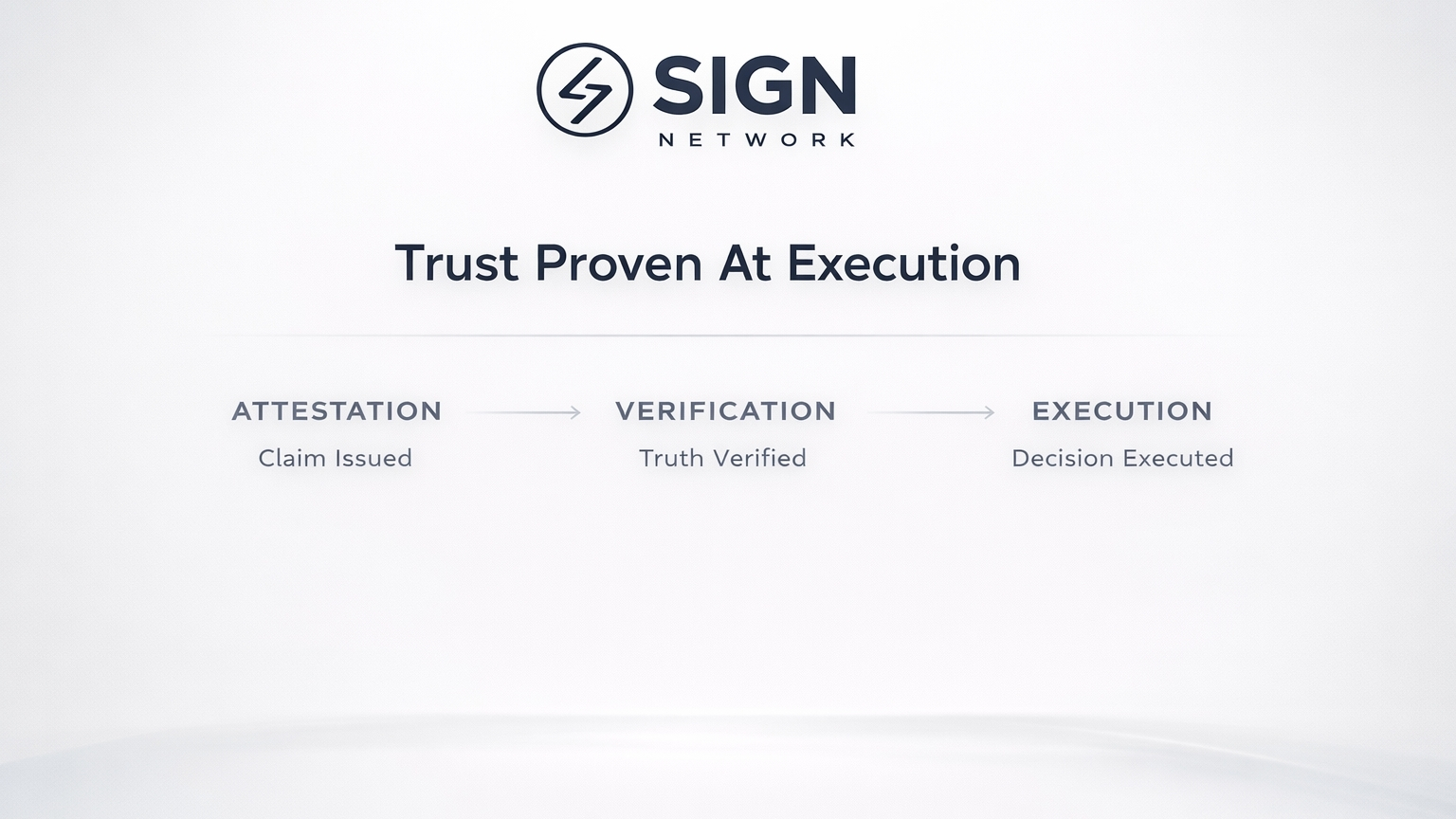
Instead of treating trust as something static, it treats it as something that must be proven at the moment it is used.
That sounds simple, but it shifts the entire architecture.
In this model, decisions are not stored as permanent approvals. They are represented as attestations. These are structured claims issued by specific entities under defined conditions. What matters is not just that a claim exists, but that it can be verified right now under the rules that govern the action being executed.
That means every transaction, every access request, every distribution event is tied to conditions that must still hold at that exact moment.
If those conditions change, the outcome changes automatically.
No manual intervention. No delayed reconciliation. No hidden dependency on another system.
Execution becomes conditional on truth, not history.
This is where the difference becomes real in practical terms. Take something like large scale distribution systems or incentive programs. Today, most of them rely on snapshots, static eligibility lists, or periodic checks. They work, but they introduce inefficiencies. Either you accept leakage because conditions change after approval, or you increase friction by constantly re verifying everything.
With this approach, eligibility is not something you check once. It is something that must be provable at the time of execution. That reduces both over distribution and unnecessary friction at the same time.
And this is already moving beyond theory.
Recent developments around Sign are not just about expanding reach but about embedding this logic into real usage environments. From omni chain attestations that allow claims to move across ecosystems to integrations that support large scale user flows, the direction is clear. This is not positioning itself as another application layer. It is positioning itself as the layer that other systems rely on to make decisions safely.
That distinction matters.
Because most of Web3 has focused on moving assets, scaling throughput, and reducing costs. All important problems. But none of them directly solve how decisions are enforced across systems without introducing trust assumptions.
And that is where things usually break.
You can have fast payments, cheap transactions, and seamless user interfaces, but if the system cannot reliably determine whether an action should happen, everything else is built on unstable ground.
What stands out to me is how quietly this shift is happening. There is no aggressive narrative pushing it. No exaggerated claims. Just a gradual expansion of a model that starts to make more sense the deeper you look into real world use cases.
Because once you see the gap between recorded data and actual truth, it becomes hard to ignore.
And once you understand that trust needs to be continuously valid rather than historically approved, the old way of designing systems starts to feel incomplete.
That is why I think Sign is not just another protocol competing for attention. It is addressing a layer that most systems have been working around rather than solving directly.
It is not trying to move money faster.
It is making sure money moves only when it should.
And that difference is where infrastructure stops being visible and starts being necessary.