

I’ll be honest… I used to think crypto’s biggest problem was Speed. Faster chains, lower fees, smoother transactions that felt like the whole game. I was fully in that mindset for a While. But recently something started to feel off, and I couldn’t really ignore it anymore.
It is not that we can not move value. We’ have actually gotten pretty Good at that. It’s that we do not always know who actually deserves to receive it. And the more I thought about it, the more I realized that this part breaks way more often than transactions ever do.
Before anything moves, every system has to answer a simple question that turns out to be not simple at all. who qualifies?
Not just can we send it? but should we send it?
And this is exactly where things get messy.
We have got transparent wallets, Visible transactions, clean on-chain activity. but the logic behind decisions still feels shaky. I’ve personally seen Airdrops get farmed by people who barely contributed, while others who actually showed up and did real work got less. That’s not a blockchain issue. That’s a trust and qualification issue.
That’s honestly the moment I started paying more attention to what Sign is trying to do.
At first, I didn’t fully get it. I saw the usual terms—attestations, schemas, token distribution—and it felt like just another infrastructure layer. Nothing really stood out immediately. But the more I looked into it, the more it clicked that it’s not just about proving something is true.
It is about making that proof usable.
Usable in a way where a system can actually act on it. Where it can decide who gets access, who receives value, who Qualifies for something, and do all of that without relying on hidden logic or manual checks.
That shift feels small when you say it quickly, but it’s actually pretty deep.
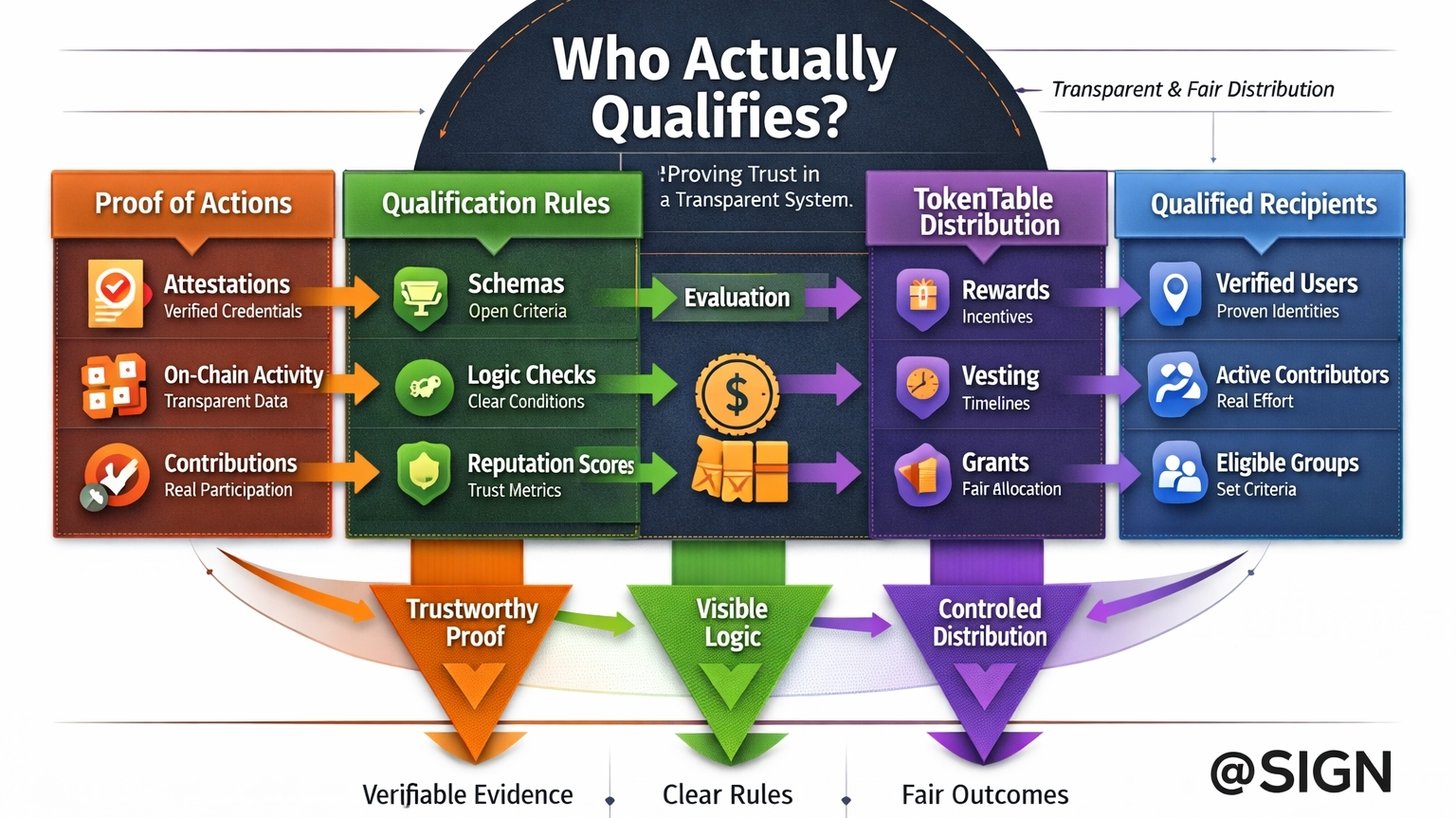
What I find really interesting is how the system is structured. Most setups mix everything together—proof, rules, payouts. all in one place. And that’s usually where things quietly break or get manipulated.
SIGN separates those pieces. Proof is handled through attestations. Rules are defined through schemas. Execution happens through TokenTable. And that separation just makes sense the more you think about it.
Because now proof is not Stuck in one place. It can move. Rules aren’t hidden. They can be checked. and distribution does not rely on guesswork. It follows defined logic.
It makes the system feel more honest, not because someone claims it is, but Because you can actually see how decisions are made.
TokenTable is another part that I think people underestimate a lot. Most people hear distribution and immediately think airdrops or quick rewards. But if you zoom out a bit, distribution is really about controlling how value moves.
Who gets what, when they get it, and why they get it.
That applies to way more than just crypto rewards. It touches grants, vesting, incentives, and honestly even real-world allocations if things move in that direction. So it’s not just a side feature, it is actually one of the more practical Pieces of the whole setup.
And this is where things start to feel bigger than just Web3.
Because the problem here isn’t limited to crypto. It exists everywhere. Governments deal with it. Institutions deal with it. Figuring out who qualifies for something, verifying that fairly, and distributing value accordingly is still a messy Process in most systems.
If even a small part of those systems becomes more digital or interoperable, the need won’t just be for moving value faster. It’ll be for making decisions in a way that’s verifiable and consistent.
That’s where something like Sign could actually matter a lot.
At the same time, I am not looking at this in a blindly bullish way. There’s still a big gap between a strong idea and real-world adoption at scale. We’ve seen projects before that made perfect sense on paper but took years to actually stick, or never fully got there.
And then there’s the token side, which I think deserves a more honest take.
A Project can be genuinely important and still have a token that takes time to reflect that. I’ve learned that the hard way. Good tech doesn’t automatically mean immediate price movement.
With Sign, it kind of feels like that situation again. The product direction looks solid, the use case makes sense, there are signs of adoption building, but the token still has its own path to figure out. Supply, unlocks, demand—. those things do not just disappear because the idea is strong.
So the real question is not just “is this useful?” It’s whether that usefulness eventually turns into something the token actually captures.
And that’s not always a straight line.
What keeps me interested is the problem itself. Because it’s not some minor inefficiency. It’s something structural.
We already solved how to move information through the internet. We improved how to move value through blockchains. But trust, in a form that systems can actually use, still feels incomplete.
Not just knowing that something happened, but knowing whether it should have happened, and being able to verify that later without relying on a black box.
That’s the gap I keep coming back to.
And that’s why Sign feels early in a different way to me. Not hype early, but the kind of early where something is quietly working on a problem most people don’t fully notice yet.
I’m still watching it, Still thinking through it, and honestly still a bit unsure how it all plays out.
But one thing does feel clear to me now.
Every System eventually runs into the same question, no matter how advanced it looks on the surface.
Who actually qualifies… and can we prove it in a way everyone can trust?
If that question gets solved properly, then this whole category becomes a lot more important than it seems today.