
When I first started reading about these national digital systems,
New Money
New ID
New Capital
I honestly thought it would be too technical for me. I just wanted to understand the basics, nothing more. I expected long jargon, complicated diagrams, the kind of stuff that makes you close the tab after five minutes. But when I actually sat with it and tried to understand the flow, something different happened. It felt less like theory and more like a real structure that countries might actually use.
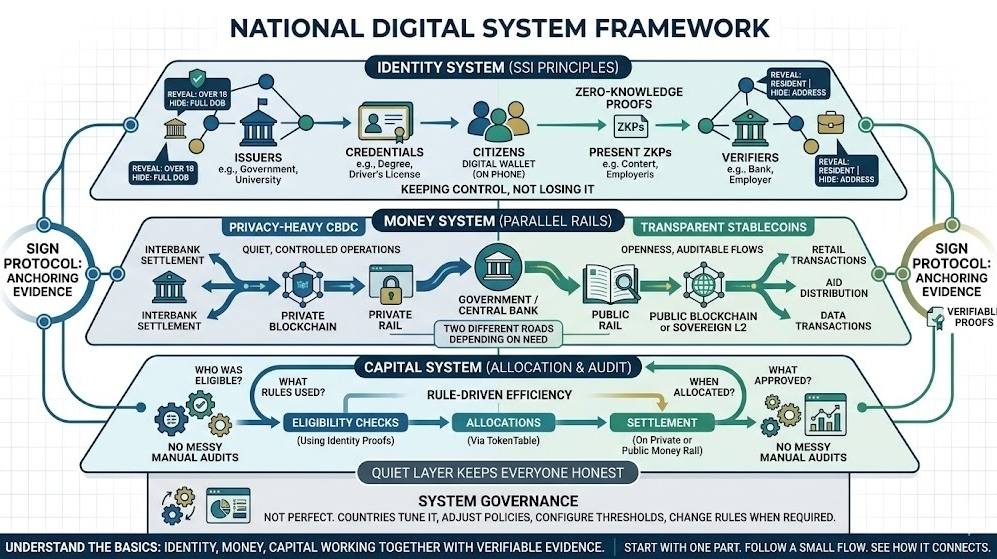
The first thing that caught my attention was how everything connects: identity, money, and capital. Not separately, not in pieces, one framework, three layers, but working together. The New Money System isn’t just about CBDCs or stablecoins, but about giving a government two parallel rails. One private rail for privacy-heavy CBDC, and one public rail for transparent stablecoins. At first I thought, okay, sounds technical, but then the idea clicked. It’s like giving the system two different roads depending on what the country needs: privacy when required, openness when necessary.
The architecture felt surprisingly simple. If you need transparency, go with the public blockchain or even a sovereign Layer 2. If you need quiet, controlled operations, the private CBDC mode handles that. No one-size-fits-all pressure. Just choices. It reminded me of tools that don’t force you into one setup, they let you pick the mode that matches your reality.
The identity part also surprised me. The New ID System works on SSI principles, but the way it was structured made sense. Issuers create credentials, citizens hold them, verifiers check them, without constantly hitting some central database. The privacy aspect stood out: reveal only what is needed, nothing extra. Age without full DOB, residency without full address. For the first time, I felt like digital identity wasn’t about losing control, it was about keeping it.
Then I looked at the capital system. This one caught me because it deals with real people, real needs. Instead of messy manual audits and mismatching records, everything is rule-driven. Eligibility comes from identity proofs. Allocations happen through TokenTable. And then settlement runs through whichever rail the program selects. It didn’t feel futuristic or unrealistic; it felt like something governments should have already implemented by now.
What tied the whole picture together was Sign Protocol. It doesn’t run the programs, but it anchors the evidence: who was eligible, what rules were used, when funds were allocated, what was approved. It’s like the quiet layer that keeps everyone honest. No flashy behavior, just solid verification.
Would I say this system solves everything? Of course not. Nothing is perfect. Countries will still need to tune it, adjust policies, configure thresholds, change rules when required. But the concept itself, identity, money, and capital working together with verifiable evidence, felt like a step in the right direction. Not hype, not buzzwords, just structure.
If someone asked me whether they should explore it, I’d say don’t overthink. Start with one part. Maybe the identity layer or the money rails. Follow a small flow. See how it connects. You’ll understand it faster than you expect. In a world moving toward digitization at full speed, understanding these foundations feels necessary, not optional. And honestly, once you see how the pieces fit, the whole system starts making sense on its own.
@SignOfficial #SignDigitalSovereignInfra $SIGN
