
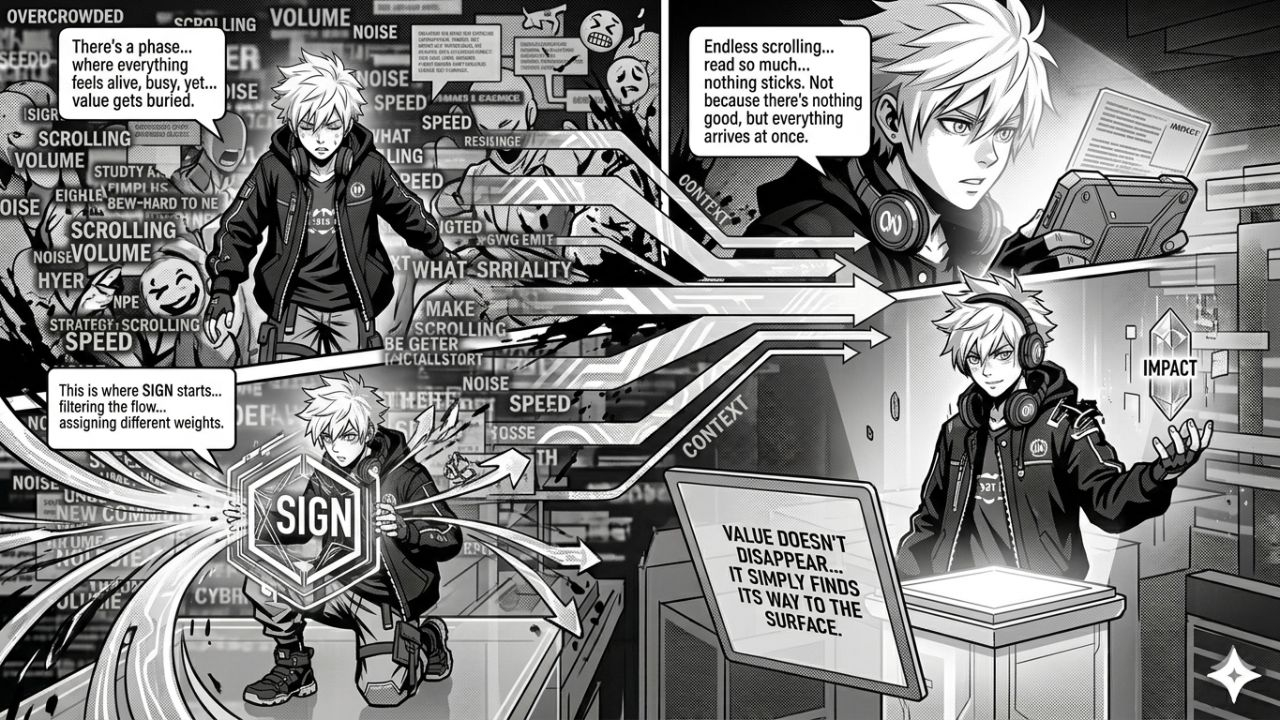
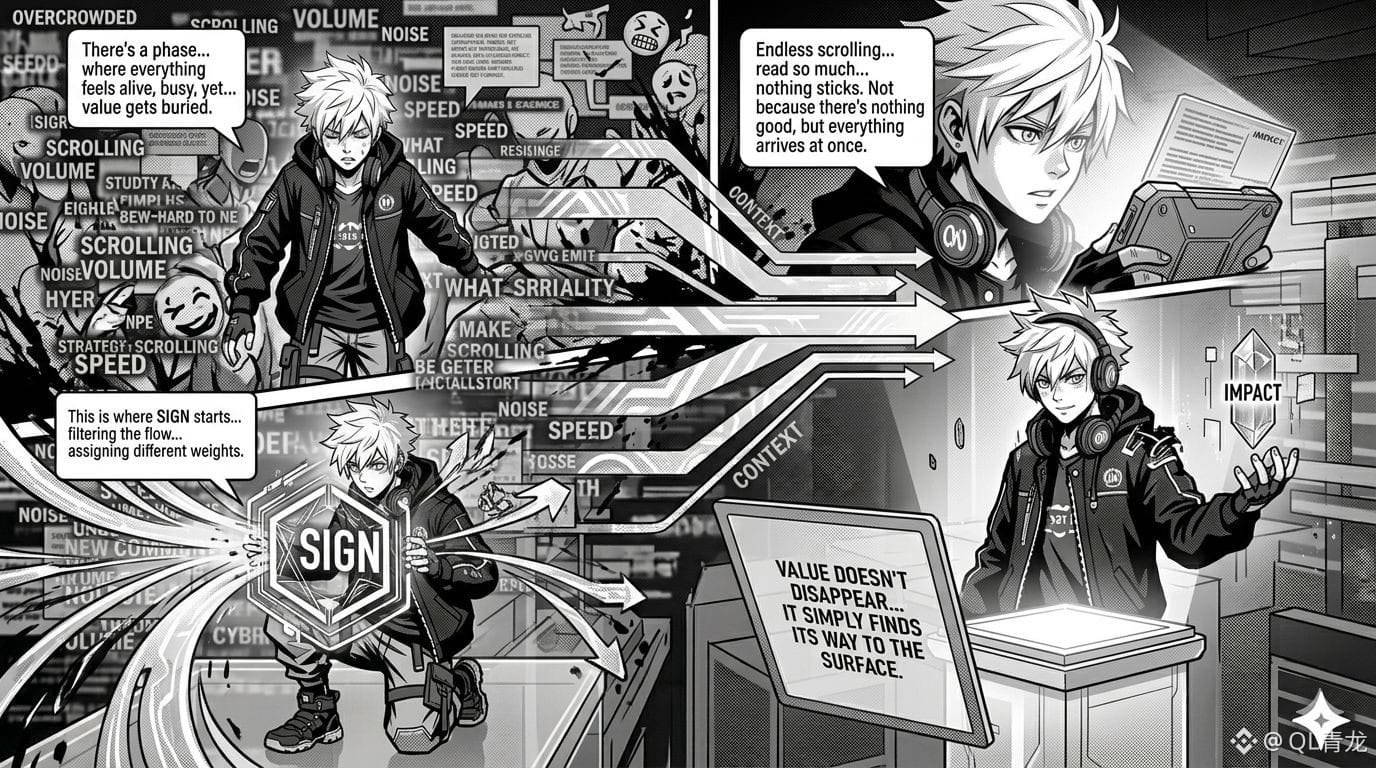
There’s a phase that often happens in many digital ecosystems: everything feels alive, busy, full of activity, yet strangely, it becomes harder to tell what actually matters. Everyone is moving, talking, appearing active. But in all that noise, value often gets buried.
I’ve been there. Endless scrolling, reading so much, yet nothing really sticks. Not because there’s nothing good, but because everything arrives at once, without clear structure. What rises to the surface isn’t what’s most meaningful, but what’s fastest or most frequent.
This is where SIGN starts to feel like a quieter, but deeper mechanism. It doesn’t try to speed up the flow, but to filter it. Not by removing anything, but by assigning different weights to each interaction.
What’s interesting is that SIGN doesn’t rely on volume. It doesn’t automatically amplify what’s loudest. Instead, it reads context, distinguishing which interactions truly resonate and which simply pass by. From there, layers begin to form, allowing value to surface instead of being lost.
This approach changes the experience of crowded spaces. It’s no longer about who is the loudest, but who actually has impact. SIGN helps bring forward things that were previously hidden beneath the noise.
On the other side, it also shifts how people interact. When systems stop rewarding sheer quantity, the way people contribute starts to change. There’s no longer a need to constantly appear, what matters is showing up with something meaningful.
What stands out is how SIGN doesn’t reduce the noise, but makes it more readable. Value doesn’t disappear in the crowd, it simply finds its way to the surface.
@SignOfficial #SignDigitalSovereignInfra $SIGN
