
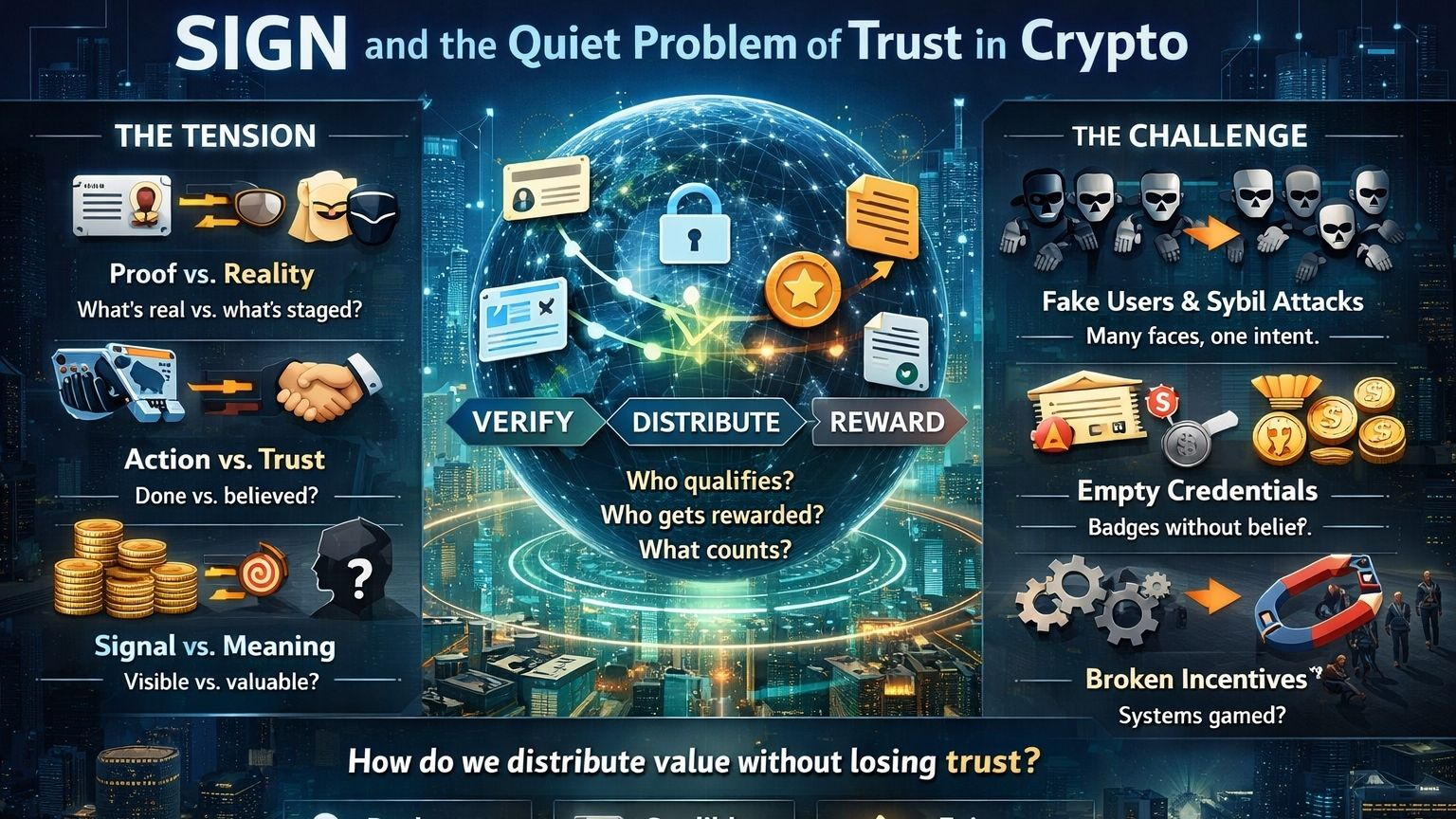
At first, SIGN felt like one of those projects I would read once, understand in broad strokes, and then forget by the next day. Crypto has a way of flattening everything into the same first impression. The names start sounding familiar, the ideas start folding into each other, and even the projects that are trying to do something useful often arrive wrapped in language that makes them feel more distant than they really are. Credential verification. Token distribution. Global infrastructure. I have seen enough of this market to know that those phrases can either point to something real or just sit there looking more important than they feel.
That was probably why I did not think much of it at first.
But the more I came across SIGN, the less it felt like just another project trying to position itself inside a trendy category. It started to feel like it was sitting near a problem that keeps coming back, no matter how many times crypto changes its vocabulary. Not a new problem. Not even a crypto problem, really. Just an old question that keeps showing up in new systems. How do you know what is real, what should count, and who should receive something when every signal can be copied the moment it starts to matter?
That is the part that stayed with me.
A lot of projects talk about distribution as if distribution is the easy part. Build something, launch a token, reward users, move on. But anyone who has watched this space closely knows that distribution is never just distribution. The second value enters the picture, everything gets harder. The question is no longer only who showed up. It becomes who actually participated, who actually contributed, who is real, who is pretending, and what kind of proof is enough to make that distinction without turning the whole thing into a mess.
That is where SIGN started to feel more serious to me.
Not because it comes with some giant promise, but because it seems to understand that the real difficulty is not handing something out. The real difficulty is making that process mean something. Crypto has spent years pretending that visible activity and meaningful participation are basically the same thing. A wallet interacts with an app, signs a few transactions, mints something, bridges funds, maybe votes once, and suddenly that activity gets treated like evidence of belonging. But that is not always true. Sometimes activity is just activity. Sometimes it is curiosity. Sometimes it is farming. Sometimes it is a script. Sometimes it is someone showing up only because they expect a reward later.
The chain records what happened, but it does not tell you what it meant.
That gap is where so much of the trouble begins. And it is also where SIGN seems to be paying attention. What interested me was not just that it deals with credentials or verification, but that it sits in the uncomfortable space between proof and trust. That space matters more than people like to admit. Every system wants reliable records, but a record is never the whole story. Every system wants fair distribution, but fairness gets complicated the second people learn what qualifies them. Every system wants openness, but total openness tends to invite imitation, manipulation, and noise. So you end up with the same tension over and over again. You want inclusion, but you also want protection. You want proof, but you do not want to demand too much. You want trust minimized, but you still need some reason to believe the record in front of you means anything.
That is not a glamorous problem. It is actually a pretty awkward one. Which is probably why I kept coming back to SIGN. It did not feel like it was trying to turn that awkwardness into a slogan. It felt more like it was built around the fact that this problem does not go away just because people prefer cleaner narratives.
The more I thought about it, the more the project stopped looking like simple infrastructure and started looking like a response to a deeper kind of friction that has always existed. Outside crypto, systems have always had to decide what counts as valid proof. A certificate, an ID, a document, a stamp, a signature, a list, a record. All of those things are meant to reduce uncertainty, but none of them fully remove it. They just create a version of reality that institutions can work with. Sometimes that works well enough. Sometimes it breaks down. Sometimes the record becomes more important than the truth it was meant to reflect.
Crypto did not invent that problem. It just made it easier to see.
That is why a project like SIGN feels more important the longer you sit with it. Not because it is loud, and not because it tries to present itself as some giant turning point, but because it is circling a question that almost every network eventually runs into. How do you verify people, actions, or claims in a way that can actually support real distribution without collapsing into pure theater? How do you give tokens, access, or recognition to the right people when the wrong people are often very good at looking right? How do you make credentials useful without turning them into empty badges or rigid gates?
I do not think there is a perfect answer to any of that. Maybe that is part of why the project feels more human to me than a lot of crypto writing around similar themes. The problem itself does not allow for neat certainty. Every time a system creates a signal that matters, people start optimizing for the signal. Every time a credential becomes valuable, it stops being just a record and starts becoming a target. Every time a distribution model seems fair, it eventually gets tested by behavior that the designers did not fully account for.
That is just how these systems work. Incentives always reach the weak spots eventually.
So when I look at SIGN now, I do not really see it as just a tool for verification or token distribution. I see it as a project trying to work around one of the oldest weaknesses in open systems: the distance between what can be recorded and what can actually be trusted. That distance is small enough to ignore when nothing is at stake. It becomes much harder to ignore when money, ownership, access, or legitimacy starts depending on it.
And that is really what makes the project interesting to me. It is not only about moving tokens or attaching credentials to identities. It is about trying to make systems more believable at the exact point where belief usually starts to break down. That point matters. Because once distribution loses credibility, communities start to feel hollow. Once credentials lose meaning, participation becomes performance. Once proof becomes too easy to fake, trust does not disappear completely, but it becomes fragile, cynical, and expensive.
I think that is why SIGN kept returning to my attention when a lot of other projects didn’t. It was not because it looked extraordinary from the start. It was because the closer I looked, the more it seemed to be dealing with something stubborn and real. Something that keeps resurfacing across crypto in different forms. People want open systems, but they also want those systems to recognize genuine participation. They want fair access, but they do not want value leaking to whoever is best at gaming the process. They want trustless environments, but they still need some kind of record that can stand in for trust when decisions have to be made.
That is not easy to build around. It probably never will be.
Maybe that is why the project stayed with me. It does not feel like it is trying to force itself into importance. It feels more like it became harder to ignore once I realized what kind of problem it was actually sitting beside. Not a flashy one. Not the kind that gets people overly emotional for a week. Just a real one. Quiet, structural, and much older than crypto itself.
And maybe that is enough. Sometimes the projects worth paying attention to are not the ones that sound the biggest on first contact. Sometimes they are the ones that seem ordinary until you notice they are touching the part of the system that most people still do not know how to handle. SIGN feels closer to that kind of project. Not because it answers everything, but because it is working around a question that still has not gone away.