
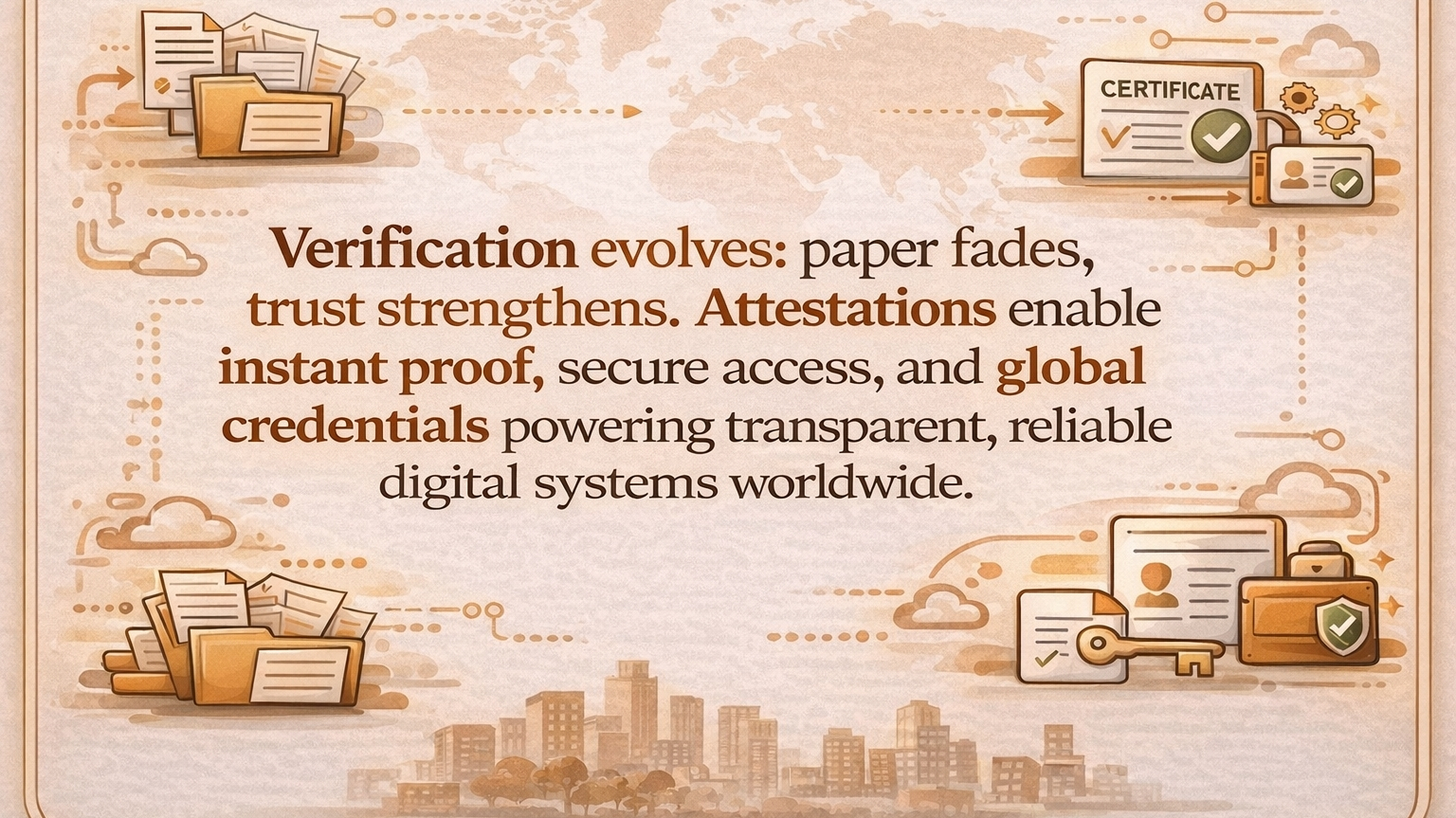
Every system eventually runs into the same old, messy problem: proof.
Not the philosophical kind, but the boring, everyday kind that shows up everywhere. Did this person actually graduate?
Does this wallet belong to a real human? Is this certificate valid, expired, revoked, or quietly forged somewhere?
Right now, the way we handle these questions is like a tired office clerk on a Friday afternoon: send the PDF, attach the scan, wait for confirmation.
Sometimes it takes three days. Verification today is far from a sleek digital system. It’s more like a stack of manila folders being passed from desk to desk, with very little trust between people.
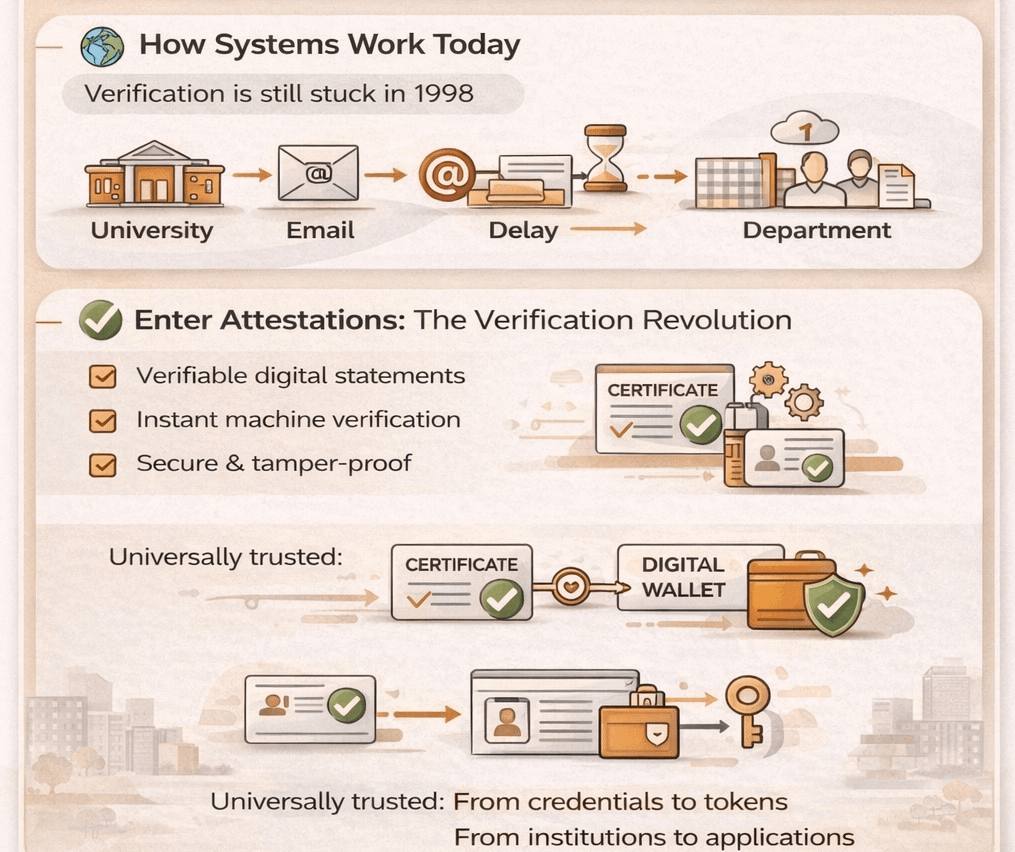
Imagine a university registrar’s office. Thousands of records. Some digitized, some half-digitized, some stuck in dusty archives.
Now imagine a company in another country trying to verify one of those degrees. An email goes out.
Two days later, a reply arrives. Another department needs to confirm it. Eventually, someone says,
“Yes, that looks correct. Maybe.” This isn’t infrastructure it’s improvisation. And the same chaos exists in licenses, certifications, identity checks, and access permissions.
The modern internet runs on proof, but most of that proof still moves like paperwork from 1998.
Computers don’t trust vague statements. They need something concrete, mechanical, something they can verify without calling someone.
The system needs a new kind of object. Not a document, but a statement: “This person passed this course,”
“This wallet controls this credential, or “This user is allowed inside the system.” These small claims are digitally signed and machine
readable. They are called attestations: small claims with cryptographic proof.
An attestation isn’t just a claim it’s backed by proof. Traditional documents can be fragile, editable, or forged.
Attestations can be verified instantly by machines
. No phone calls, no inbox searches, no human confirmations. It works like a neighborhood watch log:
each entry shows who reported what and when. If anyone tries to rewrite history, everyone notices.
Here’s where it gets interesting. Once a credential exists as a verifiable statement, you can attach tokens.
A verified student could receive a scholarship token. A licensed doctor could unlock access to medical systems. A developer who completes a course could earn governance rights in a protocol. The credential becomes the gate, and the token becomes the key.
Token distribution, however, is often the hardest part. Who qualifies?
Who doesn’t? Who is trying to game the system?
The crypto world is full of clever actors creating hundreds of wallets to catch free tokens. Projects often resort to messy filters, half-baked reputation systems, and complicated eligibility rules.
Sometimes effective, rarely elegant.
Systems like SIGN are building a global layer where institutions, applications, and protocols can issue attestations that machines actually trust. Universities can publish credentials. Organizations can grant permissions. Protocols can distribute tokens based on verified
achievements.
No endless PDFs.
No manual confirmations.
No guessing. Proofs move between systems like standardized shipping containers.
The internet first solved communication.
Then payments. Then media. Now it’s tackling something oddly bureaucratic: verification. When machines can reliably answer,
“Is this claim real?” without human intervention, friction disappears. Hiring becomes faster and safer. Education becomes more transparent and trusted.
Governance and online identity improve. If this verification layer becomes universal, every credential, permission, and qualification can be automated, secure, and globally trusted.
This system might look boring, but it’s foundational internet infrastructure.
Like TCP/IP once seemed mundane but now runs the world, a universal verification layer replaces slow, inconsistent, error-prone proof with fast, automated, verifiable statements. It reduces human error and increases trust.
In short, projects like SIGN aren’t just technical tools.
They are laying the foundation for a new web, where proofs are instant and reliable, permissions and access are simple to manage, and tokens and rewards are fair and secure. This is the future of digital trust networks.
