
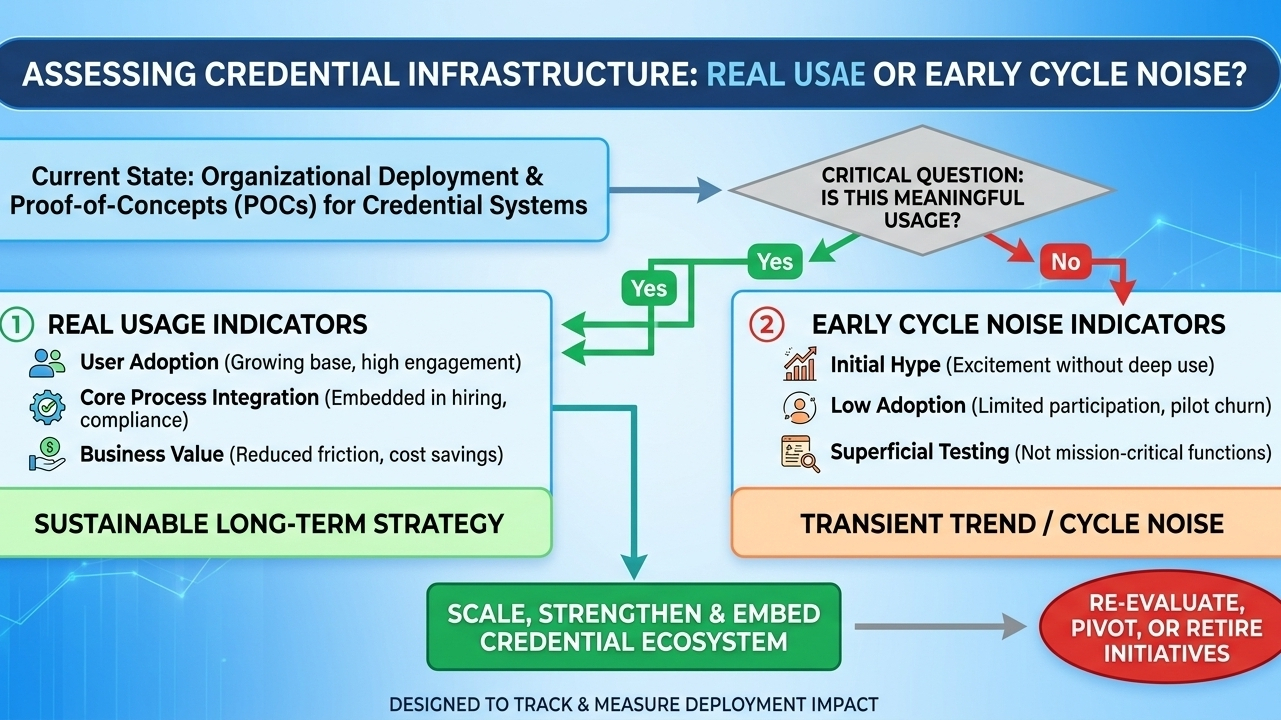

I’ve been thinking about SIGN lately in a way that feels less like “researching a token” and more like trying to understand whether I’m watching infrastructure being born—or just another well-packaged narrative riding early liquidity.
SIGN calls itself “Global Infrastructure for Credential Verification and Token Distribution,” which is a big sentence for something that, in practice, is trying to do a very simple but difficult thing: prove that something happened off-chain, and make that proof usable on-chain without rebuilding trust systems every time.
When I first came across it, I didn’t feel excitement. It was more like hesitation mixed with curiosity. Because I’ve seen this pattern before—identity, reputation, attestations, “trust layers”—they all sound inevitable in theory. But in crypto, inevitability doesn’t matter as much as repetition. The question is always the same: does anyone keep using it after the incentives stop?
From a token perspective, SIGN doesn’t try to hide its structure. The total supply is 10 billion, and what matters more than the number itself is how slowly and steadily it enters circulation. Only a small portion is initially liquid, while the rest is tied up in long vesting schedules across team, investors, foundation, and ecosystem allocations. On paper, that looks responsible. In reality, I’ve learned to translate it differently: it means supply pressure doesn’t hit all at once—it drips in over time, and the market has to continuously absorb it.
And markets don’t always price that correctly early on.
What usually happens in tokens like this is not hidden. You get the same rhythm every time: listing excitement, airdrop claims, liquidity inflows, then fast rotations as early recipients exit or rebalance. Volume spikes look like adoption if you’re not paying attention, but a lot of it is just mechanical movement—people moving tokens because they have them, not because they’re using the system.
SIGN has had those typical early lifecycle moments: exchange exposure, distribution events, and short bursts of attention that don’t necessarily tell you anything about real demand. I don’t count that as usage anymore. I just see it as the market doing what it always does in the first phase—discovering price, not value.
The real idea behind SIGN is actually more interesting than the trading behavior. If you strip away the token, what it’s trying to build is a kind of shared verification layer. Instead of every app building its own system for “who did what” or “who qualifies for what,” you get a reusable attestation system. Heavy logic happens off-chain, and what gets recorded on-chain is just the proof that something is valid.
That matters because it solves a real scaling problem. On-chain computation is expensive and limited. Off-chain systems are cheap but untrusted. SIGN sits in the middle, trying to bridge that gap.
But I keep coming back to a simple thought: just because something is useful in theory doesn’t mean people will actually integrate it in practice. Developers are lazy in a rational way—they only adopt infrastructure that clearly improves their product or gives them immediate distribution benefits.
And that’s where my skepticism starts.
Right now, I don’t see enough evidence that SIGN has crossed from “interesting infrastructure idea” into “habitual usage layer.” I don’t see strong signals of repeated, organic attestation activity that continues regardless of incentives. What I mostly see is early-cycle behavior—flows driven by listings, claims, and token movement rather than deep, repeated interaction with the protocol itself.
That difference matters more than most metrics people look at.
Because a protocol like this doesn’t succeed on hype cycles. It succeeds if it quietly becomes something developers rely on without thinking about it. If applications are still generating attestations a year from now without needing rewards to justify it, then it starts to feel real. If not, it slowly fades into the category of “good idea that never became necessary.”
My position on SIGN is still not conviction, but it’s not dismissal either. It feels like one of those projects where the architecture is ahead of the usage curve—and in crypto, that gap can either close naturally or stay open forever.
What I’m watching closely isn’t price. It’s whether activity becomes boring in a good way. No spikes around listings. No dependency on incentives. Just steady, unremarkable usage that continues even when nobody is paying attention.
If that ever shows up, I’ll change how I think about it immediately.
Until then, I’m staying in that familiar trader mindset: interested, cautious, and quietly waiting to see whether this is real infrastructure forming under the noise—or just another early cycle story that only looks meaningful while liquidity is still rotating through it.
@SignOfficial #SignDigitalSovereignInfra $SIGN
