
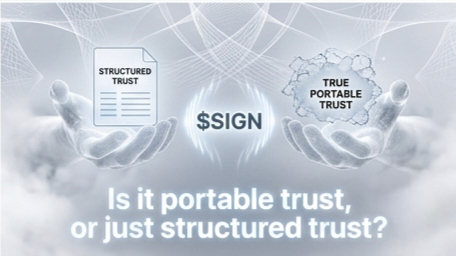

I wasn’t planning to write today. I actually told myself I’d take a break. But something about this moment feels different. It’s not just the end of a campaign I’ve been following. It feels like the end of a phase… or maybe the beginning of a more uncomfortable way of thinking.

I’ve been watching this space for a while now, and if I’m being honest, I keep seeing the same patterns repeat. Hype builds, attention spikes, prices run, then everything cools down. Then it starts again. It’s almost rhythmic. Predictable in a strange way. And sometimes, when I step back, I can’t help but feel like we’re not really building systems… we’re building loops. Small, self-contained cycles designed to hold attention just long enough.
There are moments when it genuinely feels less like infrastructure and more like a casino. That thought doesn’t sit well with me, but it keeps coming back.
And then, every once in a while, something slightly different shows up. Not loud. Not overly polished. Just… different enough to make me pause.
That’s how I came across $SIGN.
At first, I didn’t take it too seriously. I’ve seen enough projects wrap themselves in big words like “sovereign infrastructure” to know that narratives can be powerful, sometimes more powerful than the tech itself. So yeah, I was skeptical. But curiosity got the better of me, and I decided to look a little deeper.
What I found was interesting. Not perfect, not fully convincing, but definitely worth thinking about.
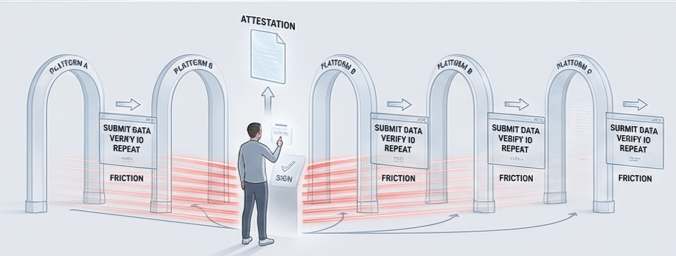
From what I understand, Sign is trying to tackle a very specific kind of problem. Not the abstract, philosophical idea of trust that we often talk about in crypto, but something more practical. Something like… “prove something once, without exposing everything, and be able to use that proof again.”
That idea sounds simple when you say it out loud. Almost obvious. But when I thought about how things actually work today, it started to click.
Right now, we repeat ourselves constantly. We verify the same identity across different platforms. We submit the same data again and again. Every system wants its own version of the truth. And we’ve just accepted that as normal.
Sign comes in with a different approach. I see it as them saying, “Attest once… and carry it with you.”
A credential gets issued. A validator confirms it. And then, instead of starting from scratch every time, that same credential can be reused across multiple applications.
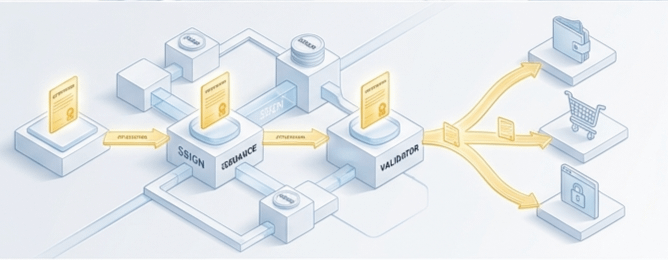
From a technical point of view, I get the appeal. It reduces friction. Cuts down latency. Lowers costs. It feels cleaner. More efficient.
But the more I sat with it, the more a small doubt started forming in the back of my mind.
Because reality isn’t static.
A credential might represent something true at a specific moment. But people change. Context shifts. Situations evolve. What’s valid today might not be relevant tomorrow.
So I keep wondering… is the system only checking if something is valid, or is it capable of understanding whether it’s still meaningful?
That’s where things get a bit uncomfortable for me.
The architecture itself is elegant. I actually like how clearly it’s structured. There’s issuance, then validation, then usage. It’s neat. Logical. Easy to follow.
But life doesn’t really work in neat layers like that.
What happens if a validator is slow? Or if two platforms interpret the same credential differently? What if something is technically valid but practically outdated?
I don’t think those failures would show up immediately. It wouldn’t be a dramatic collapse. It would be quieter than that. A slow drift. A mismatch between what the system believes and what reality actually is.
And then there’s governance, which honestly might be the most important piece.
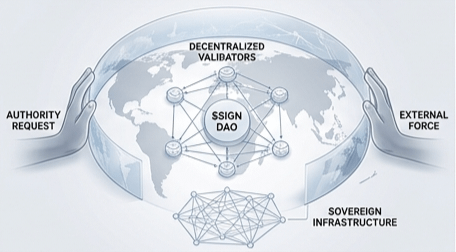
If you’re building something that calls itself “sovereign infrastructure,” then control becomes a real question. Who defines what counts as valid proof? Who sets the standards? And what happens when external forces get involved?
If a government or authority demands that a certain identity be revoked, does the system resist that? Or does it comply?
I don’t think technology alone can answer that. It wants to stay neutral, but the moment it interacts with the real world, neutrality becomes complicated.
Then there’s the market side of things, which I can’t ignore.
After its token launch back in April 2025, $SIGN followed a pattern I’ve seen many times before. Initial excitement, a strong price push, then a sharp correction. The numbers were intense. A rapid climb to its peak, followed by a steep drop in a very short time.
At first glance, it looks brutal. But in this space, it’s almost normal.
What caught my attention more was the recovery afterward. That bounce suggests there’s still some level of belief. People haven’t completely walked away.
At the same time, the gap between market cap and fully diluted valuation is hard to ignore. It tells me that future supply could create pressure. And no matter how strong the idea is, token dynamics always find a way to matter.
Still, what stayed with me the most throughout all of this wasn’t the price action or even the architecture. It was the feeling that this project isn’t trying to impress instantly. It doesn’t shout. It doesn’t overwhelm you with hype.
Instead, it quietly pulls you into a question.
Are we actually solving problems, or are we just reorganizing them?
We often say that blockchain removes friction. But lately, I’ve started to wonder if we’re just moving that friction somewhere less visible. Somewhere harder to measure.
Maybe that’s why this doesn’t feel like an ending to me.
If anything, it feels like the point where the real questions begin.
Can something like this scale without losing accuracy?
Can different systems stay aligned over time?
Can a proof remain meaningful when the world it represents keeps changing?
And the one question I keep coming back to, again and again…
Am I looking at a system that truly makes trust portable… or just one that structures it in a cleaner, more convincing way?
