
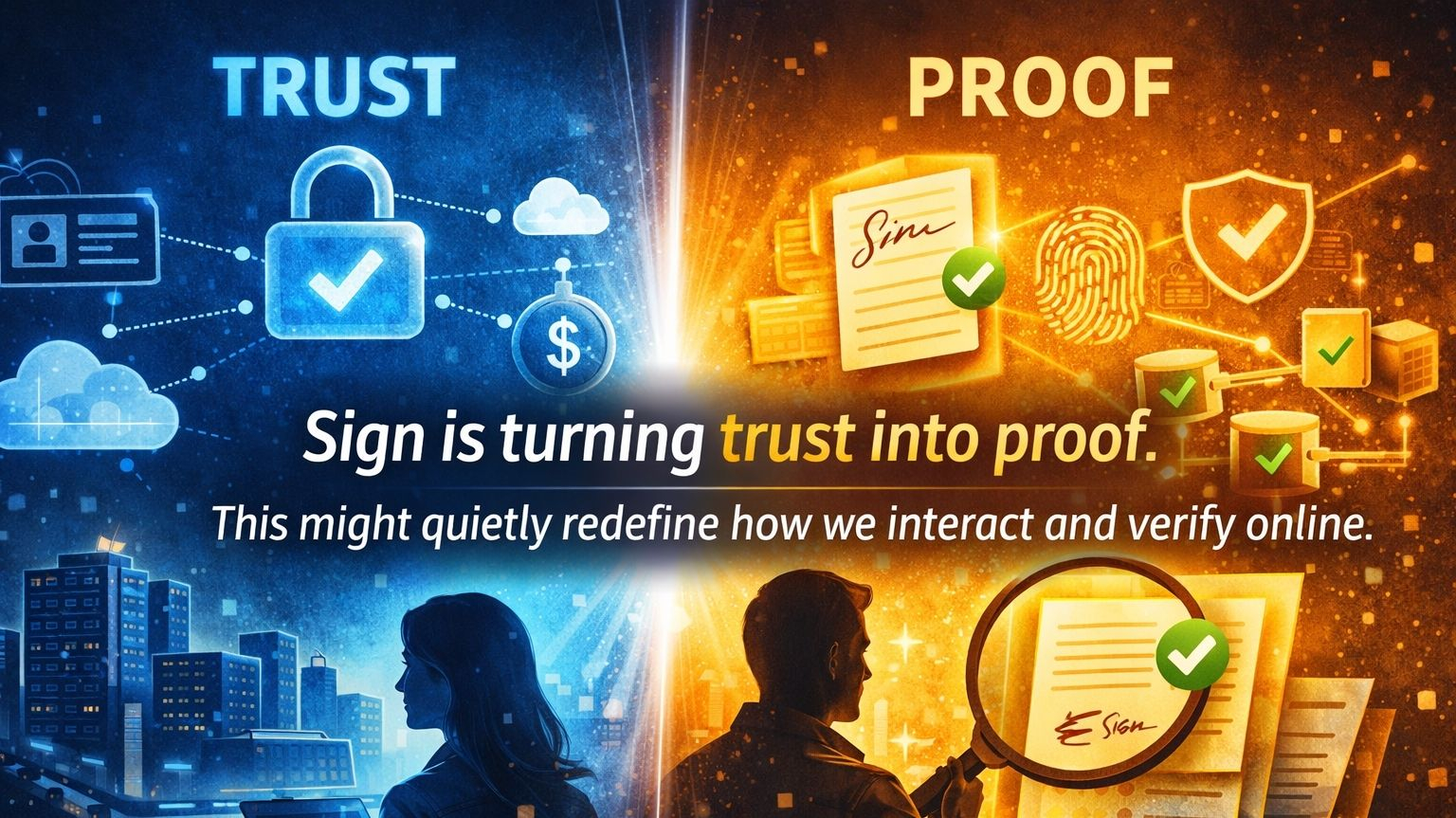
I used to think the internet worked because it was smooth and fast. Everything felt easy. I could sign documents, verify my identity, and use apps without thinking much. But when I slowed down and really looked at it, I realized something important. Most of what I do online is not truly verified. It is just trusted. I trust platforms to store my data. I trust systems to confirm who I am. I trust that things are fair. And in most cases, I cannot check any of it myself. That is where Sign started to make sense to me in a deeper way.
The main idea behind Sign is simple, but powerful. Instead of asking people to trust systems, it focuses on making things provable. It turns actions into something called attestations. These are records that prove something actually happened. Not just stored somewhere, not just claimed by a platform, but something that can be checked by anyone. This small shift changes everything. It means I do not have to depend only on what a system tells me. I can verify it myself.
When I think about how this works in real life, identity is the first thing that comes to mind. Right now, proving who I am online usually means giving my personal data to a platform. That platform stores it, controls it, and decides how it is used. My identity becomes something I do not fully own. With attestations, identity becomes something I carry. It is backed by proofs, not just stored data. That feels very different. It gives me more control and more confidence.
The same idea applies to agreements. When I sign something online, I trust that the platform will keep it safe and unchanged. But what if that agreement existed as a proof that anyone could verify, even without the platform? That would make it stronger and more reliable. It would not depend on a single system staying active or honest.
One thing I like about Sign is that it does not force everything to be public. Some systems make everything visible, which is not always practical. Many things need privacy. Sign allows attestations to be public, private, or even hidden while still being verifiable. That means I can prove something is true without sharing all the details. This balance feels more natural and closer to how trust works in real life.
As I explored more, I started to see that this is not just about small use cases. Sign is growing into something bigger. It is becoming a layer that can support identity, money flow, and coordination between people and systems. Instead of each platform creating its own version of trust, they can use shared proofs. That makes everything more connected and more reliable.
This becomes very important when we talk about fairness. Many systems today say they are fair, but we cannot really check. Whether it is rewards, access, or decisions, we are often asked to believe things without proof. With attestations, these processes can be recorded in a way that anyone can verify. It does not remove trust completely, but it reduces blind trust. I can see what actually happened instead of just believing it.
Of course, this idea is not perfect. There are challenges. One big challenge is usability. Most people do not think about proofs. They just want things to work easily. For Sign to grow, it has to feel simple. The technology should stay in the background, while the benefits are clear and easy to understand.
Another challenge is making sure different systems can work together. If every platform uses attestations in a different way, it can create confusion. There needs to be some level of consistency so that proofs can move across systems without losing meaning.
There is also the question of incentives. A system like this needs people to create and use attestations honestly. If there is no clear benefit, participation can drop. Designing the right balance is not easy, but it is important for long-term success.
Even with these challenges, the direction feels very important. The internet has already changed many times. First it was about sharing information. Then it became interactive. Now it feels like it is moving toward something new, where information is not just shared but proven. That changes how we use it and how we trust it.
Today, we live in a world full of information, but not always full of certainty. We see claims everywhere, but we often cannot verify them. Most solutions try to fix this by adding more control or stronger platforms. Sign takes a different path. It focuses on proof instead of authority. It asks not who we should trust, but how something can be proven.
What I find most interesting is that this change does not need to happen all at once. It can grow slowly. Step by step, more systems can start using proofs. Over time, the need for blind trust can reduce naturally. It is not about replacing everything, but improving what already exists.
I keep thinking about how much of the internet depends on trust as a shortcut. It makes things easy, but it also hides risk. When something fails, we realize how little control we actually have. By adding proof, Sign gives a better option. It keeps things simple but makes them more reliable.
For me, this feels like a shift in mindset. Instead of trusting systems without question, I can check things myself. Instead of hoping processes are fair, I can see evidence. That small change makes a big difference in how I experience the digital world.
That is why Sign stands out to me. It is not just another tool. It is solving a deeper problem that has always been there. The gap between what we believe and what we can prove. Closing that gap can make the internet more reliable, more transparent, and more aligned with the people who use it.
If this idea continues to grow, it could change how we interact online. Not by removing trust completely, but by making it stronger through proof. It gives us a way to move from assumption to verification, from dependence to control. And in a world where so much of life is online, that kind of change matters more than we think.
