
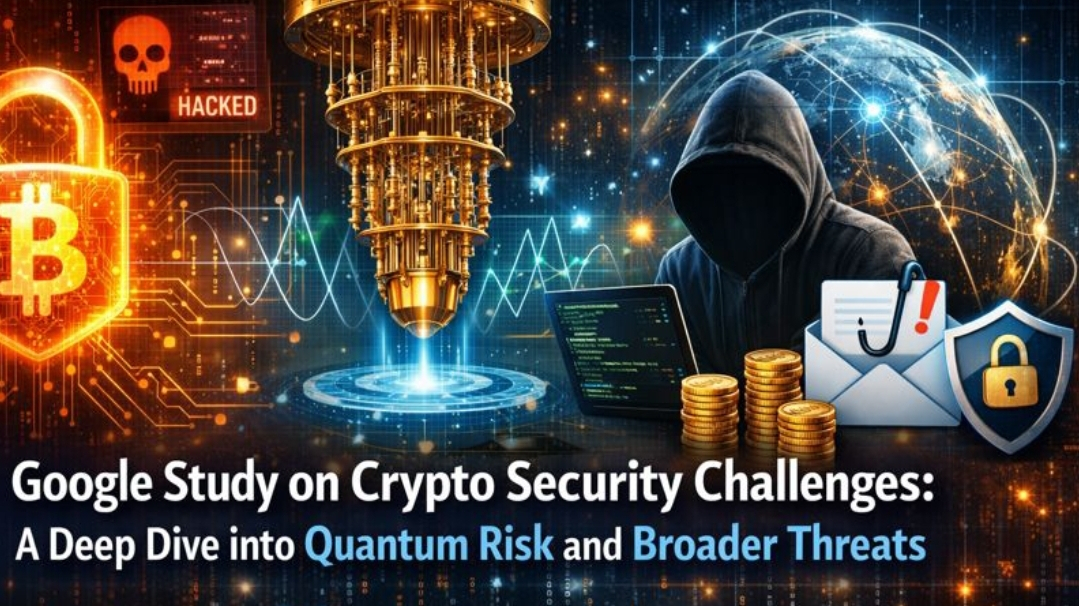

In early 2026, Google’s quantum computing research team published a paper that has sent shockwaves through the cryptocurrency community. The study examines how advances in quantum computing could fundamentally undermine the cryptographic foundations that secure major cryptocurrencies — especially Bitcoin and Ethereum. This research highlights new timelines, new threat estimates, and urgent calls for the crypto ecosystem to adapt.
This article synthesizes the latest Google research findings, explains the cryptographic vulnerabilities, explores the implications for blockchains and wallets, and places them within the broader landscape of crypto security challenges.
1. What Did Google Publish? An Overview of the Research
Google’s Quantum AI team — in collaboration with academic partners including Stanford and the Ethereum Foundation — released a detailed quantum threat analysis focusing on the cryptography that protects blockchain networks.
At its core, the research warns that:
Quantum computers could soon be powerful enough to break elliptic‑curve cryptography (ECC), the algorithm used by Bitcoin, Ethereum, and most major cryptocurrencies.
New estimates suggest that fewer than 500,000 physical qubits — the fundamental units of quantum computation — might be enough to threaten current crypto protection systems.
If such machines were built, a sufficiently large quantum computer might derive a Bitcoin wallet’s private key from its public key in as little as nine minutes, enabling theft of funds during unconfirmed transactions.
This represents a 20‑fold reduction in the quantum resources previously estimated necessary to threaten these systems.
Google’s research paper is framed as an alarm — not because quantum machines exist today that can break ECC, but because progress is accelerating and the crypto ecosystem must prepare for a “post‑quantum” future.
2. Why Is Cryptography the Core of Crypto Security?
At a technical level, the security of most blockchains relies on two pillars:
Cryptography Protecting Keys
When you control cryptocurrency, what actually matters is the private key — a long string of numbers that proves ownership. The public key, derived from the private key, is routinely shared on public ledgers during transactions. The idea is that computationally infeasible math problems protect the private key from being derived from the public data.
Elliptic‑Curve Cryptography (ECC) is central here. It’s a strong mathematical foundation used by Bitcoin’s ECDSA signature scheme and by Ethereum’s cryptographic primitives. The entire security of transactions depends on this.
The Blockchain Consensus Mechanism
Separate from key cryptography, blockchains use consensus like Proof of Work (Bitcoin) or Proof of Stake (Ethereum) to ensure that transactions are validated and blocks are added correctly. Most consensus mechanisms themselves are not under immediate quantum threat — the risk is primarily in the signatures that authorize transactions.
3. What Is the Quantum Threat and Why Does It Matter?
Quantum computers are fundamentally different from classical computers. They exploit the laws of quantum mechanics, allowing them to solve certain math problems far more efficiently. One such attack is Shor’s algorithm, which — in theory — can break ECC and RSA cryptography.
According to Google:
A large‑scale cryptographically relevant quantum computer (CRQC) could be built with 500,000 physical qubits, not the millions previously assumed.
This could enable an “on‑spend attack” where a quantum attacker observes an unconfirmed transaction (public key visible in the mempool) and computes the private key fast enough to broadcast a fraudulent transaction before the legitimate one confirms.
Bitcoin’s ~10‑minute block time provides a critical window. In Ethereum’s case, faster block times translate to a somewhat reduced risk window, though other attack vectors on programmable smart contracts complicate the risk profile.
While this scenario is still theoretical — because no existing quantum computer has enough qubits — the pace of progress in quantum hardware, error correction, and logical qubit scaling has forced researchers to take these threats seriously.
4. Current Crypto Exposure: How Bad Is It Now?
Even though quantum computers of sufficient power do not yet exist, Google warns that:
Some cryptocurrency wallets already expose public keys (especially those that have participated in transactions), making dormant coins potentially vulnerable far before a global upgrade to post‑quantum standards.
Approximately 6.9 million Bitcoin from older address types are currently exposed to this theoretical threat.
Ethereum’s structure, with smart contracts and various key types, introduces multiple potential ways an advanced attacker could act.
This means that even dormant coins — which have not been moved in years — could be at risk if and when quantum devices mature enough to exploit ECC.
5. Industry Response and Post‑Quantum Cryptography
In response to the threat — and well before quantum computers achieve the necessary power — there are proactive solutions:
Post‑Quantum Cryptography (PQC)
PQC refers to cryptographic algorithms resistant to quantum attacks — typically based on lattice problems, hash‑based signatures, or other advanced math constructs. Standards bodies like NIST finalized PQC standards in 2024, and proposals are being integrated into blockchain systems.
Bitcoin’s BIP‑360 quantum‑resistant address proposal has already been merged and is being tested on testnets. If fully deployed, this would allow Bitcoin users to transition to quantum‑safe wallets.
Network Upgrades and Governance Challenges
However, because blockchain networks are decentralized, upgrades require broad consensus and adoption. Some major hurdles include:
Slow network upgrades (Bitcoin prioritizes stability)
Decentralized governance structures
Compatibility and migration complexities across billions in assets
This means that preparation may take years, even after safe cryptographic standards are ready.
6. Broader Crypto Security Challenges Beyond Quantum
While Google’s research highlights a future quantum threat, the crypto ecosystem already faces significant security challenges today:
User Awareness and Cybercrime
Kaspersky research shows that a large portion of crypto users are unaware of threats, and many have been hit by cybercrime, including scams, phishing, and malware — with significant numbers of users feeling current protections are ineffective.
Volatility and Adoption Barriers
Security concerns and volatility are also major barriers to broader adoption, with many users reluctant to hold or transact in cryptocurrencies because of perceived risk.
Existing Technical Vulnerabilities
Academic research underscores a wide class of existing blockchain vulnerabilities, from coding flaws in smart contracts to poorly maintained forks with unpatched security holes.
7. What Should the Crypto Ecosystem Do?
Experts agree that while quantum threats may be years away, preparation must begin now:
Prioritize post‑quantum cryptographic upgrades
Educate users and developers about quantum risks
Develop wallet standards that minimize public key exposure
Invest in blockchain security research and threat monitoring
Without action, the consequences of quantum breakthroughs could be severe: irreversible theft, catastrophic network compromise, and loss of trust in decentralized systems.
Conclusion
Google’s research into quantum computing and crypto security has reframed the discussion from “theoretical distant threat” to reachable future challenge. While quantum computers capable of breaking current cryptography do not yet exist, the rapidly evolving landscape suggests that the crypto community has limited time to adapt.
This is just one piece of the broader landscape of crypto security challenges, but its importance lies in the potential for fundamental cryptographic systems to be broken — undermining the trustless foundations that blockchains were built upon.
Cryptocurrencies must evolve not just technologically but also in terms of governance, education, and industry collaboration to survive and thrive in a quantum future.