
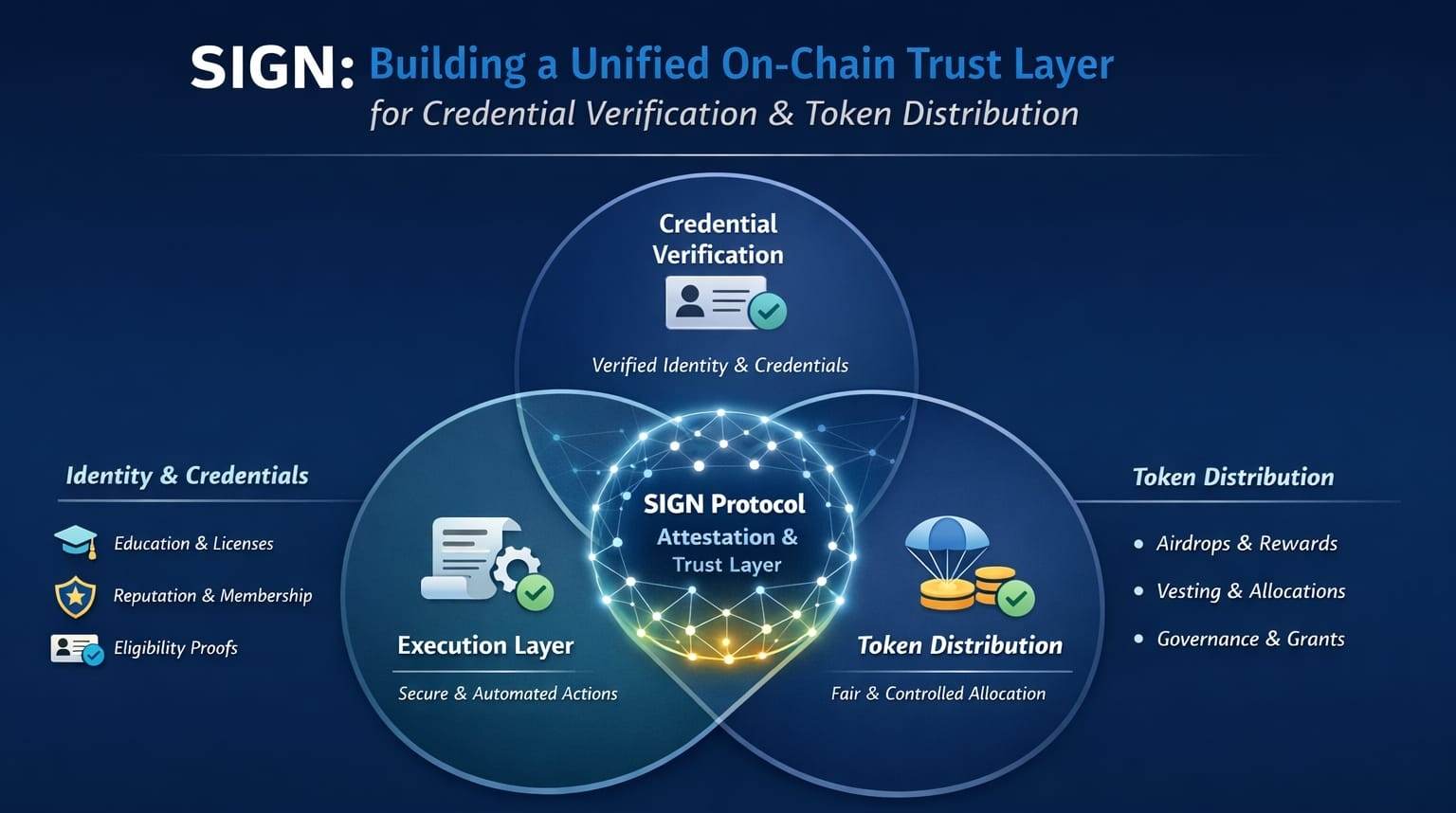
What keeps drawing me back to on-chain infrastructure right now is not the noisiest part of the market. It is not the usual burst of excitement around price, and it is not another cycle of short-term attention moving from one trend to the next. What I keep coming back to is something quieter, but much more important underneath the surface. I am watching the rise of systems that are trying to solve trust at the data layer, and to me, that is where the conversation gets serious. When I look at the idea of building a unified on-chain trust layer for credential verification and token distribution, I do not see a niche technical theme. I see a foundational shift in how crypto infrastructure may mature.
What stands out to me is that this problem is often framed too narrowly. A lot of people talk about identity in one corner, reputation in another, and token distribution somewhere else entirely. I do not read the market that way. I see these as deeply connected parts of the same coordination challenge. If credentials cannot be verified cleanly, transparently, and in a way that can move across systems, then distribution models eventually become messy. They become easy to exploit, difficult to audit, and hard to trust at scale.
That is where my focus shifts.
Because once token distribution grows beyond simple marketing campaigns and into something more serious, the standard gets higher. It is no longer enough to send assets around and hope the logic holds. The market starts needing proof. Who qualified? Why did they qualify? Was the process fair? Was it repeatable? Could it be audited later? I pay attention to questions like this because they sit at the core of whether a system can actually scale or whether it just looks good in a bullish phase.
This is why the idea behind a unified trust layer matters to me so much. It is not just about creating records on-chain. It is about creating a reliable evidence system that allows credentials, attestations, and eligibility signals to be structured in a way that other applications can actually use. That distinction matters. A lot of crypto products generate data. Far fewer generate trust.
And trust, in this context, is not a vague concept. It has to be portable. It has to be verifiable. It has to be easy enough for developers to plug into and strong enough for users or institutions to rely on. If every new project has to rebuild its own verification logic from scratch, the system does not scale properly. Friction increases. Errors multiply. The same trust problem keeps showing up in different clothes.
This is one reason I find the broader Sign framework interesting. What I see there is an attempt to connect identity, evidence, and execution into one coherent structure instead of leaving them as fragmented tools. That matters to me because fragmentation is one of the easiest ways for trust to break down. When records sit in one place, identity logic lives somewhere else, and token distribution happens through a disconnected mechanism, gaps appear. And markets are very good at exposing those gaps over time.
I do not ignore signals like this, especially when the product direction points toward standardization.
Because that is really the deeper opportunity here. Not simply issuing credentials. Not simply distributing tokens. But building a shared attestation layer that makes those actions more credible, more reusable, and more scalable across ecosystems. That is where I think many people still underestimate the category. Retail tends to react to the visible moment. An airdrop happens. A campaign trends. A token gets attention. But the deeper layer, the system deciding whether those actions are fair or trustworthy, usually receives far less discussion.
That does not mean it is less valuable. In many cases, it means the opposite.
What I keep noticing in this market is that the loudest narratives often sit on top of infrastructure that barely gets understood until much later. By the time the broader market realizes what is essential, the early signal has usually already been there for a while. This feels like one of those areas to me. Credential verification and token distribution may look like separate product categories at first glance, but when I study them more carefully, I see one shared requirement underneath both: reliable truth.
Without that, distribution becomes vulnerable to manipulation. Incentives become distorted. Sybil behavior becomes harder to contain. And the quality of participation starts getting diluted. That is not just a technical issue. It is a market quality issue.
I think this is where more mature capital starts looking differently from emotional participants. Retail often responds to outcomes. Smart money usually studies the mechanism producing the outcomes. That difference matters. One side chases events after they happen. The other side tries to identify which infrastructure becomes necessary if the market evolves in a more serious direction. I am always paying attention to that gap, because it often reveals where real opportunity is quietly building before the crowd fully understands it.
There is also another layer here that deserves more attention. A trust system is only as useful as its ability to integrate across real workflows. If the attestations cannot be indexed properly, queried efficiently, or used across applications without excessive friction, the promise stays theoretical. This is where I stay cautious. A good narrative is not enough. A protocol in this category needs actual utility at the infrastructure level. It needs composability. It needs a model developers want to build on. It needs to reduce complexity, not just rename it.
That is where my thinking becomes more practical.
I am not interested in whether a project can explain its vision in polished terms alone. I want to see whether that vision translates into real usage. I want to see credentials being used as meaningful gates for incentives, grants, access, benefits, or distributions that actually matter. I want to see proof that attestations are being treated as core infrastructure rather than decorative features attached to a campaign. If that happens consistently, then the trust layer begins to look less like an interesting concept and more like a necessary market primitive.
This is where I am watching closely going forward. I want to see stronger evidence of adoption quality, not just narrative momentum. I want to see whether verified credentials are becoming part of real capital coordination. I want to see whether projects use these systems to improve fairness, tighten eligibility, reduce abuse, and create better auditability around distributions. Those are the signals that matter to me.
Confirmation would not come from hype alone. It would come from repeatable use, from deeper integrations, from systems that clearly work better because verifiable trust is embedded into them. I would want to see better sybil resistance. Cleaner logic around who qualifies and why. More confidence in the rules behind token distribution. Stronger links between identity, evidence, and execution.
If I start seeing that consistently, my conviction increases.
If I do not, then I stay measured.
Because invalidation matters too. If adoption remains fragmented, if standards fail to spread, or if token distribution continues operating mostly on superficial engagement metrics instead of verifiable logic, then the category may take longer to mature than people expect. I do not force conviction where the market has not earned it. I stay patient when the idea is strong but the proof is still developing. That discipline matters more than enthusiasm.
This is also where I think many newer participants get trapped. They confuse a promising concept with a completed market structure. Those are not the same thing. A strong thesis still needs real confirmation. Price can move early. Narrative can move even earlier. But structure is what gives a thesis durability. I pay attention to that difference all the time, because it helps me separate what is exciting from what is actually building.
And that, to me, is the real importance of a unified on-chain trust layer.
The next stage of crypto will not be defined only by moving assets faster or making token systems more visible. It will also be defined by proving who qualifies, what is true, and why value is being distributed in a certain way. That is a more serious layer of market design. It is less flashy, but far more durable if executed well.
When I step back and review this theme honestly, that is the conclusion I keep returning to. This may not be the loudest opportunity in the market right now. It may not be the easiest story to package for short attention spans either. But some of the most important infrastructure trends rarely begin as obvious crowd favorites. They begin as quiet necessities.
And from where I stand, this looks increasingly like one of them.
@SignOfficial #SignDigitalSovereignInfra $SIGN
