
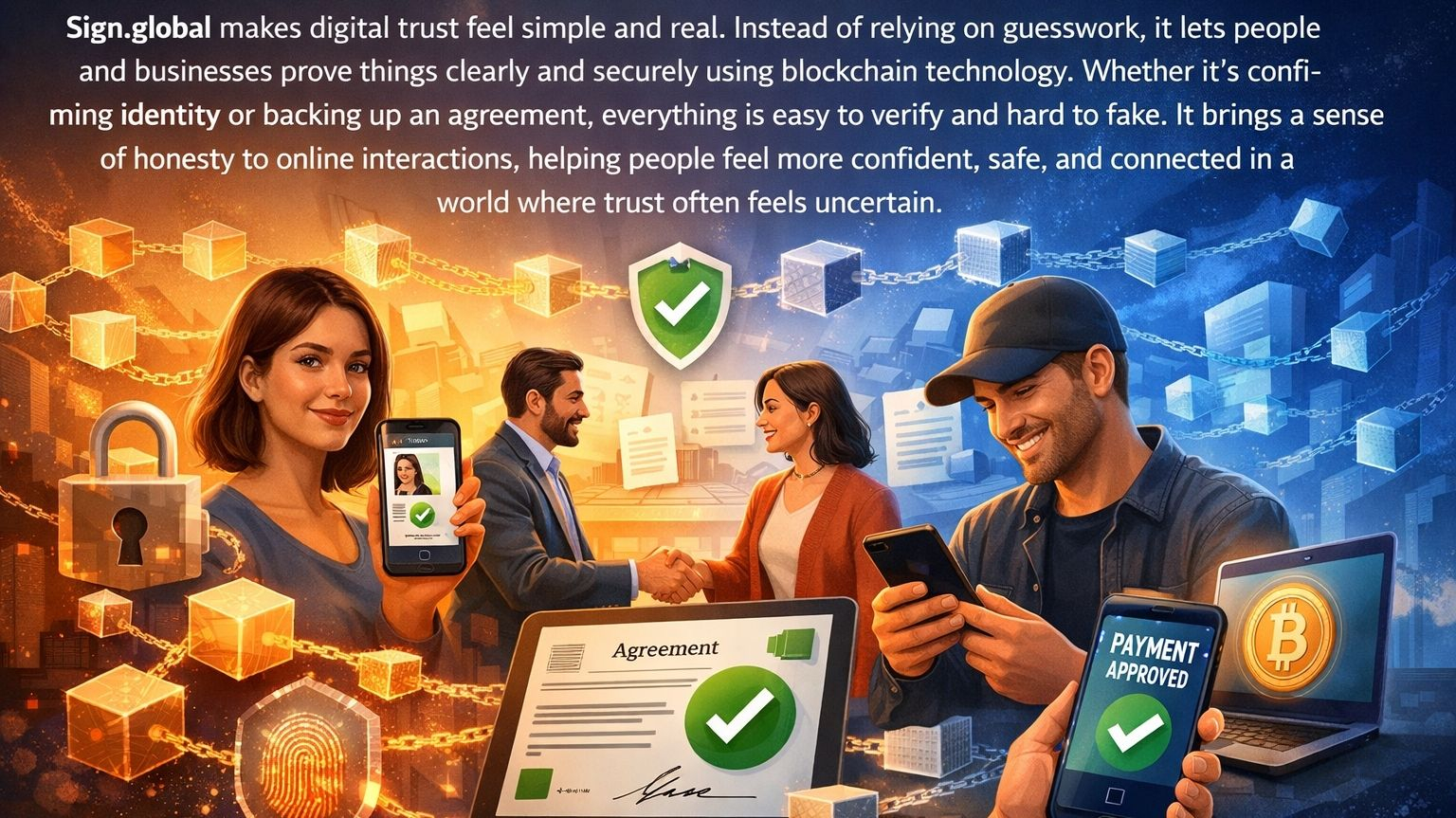
Trust is something we all rely on, often without thinking about it. We trust the documents we sign, the credentials people present, and the information we receive online. But in a world that is becoming increasingly digital, that trust is no longer as simple as it once was. Screens have replaced paper, identities are scattered across platforms, and verification often feels like a complicated process filled with uncertainty. This growing gap between interaction and assurance is exactly why solutions like Sign.global are becoming so important, quietly redefining how trust works in the modern age.
At a glance, the idea behind it feels refreshingly straightforward. Instead of asking people to blindly trust systems or institutions, it focuses on making trust something that can be proven. That small shift changes everything. Rather than depending on reputation alone or lengthy verification processes, individuals and organizations can rely on secure, verifiable proofs that confirm authenticity instantly. It transforms trust from something abstract into something tangible, something you can actually check and rely on without hesitation.
Think about everyday situations where trust plays a role. A freelancer shares their portfolio with a new client, a graduate applies for a job with academic credentials, or a business signs a digital agreement with a partner across the world. In each of these cases, there is always a moment of doubt, a silent question about whether the information is genuine. Traditionally, resolving that doubt takes time and effort. Emails are exchanged, references are checked, and documents are reviewed manually. With a verifiable system in place, that entire process becomes smoother and more reliable. Proof is no longer something that needs to be chased down; it is presented clearly and can be verified in seconds.
What makes this shift particularly powerful is how naturally it fits into the way people already work. There is no need for complex learning curves or technical expertise. The experience feels familiar, almost intuitive, which lowers the barrier to adoption. This is crucial because even the most advanced systems fail if they are too difficult to use. By keeping things simple and accessible, it ensures that trust is not just a feature for experts but a practical tool for everyone.
Another layer that adds to its appeal is transparency. Many traditional verification processes operate behind closed doors. You submit information and wait, hoping that everything is handled correctly. There is very little visibility into how decisions are made or how data is processed. A more open approach changes that dynamic. When verification becomes something that can be independently checked, users gain confidence not only in the result but also in the process itself. That sense of clarity builds a deeper kind of trust, one that feels earned rather than imposed.
For organizations, this approach offers more than just convenience. It addresses long-standing inefficiencies that slow down operations. Onboarding employees, verifying partners, and ensuring compliance often involve repetitive steps that consume both time and resources. By using reusable, verifiable credentials, these processes can be streamlined significantly. A single piece of verified information can serve multiple purposes, reducing duplication and minimizing the chances of error. Over time, this creates a smoother workflow that allows businesses to focus on what truly matters instead of getting stuck in administrative loops.
There is also a human side to this transformation that often goes unnoticed. Not everyone has equal access to reliable systems of verification. In many parts of the world, proving identity, education, or work experience can be challenging due to fragmented records or limited infrastructure. A system that allows individuals to carry their own verifiable credentials changes that reality. It gives people control over their achievements and identity, making it easier to access opportunities regardless of location or background. In that sense, it is not just about technology; it is about empowerment.
Of course, any shift in how trust is managed comes with its own set of challenges. One of the biggest hurdles is adoption. For a system like this to truly make an impact, it needs to be widely accepted and used across different platforms and industries. If only a small group participates, its benefits remain limited. That is why building an ecosystem is so important. When more organizations and individuals start using a shared framework for verification, the value of the entire system grows. Each new participant strengthens the network, making it more useful for everyone involved.
Another challenge lies in understanding. Concepts like digital verification and cryptographic proof can feel unfamiliar or even intimidating to many people. There is often a natural hesitation when it comes to adopting new ways of handling something as sensitive as trust. Overcoming this requires clear communication and thoughtful design. When people see how easily these systems fit into their daily lives, and when they understand the benefits without needing to dive into technical details, that hesitation begins to fade.
Privacy is another area where misconceptions often arise. It is easy to assume that increased verification means more data exposure, but the reality can be quite the opposite. With the right approach, users can share only the information that is necessary for a specific purpose. Instead of handing over entire documents, they can provide precise proofs that confirm a claim without revealing unnecessary details. This selective sharing not only protects privacy but also builds confidence in the system itself.
The practical applications of this approach are wide-ranging. Digital signatures, for example, are something many people use regularly, yet they often rely on centralized services that can create dependencies. A more decentralized method ensures that signatures remain valid and verifiable independently of a single authority. This reduces risks and provides a stronger foundation for agreements, especially in situations where trust is critical.
Content authenticity is another area where this shift can make a significant difference. With the rise of manipulated media and misinformation, it has become increasingly difficult to determine what is real. A system that allows content to be verified at its source adds a valuable layer of credibility. Whether it is a piece of art, a document, or a digital post, having a verifiable origin helps users make more informed decisions about what they choose to trust.
One of the most interesting aspects of this evolution is how it blends into existing workflows rather than disrupting them entirely. People do not need to abandon their current tools or habits. Instead, they enhance them with an added layer of trust. This gradual integration makes the transition feel natural and manageable. It is not about forcing change but about offering a better way that people can adopt at their own pace.
For individuals, this opens up new possibilities in how they present themselves and their work. Professionals can maintain a collection of verified credentials that speak for them instantly. Creators can establish ownership of their work in a way that is both secure and portable. These capabilities not only protect against misuse but also create opportunities for recognition and growth that were previously harder to achieve.
Businesses, on the other hand, can use this approach to strengthen their relationships with customers and partners. In a competitive environment, trust can be a powerful differentiator. Being able to provide clear, verifiable proof of claims builds confidence and credibility. Over time, this can lead to stronger connections and a more loyal customer base, as people naturally gravitate toward brands they can rely on.
As this space continues to evolve, it is likely that expectations around trust will change as well. People may begin to expect proof as a standard part of digital interactions rather than an added bonus. This shift could lead to a more transparent and accountable digital landscape, where authenticity is not questioned as often because it can be easily verified.
Ultimately, the real value of this approach lies in how it redefines the relationship between people and the systems they use. It moves away from blind trust and toward informed confidence. It gives individuals more control, reduces friction in interactions, and creates a foundation for a more reliable digital environment.
As we move further into a world where digital interactions dominate, the need for trustworthy systems will only grow. The question is not whether we need better ways to verify authenticity, but how quickly we can adopt them. Solutions that make trust visible and verifiable are not just innovations; they are essential building blocks for the future.
In the end, it comes down to something very simple yet deeply important. People want to feel confident in what they see, share, and sign online. When that confidence is supported by clear, verifiable proof, it changes everything. It makes interactions smoother, decisions faster, and relationships stronger. And in a world where trust can sometimes feel uncertain, having a reliable way to verify it is not just helpful, it is transformative.
