
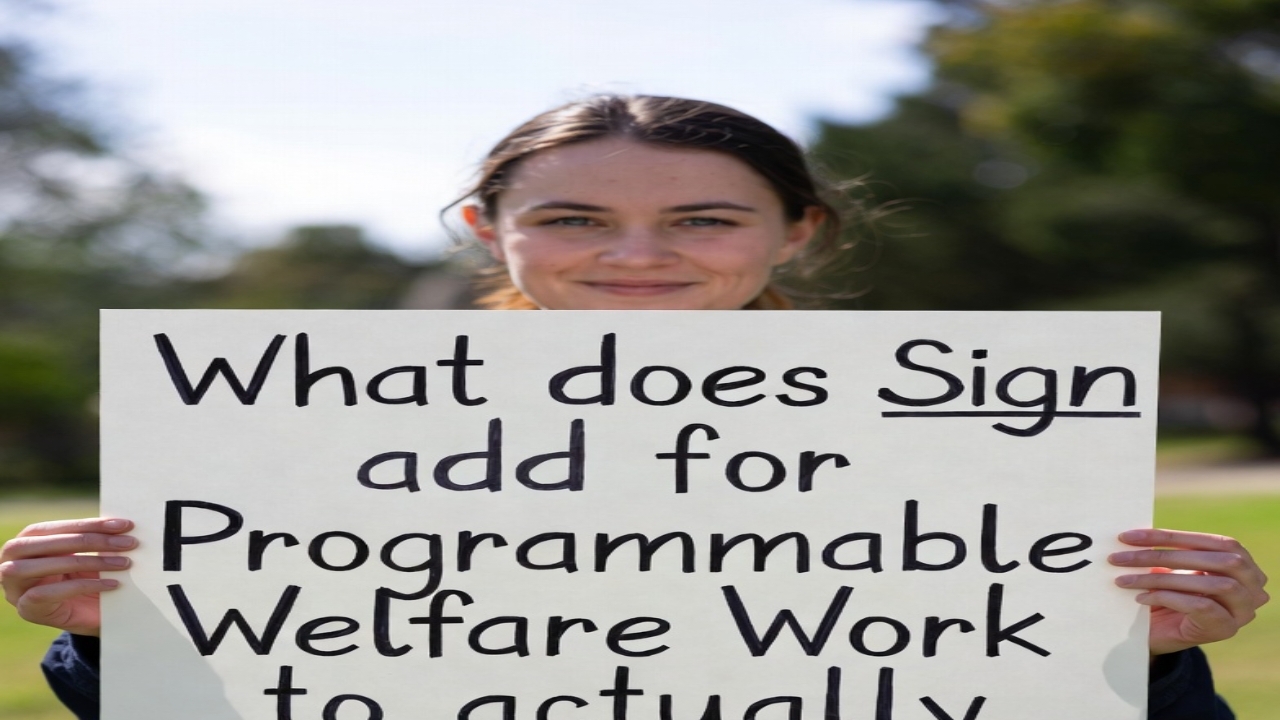
This morning, while scrolling on X, I accidentally came across the Article 'Programmable Welfare Work' by Sign Protocol, just as I was looking for more interesting insights about the project.
The first thing that caught my eye was the text highlighted in red below.
"Should this payment happen, to this person, under this rule, right now? That question is not a money question. It is a proof question."
I think many people in the blockchain industry often assume that putting money on the blockchain modernizes welfare: faster money, more transparency, easier auditing. I used to think that too. But this question made me realize that speed or transparency does not address the most important issue. Is this payment going to the right person, under the right conditions, at the right time? Blockchain is just a money transfer channel, and the proof question remains.
Welfare is not merely about transferring money. It is about connecting value with policy: who is eligible, under what conditions, through which organization, within what limits, and how to prove it when verification is needed. If this part is omitted, blockchain is just a fast-moving token that does not ensure accuracy or accountability.
The way Sign approaches the issue feels both intuitive and profound. They divide the system into three layers: identity, programmable money, and verification. Identity authenticates the recipient without needing to disclose all personal data. Programmable money does not inherently 'understand' anything, but it allows money to go to the right person, for the right purpose, at the right time. Verification creates standardized proof, auditable, but does not turn the system into a citizen monitoring machine. It feels like they are solving the operational issue while respecting privacy rights.
I often think of the analogy of conditional gift cards: households receive cards, merchants only see valid balances for permitted item groups, and oversight agencies check overall compliance without needing to know the details of each transaction. Citizens verify their identity once, and the eligibility claim is sufficient proof for the money to be spent according to the rules. It is simple but effective and highlights the insight 'proof > money'.
A real-life example is the food assistance program: households receive money monthly but can only spend it at approved merchants, for permitted item groups. Citizens verify their identity once, the welfare agency issues eligibility claims, and payments are checked for validity. Merchants do not need the entire household profile, just a valid fund. Proof is recorded, auditing is easy, and privacy is protected. The Barbados Asset Distribution System illustrates how Sign implements this practically, combining GovTech, FinTech, and verification without infringing on personal data.
This design has significant implications. It allows for changes in banks, PSPs, or merchants without needing to restructure the system. It reduces the risk of data leakage while still ensuring auditability. Many other blockchains, such as Ethereum or Celo, may use smart contracts to limit spending, but often store a lot of data on-chain and lack separate verification layers. At Sign, proof is central, while tokens are merely a means of execution.
Of course, there are still limitations. Expanding to cover all social welfare, pensions, or insurance remains a challenge. Standardizing proof, credentials, and how the GovTech layer connects with FinTech requires extensive testing. Some complex scenarios may need multiple verification layers, increasing latency and costs.
Overall, Sign Protocol made me realize one thing. Money and data must be linked by proof for welfare to be accurate, auditable, and accountable.