
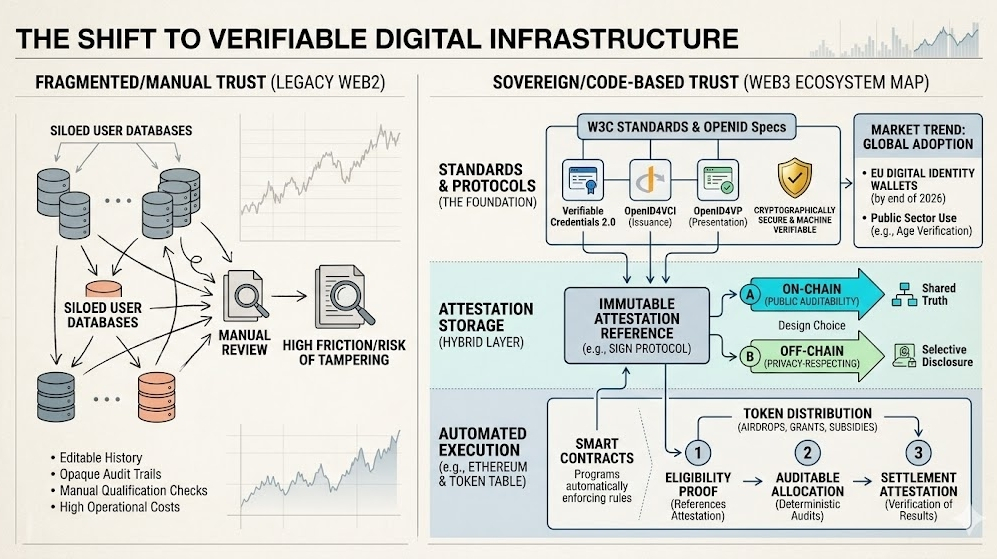
People still talk about blockchain like it is only about price charts and quick gains. That is the shallow story. The deeper story is trust. In 2025, Verifiable Credentials 2.0 became a W3C Standard, and OpenID for Verifiable Credential Issuance and OpenID for Verifiable Presentations reached final-spec status. That is a big signal. It means digital proof is no longer a side experiment. It is becoming real infrastructure for identity, access, and distribution on the web. W3C says these credentials are meant to be cryptographically secure, privacy respecting, and machine verifiable, which is exactly why this space feels different now.
This is where immutable attestation storage starts to matter. A normal database can be edited. A file can be changed. A quiet admin can rewrite history and nobody may notice. That is the uncomfortable part. Sign Protocol takes a different route. Its docs say it standardizes facts through schemas, cryptographically binds data to issuers and subjects, supports selective disclosure, and provides immutable audit references. It also says attestations can be stored on-chain or off-chain, which is the real design choice here. The point is not to shove every detail onto a public chain. The point is to anchor truth in a way that is hard to fake, easy to verify, and still flexible enough for privacy. That balance is the calm, brutal beauty of Web3 when it is used well.
The on-chain versus off-chain debate is where many teams get stuck. Some people act like on-chain is always better. That is not true. On-chain verification is strong when you need permanence, public auditability, and a shared source of truth. Off-chain verification is better when the data is sensitive, large, or simply too expensive to put fully on-chain. OpenID’s credential specs already support this mixed world. OpenID4VCI defines an OAuth-protected API for issuing verifiable credentials, and OpenID4VP defines a mechanism for requesting and presenting credentials using OAuth 2.0 and even the Digital Credentials API. The OpenID working group also has a high-assurance profile for issuers, wallets, and verifiers where security and privacy matter more. In August 2025, the OpenID Foundation said a formal security analysis of OpenID4VP over the DC API found no new vulnerabilities. That matters. It shows the ecosystem is being stress-tested before it gets bigger.
Smart contracts are the other half of the story, and they are often misunderstood. Ethereum describes smart contracts as programs stored on the blockchain that automatically enforce the rules written into their code. That sounds simple, but the consequences are serious. A smart contract is not just a helper script. It is the rule itself. Once deployed, it becomes part of the system’s memory, and deployment costs gas because the contract is stored on-chain. Ethereum also stresses testing for reliability, usability, and security before deployment, which is the part many people skip when they are chasing speed. Sign’s TokenTable uses this logic in a very concrete way. Its docs say eligibility proofs are referenced via attestations, allocation manifests are anchored as evidence, execution results are linked to settlement attestations, and audits can replay allocation logic deterministically. That is not marketing talk. That is a machine-built trail. It is exactly why smart contracts are useful for airdrops, grants, subsidy programs, rewards, and any token distribution that needs to survive scrutiny later.
The market trend is moving in the same direction. The European Commission says the EU Digital Identity framework now requires Member States to provide EU Digital Identity Wallets by the end of 2026, and the Commission’s FAQ says those wallets will let people prove a specific attribute without revealing their full identity. It also says the wallets can be used for bank access, loans, taxes, university enrollment, rentals, jobs, and signing contracts. The age-verification blueprint is built on the same technical base, which shows how fast the stack is moving from theory into public use. This is not a small detail. It is a sign that wallets, credentials, and verifiable presentations are becoming normal digital plumbing, not just crypto culture.
From a developer’s view, this stack is attractive because it turns trust into code. No more messy manual checks every time. No more endless back-and-forth over who qualifies and who does not. But it also forces discipline. Ethereum’s own docs remind builders that smart contract testing is about reliability, usability, and security, and that contract deployment has real on-chain cost. For retail traders, the appeal is simpler and a bit more emotional. Clean eligibility. Fewer fake claims. Distribution rules that are visible instead of mysterious. For institutions, the value is more serious. It is auditability, controlled execution, and less operational drag when identity or capital is on the line. The risk is also real. Bad logic on-chain can stay bad for a long time. Off-chain systems can hide weak custody. Privacy can disappear if teams are careless. So the honest answer is not “everything on-chain.” The honest answer is mix the layers with intent. Put the proof where permanence matters. Keep sensitive data where privacy matters. Use smart contracts where execution must not drift. That is the path that feels strongest, and the one that seems most likely to last.
My personal view is simple. The projects that win here will not be the loudest ones. They will be the ones that make verification boring in the best possible way. Fast. Clear. Hard to fake. Easy to audit. Sign is interesting because it sits right at that junction, with an attestation layer and a distribution layer that actually talk to each other instead of living in separate worlds. In a market that is slowly maturing, that kind of structure may end up mattering more than the hype ever did.