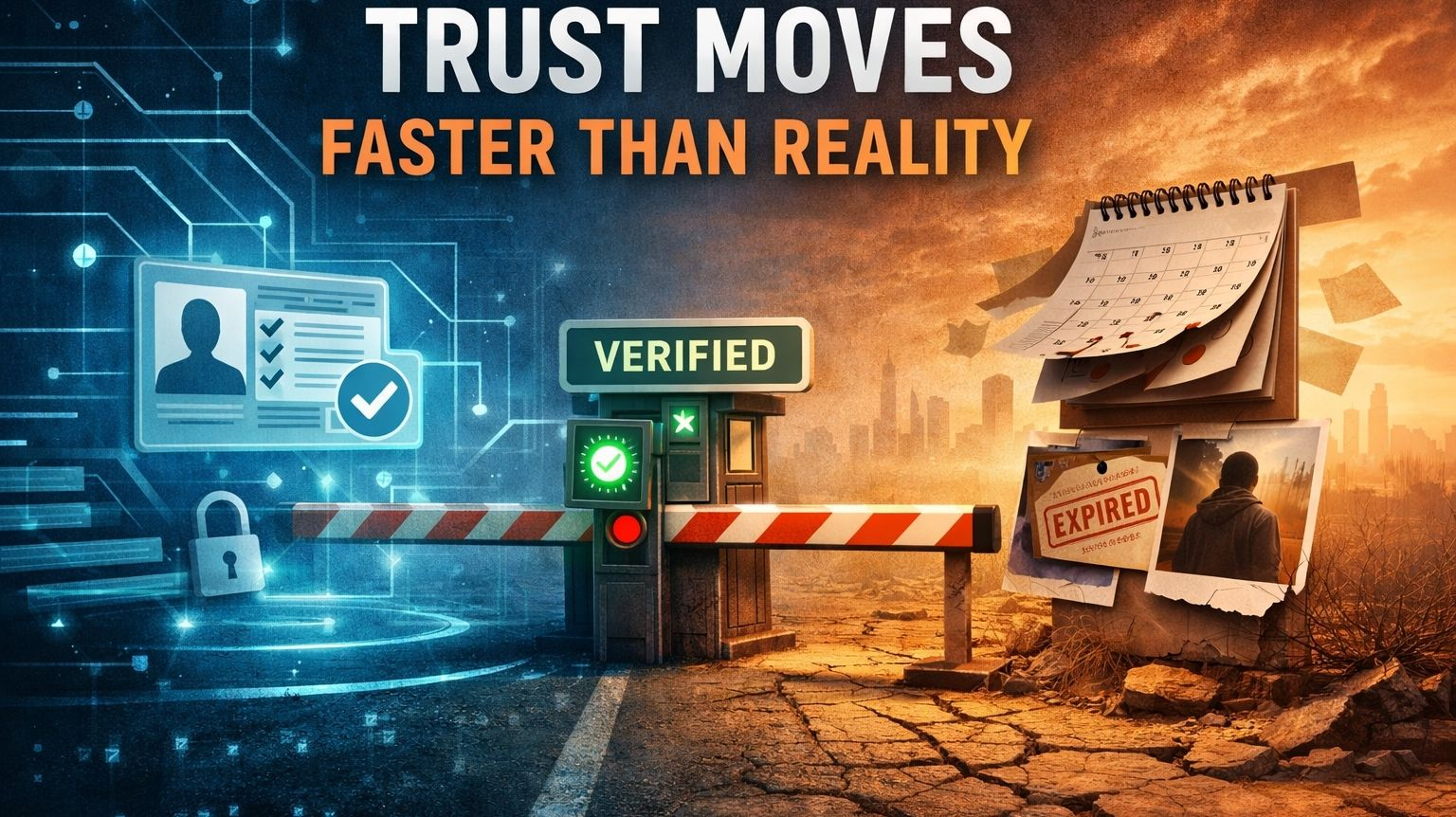


When Systems Decide to Stop Asking
Every system has to make a quiet decision at some point.
Not what is true, but when something is true enough to stop checking and move on.
That moment matters more than it looks. It’s where doubt ends and action begins.
And most systems don’t solve this perfectly. They just manage it.
The Cost of Never Stopping
If a system never stops questioning, it becomes unusable.
Imagine proving your identity every single time from scratch. Every login, every transaction, every interaction. Nothing carries forward. Nothing is remembered. Trust never accumulates.
That kind of system would be perfectly cautious, and completely impractical.
So instead, systems compress trust. They take a moment of verification and turn it into something reusable.
That’s where structures like Sign come in.
Freezing Trust in Time
At its core, the idea is simple.
An issuer defines a claim. Validators confirm it. After that, the result becomes portable. It can be reused without repeating the entire process.
It feels efficient because it is.
But something subtle happens here. Trust gets frozen.
A decision made at one point in time starts traveling forward as if it still belongs to the present.
And most of the time, that’s fine. The world doesn’t change fast enough to break it.
But sometimes, it does.
The Illusion of Stability
A credential looks stable. It’s been verified, approved, accepted.
But what it really represents is a past state, captured and preserved.
The system treats it as current, even though it may no longer be.
This creates a quiet gap between what was true and what is true now.
The system doesn’t ignore this gap. It just chooses not to constantly reopen it.
Because reopening it would bring back the friction it worked so hard to remove.
Distributed Trust, Fragmented Awareness
Another layer of complexity comes from how responsibility is split.
Issuers create. Validators confirm. Platforms use.
Each role is clear. That’s what makes the system scalable.
But clarity also means separation.
No single part sees the full story. Validators don’t control future use. Platforms don’t fully inspect origin. Issuers don’t predict context.
Each layer acts on partial understanding.
And the system as a whole relies on the idea that enough independent checks will approximate correctness.
It usually works.
But approximation is not the same as certainty.
Drift Instead of Failure
What’s interesting is that these systems rarely fail in obvious ways.
They don’t collapse.
They drift.
A credential remains valid but slowly loses relevance. A decision stays accepted but becomes slightly misaligned with reality. Small inconsistencies appear, but nothing breaks hard enough to trigger a reset.
So the system keeps moving forward, carrying small inaccuracies with it.
Not enough to stop it. Just enough to matter.
Efficiency vs Awareness
This is the real tradeoff.
Reusable trust increases speed, reduces cost, and removes repetition.
But it also reduces sensitivity to change.
The system becomes better at remembering than re-evaluating.
Better at reuse than reconsideration.
And that’s not a flaw. It’s a design choice.
Where Is the Line?
So the real question isn’t whether this approach works.
It clearly does.
The question is where the boundary lies.
How long can a past truth remain useful before it becomes misleading?
At what point does “verified once” stop being enough?
And who decides when it’s time to question again?
Trust That Moves Faster Than Reality
Systems like Sign don’t eliminate uncertainty. They package it.
They take a messy, continuous process and turn it into something discrete and portable.
That’s what makes them powerful.
But also what makes them fragile in a different way.
Because when trust moves faster than context, it doesn’t necessarily break.
It just becomes easier to use than to question.
And that’s where things start to shift.
Not suddenly, but quietly.
From meaningful trust…
to convenient trust.
@SignOfficial #SignDigitalSovereignInfra $SIGN