
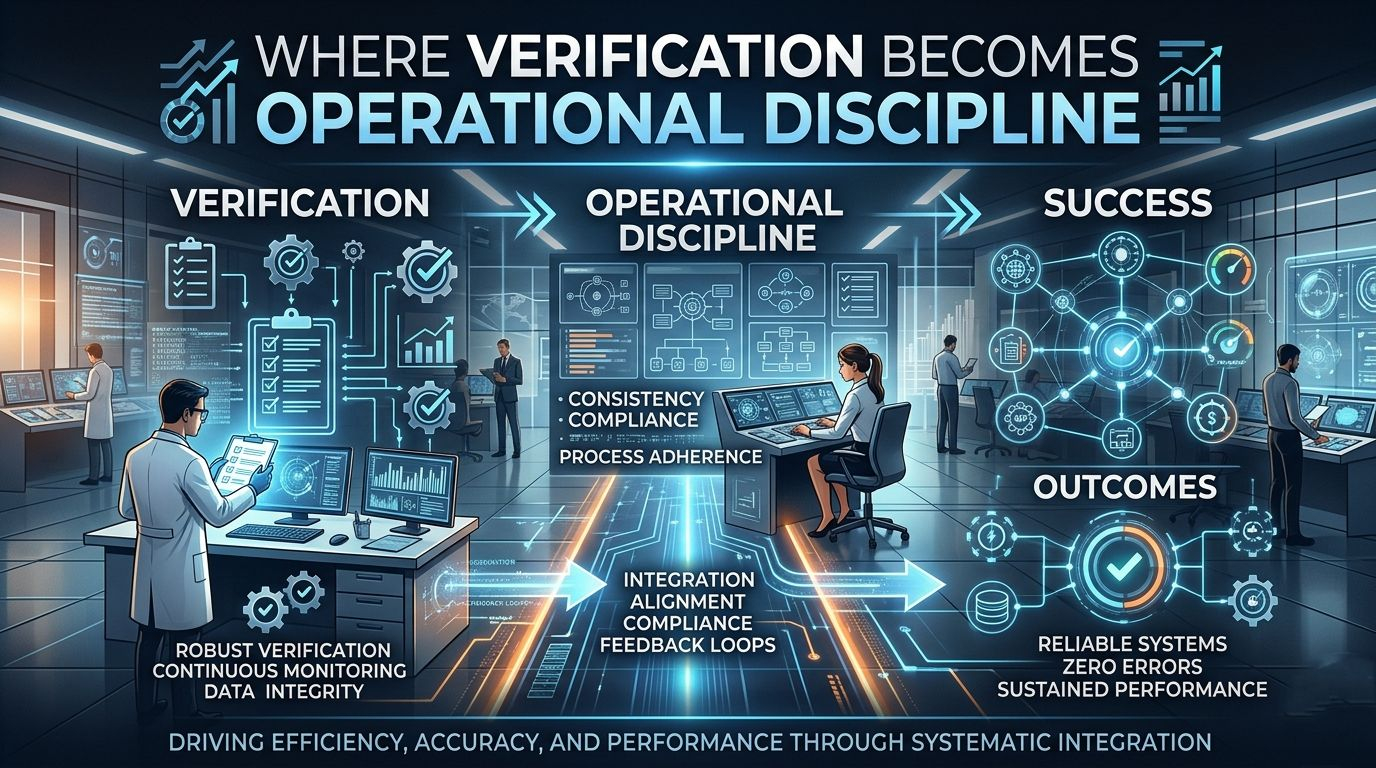
When I look at credential verification and token distribution through the lens of infrastructure rather than features, my attention shifts in quiet but important ways. I find myself less concerned with what the system enables at the surface and more focused on how it behaves under constraint during audits, within compliance requirements, and across long operational timelines where consistency matters more than speed.
What stands out to me first is the emphasis on reproducibility. I don’t see verification as a one-time decision. I have to assume that every outcome may need to be revisited, reconstructed, and explained. In regulated environments, this is not optional. A system that cannot demonstrate how a decision was made even if that decision was correct introduces uncertainty. And in my experience, that uncertainty tends to translate into friction for auditors and operators.
I also pay close attention to how records are handled. The verification outcome itself is only part of the responsibility. What matters just as much to me is how that outcome is stored, structured, and retrieved. I don’t think of logs as passive archives. I see them as operational tools. If I cannot query them easily or interpret them reliably, then their existence alone doesn’t help. The difference between storing data and making it usable becomes very clear when systems are inspected under pressure.
When I consider token distribution in this context, I don’t see it as simple movement of value or access. I think of it as a process that needs to remain consistent, traceable, and reconcilable across environments. Distribution events need to align with verification states in a way that I can audit without ambiguity. This introduces constraints on sequencing, timing, and state management. These constraints may reduce flexibility, but I notice how they strengthen reliability, which feels more aligned with infrastructure expectations.
The quieter aspects of the system design are what I keep coming back to. Predictable APIs reduce the need for interpretation. Stable defaults make behavior easier for me to anticipate. Monitoring is not something I add later; it feels like a continuous layer that helps me understand system health without digging into internals. These details don’t stand out at first, but over time, they shape how much I trust the system.
I also notice how privacy and transparency are handled through structure rather than claims. Transparency, to me, shows up in the ability to trace decisions and inspect records. Privacy appears in how access is controlled and how data is exposed. I don’t see these as abstract guarantees. I see them as outcomes of how the system is designed to store, retrieve, and present information.
From a developer perspective, I find the ergonomics leaning toward clarity and predictability rather than speed. Interfaces behave consistently. Interactions follow patterns that I can learn and rely on. That reduces cognitive load over time. In environments where I may need to justify outcomes or revisit decisions, this kind of consistency feels more valuable than flexibility.
What I take away from all of this is not a system designed to impress immediately, but one that is built to remain stable under scrutiny. I don’t see novelty as the primary goal. I see discipline clear records, consistent behavior, predictable interfaces. These are not the most visible features, but they are the ones I rely on when systems are under pressure.
In my experience, trust builds slowly through repetition. When a system behaves the same way during normal operations, audits, and over extended periods, I begin to rely on it without second-guessing. That reliability doesn’t feel accidental. It comes from prioritizing details that are easy to overlook but difficult to replace once the system is in use.
#SignDigitalSovereignInfra @SignOfficial $SIGN
