For years, participation in crypto has carried a quiet frustration. Behind every wallet address is a human effort—time spent learning, building, contributing—yet the system has rarely been able to recognize that effort with precision. Instead, rewards have often flowed to those who arrived early, deployed capital quickly, or simply  automated their way through incentives. This disconnect has created a subtle but persistent tension in decentralized ecosystems: the feeling that value is not always reaching those who truly create it. Credential verification networks are emerging at a moment when this imbalance is no longer acceptable, offering a path toward systems that can finally acknowledge meaningful participation.At their core, these networks attempt to translate human contribution into verifiable digital signals. Rather than relying on wallet balances alone, they introduce cryptographic attestations that represent actions, reputation, and involvement. A developer’s code contributions, a liquidity provider’s consistency, or a community member’s governance participation can all be encoded as credentials. These credentials are not exposed as raw personal data but secured through advanced cryptographic techniques, often using zero-knowledge proofs to confirm legitimacy without sacrificing privacy. The result is a system where identity becomes layered and nuanced, allowing individuals to prove what they have done without revealing who they are in full.This shift carries emotional weight because it addresses a fundamental question of fairness. In traditional token distribution models, the lack of distinction between genuine and superficial participation has led to cycles of extraction, where opportunistic actors capture value and exit, leaving committed contributors behind. Credential-based systems attempt to break this pattern by aligning rewards with provable effort. Tokens in this context become more than financial instruments; they act as signals of recognition, reinforcing behaviors that
 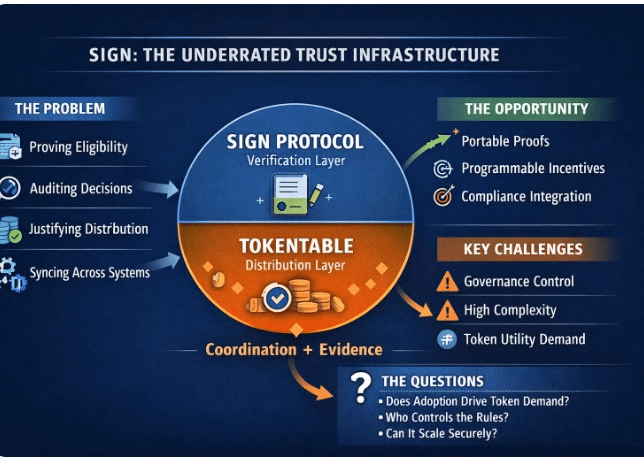 sustain ecosystems over time. Validators and issuers are economically incentivized to maintain the integrity of this recognition layer, creating a shared responsibility to protect what is, in essence, a record of collective contribution.On-chain data is beginning to reflect this transition in subtle but meaningful ways. Activity tied to credential issuance shows a steady rise, not driven by speculation but by a growing demand for acknowledgment. Wallet behavior in credential-gated environments appears more deliberate, with fewer signs of automated farming and more evidence of sustained engagement. Token distributions linked to verified participation tend to experience less immediate selling pressure, suggesting that recipients feel a stronger connection to the value they receive. Staking patterns within these networks also reveal a willingness to commit resources for the sake of long-term credibility, indicating that users are not just chasing rewards but investing in their digital reputationThe implications extend beyond metrics into the lived experience of
  participants. For builders, credential networks offer a way to ensure their work is not lost in anonymity. For investors, they provide a clearer signal of which ecosystems are built on genuine engagement rather than inflated activity. For communities, they introduce a sense of accountability, where influence must be earned and maintained. This creates an environment where trust is no longer an abstract concept but something that can be measured, verified, and rewarded in real timeYet the path forward is not without friction. The technical complexity of these systems can feel distant from the simplicity that first attracted many users to crypto. Additional steps in verification may introduce hesitation, particularly for those who value seamless interaction. There are also deeper concerns about how reputation is defined and who gets to validate it. If not carefully designed, these systems risk concentrating power among a limited set of issuers or validators, undermining the very decentralization they aim to protect. Regulatory uncertainty adds another layer of tension, as the line between anonymous participation and verifiable identity becomes increasingly blurreDespite these challenges, the direction is becoming clearer. As decentralized ecosystems continue to evolve, the demand for fairness, accountability, and meaningful recognition is intensifying. Advances in privacy-preserving technologies are gradually reducing the trade-offs between usability and security, making credential systems more accessible. Interoperability efforts are opening the door for credentials to move across platforms, allowing individuals to carry their verified contributions wherever they go. This portability has the potential to reshape how opportunities are distributed, creating a digital environment where reputation travels with the user rather than being locked within isolated systemsAt its heart, this transformation is about restoring a sense of balance. It is about ensuring that the invisible effort behind every wallet is no longer ignored. Credential networks are not just a technical upgrade; they represent a shift in values, where participation is seen, measured, and respected. If they succeed, they could redefine the relationship between individuals and the systems they contribute to, turning anonymous interaction into recognized impact and, ultimately, making decentralized economies feel a little more human.

Articol

From Invisible Effort to Verifiable Value: A New Era of On-Chain
Declinarea răspunderii: Include opinii ale terților. Acesta nu este un sfat financiar. Poate include conținut sponsorizat. Consultați Termenii și condițiile