
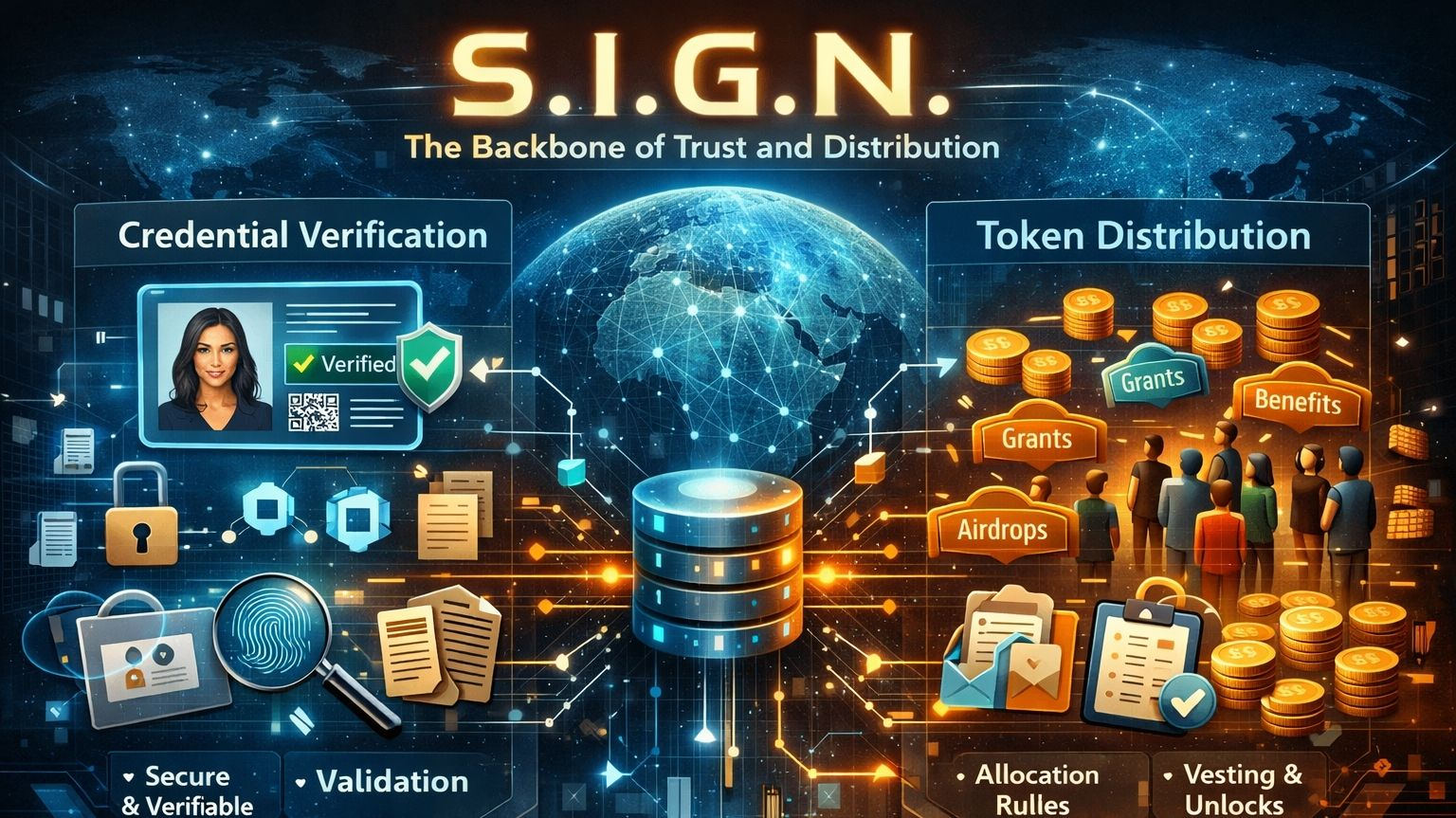
S.I.G.N. — yeah, that mouthful of a name — is kind of one of those things you read and shrug at first. I mean, who hasn’t seen projects promising trust and scale like it’s magic? But the thing with S.I.G.N. is, it actually feels like it’s trying to handle the boring stuff that nobody talks about. The plumbing. The stuff that actually makes things work.
Let me be honest. Most verification systems are a mess. You apply for something, someone has to check if you’re real, if you qualify, if you already got it. Then, somehow, a hundred people are doing the same thing in a hundred slightly different ways. Spreadsheets everywhere. Lists get copied. Mistakes happen. People get skipped. Others get double-dipped. It’s chaos masquerading as process.
S.I.G.N. tries to… well, not make it exciting. It just tries to make it work. Credentials aren’t just a “yep, this person exists.” They carry proof. You can check them. Later. Without having to beg someone for screenshots or PDFs. That’s the part that quietly impressed me. The system isn’t asking you to trust it blindly. You can actually see the trail.
Then there’s the money—or whatever you’re distributing. The thing is, giving stuff out is way harder than anyone admits. Maybe some people get it instantly, others slowly, some halfway through lose eligibility. Audit trails? Usually a nightmare. With S.I.G.N., it’s like someone finally said, “Okay, let’s write down the rules and stick to them.” They version things, freeze them once finalized, and link everything back to proof. You can argue or check later. Not because it’s flashy, but because it’s necessary.
And the really weird thing is how the verification and distribution parts talk to each other. One feeds the other. If someone’s eligible, the system knows. If they get something, there’s evidence. No repeated “did we check this person again?” moments. It just flows, quietly, behind the scenes.
But here’s the catch. This isn’t some perfect utopia. The project has to deal with real-world mess: different policies, legacy systems, people who hate change, unexpected exceptions. They seem to get that. The architecture isn’t trying to force everything into a neat box. It bends. It adapts. Not in a flashy way, just in a way that actually might survive reality.
Honestly, what I like the most is that it’s humble. It’s not shouting, “Look at us, changing the world!” It’s whispering, “We made trust slightly less terrible.” And that’s rare. Most systems promise revolution and then fail at lunch. This one? It’s trying to handle the boring but important stuff, the stuff no one notices until it breaks.
If it works, people won’t notice it directly. They’ll just stop repeating checks. Things will move faster. Mistakes will be easier to track. It won’t be glamorous, but it will matter. Slowly, quietly, and in a way that actually sticks.
That’s S.I.G.N. for you. Not flashy. Not dramatic. Just doing the plumbing. And I’ll admit… I respect that.