
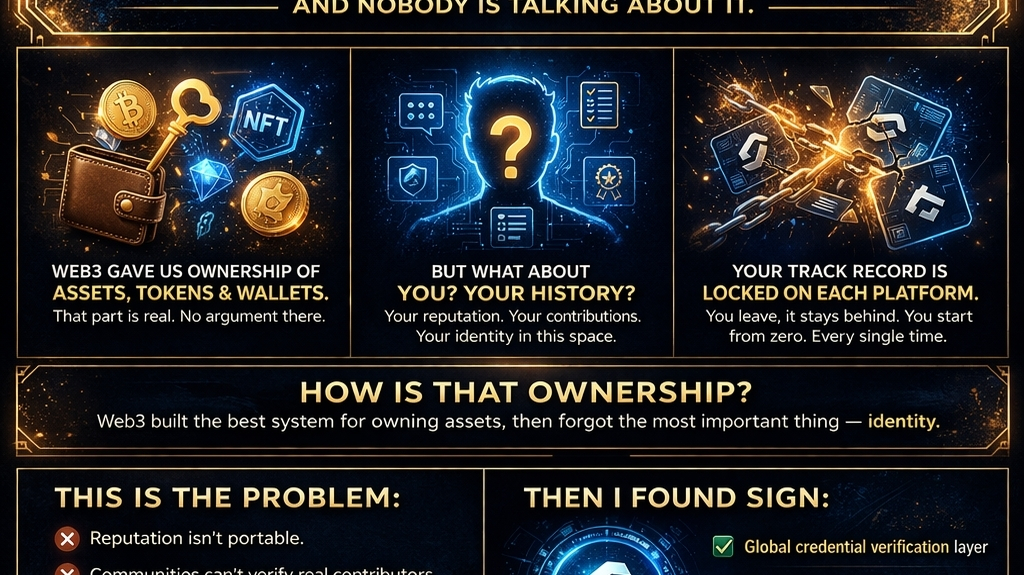
Ww web3 promised to give us ownership of everything. it lied about one thing.
and before you come at me — hear me out.
i'm not talking about assets. i'm not talking about tokens or NFTs or your wallet or your keys. all of that ownership stuff is real and i'm not taking anything away from it.
#signdigitalsovereigninfra @SignOfficial
i'm talking about something nobody in this space ever brings up and honestly i think its because people just accepted it as normal without ever questioning it.
your identity.
not your wallet address. not your ENS name. your actual identity in this space. who you are. what you've done. your history of showing up, participating, contributing, building. the reputation you've spent real time creating across different protocols and communities.
that stuff? you dont own any of it.
and i dont mean that in a philosophical way. i mean it literally. practically. technically.
if you've been in web3 for more than a year you've probably done a lot of things. joined early communities, participated in testnets, voted in governance, completed quests, contributed to launches. you've been somewhere. you've done things. you have a track record.
now go somewhere new tomorrow.
they have zero idea who you are. your entire history is invisible to them. all that time, all that effort, all those contributions — mean absolutely nothing in a new place. you are a blank wallet. a nobody. starting from scratch like you discovered crypto this morning.
explain to me how thats ownership.
i'll wait.
the truth is web3 got so obsessed with financial ownership that it completely forgot about identity ownership. we built the most sophisticated system for owning digital assets in human history and then just.. left reputation on the table. unverifiable. non portable. locked inside individual platforms that dont talk to each other.
its actually embarrassing when you think about it hard enough.
and the worst part is that this isnt a small problem. this is foundational. because reputation is how trust gets built. reputation is how communities figure out who their real contributors are. reputation is how you prove you're not a bot, not a sybil, not someone gaming the system. without a proper credential layer the whole ecosystem is basically just vibes and hoping people are who they say they are.
thats not infrastructure. thats chaos with good branding.
so when i came across SIGN i genuinely felt something i havent felt about a project in a long time.
relief.
like finally. finally someone is actually building this.
SIGN is creating the global infrastructure for credential verification. the thing that makes your on-chain reputation actually portable. verified once, carries weight everywhere. your history stops being invisible the moment you step outside one platform. you actually own your track record now.
thats not a small thing. thats fixing one of the most overlooked broken pieces of this entire ecosystem.
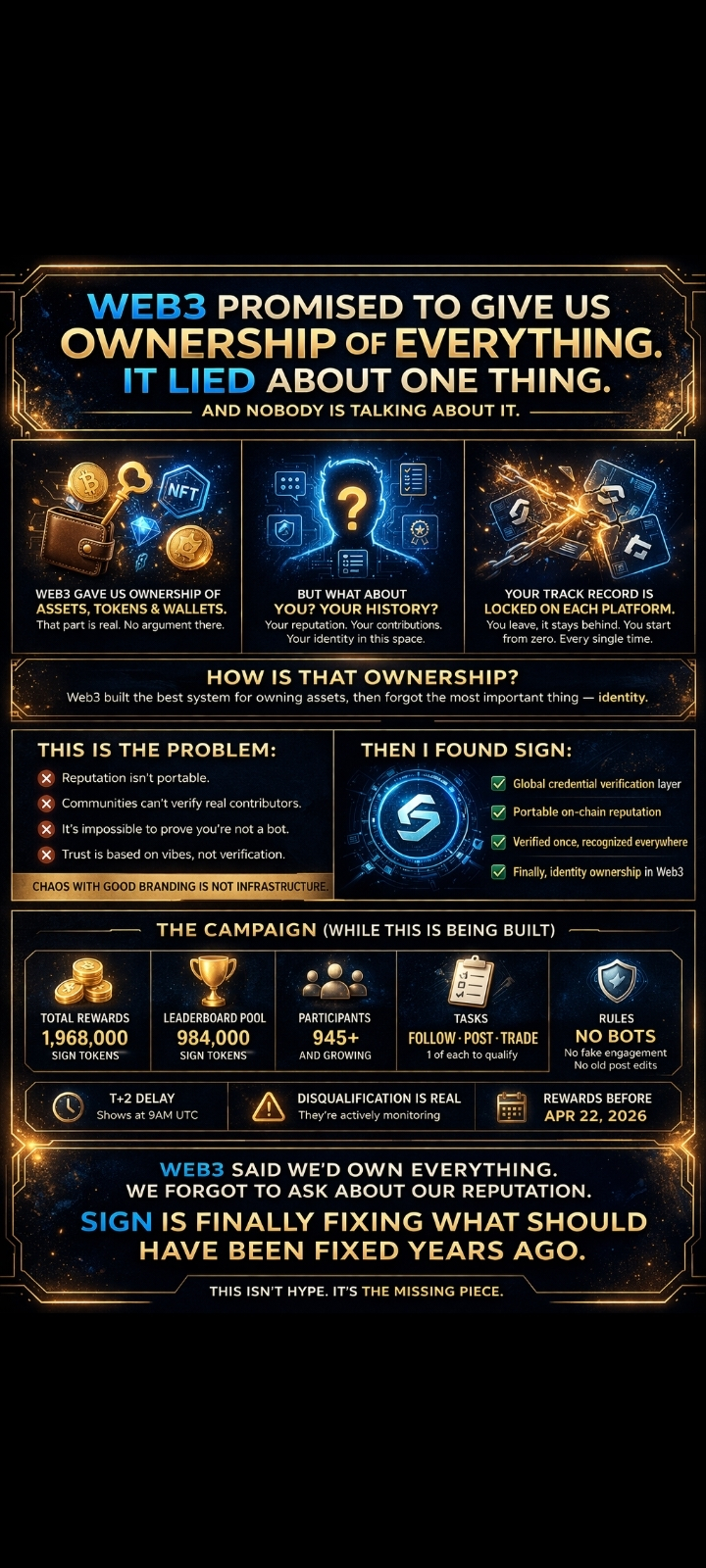
and theres a campaign running right now while all of this is being built. total rewards are 1,968,000 SIGN tokens. leaderboard pool is 984,000 SIGN. already 945+ people participating and growing.
tasks are simple — follow, post and trade. atleast one of each type to qualify. post task just pick any one format that works for you.
rules are strict tho. no bots, no fake engagement, no red packet posts, no editing old posts to submit them. genuine participation only. they're watching and disqualification is real.
leaderboard delay is T+2 — so two days after your activity it shows at 9am UTC. normal, not broken.
rewards before april 22 2026.
but honestly forget the campaign for one second.
web3 told us we'd own everything. for years we nodded and believed it. and somewhere along the way we forgot to ask — wait, what about our reputation? what about our identity? what about the track record we've been building this whole time?
SIGN is asking that question. and more importantly, its answering it.
thats the kind of project that deserves real attention.
not because of hype. because of what it fixes.
and what it fixes is something that should have been fixed a long time ago. $SIGN