
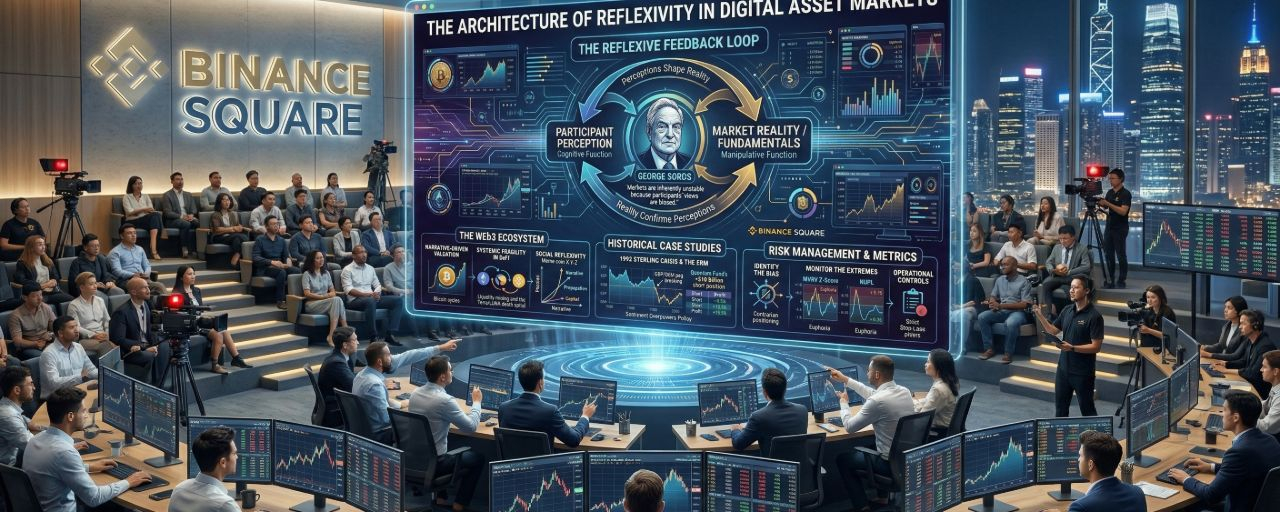
🚀 The Architecture of Reflexivity in Web3: Applying George Soros’s Macro-Strategies
TL;DR: Is the market rational? George Soros says no. In Web3, prices don’t just reflect reality—they create it. From the 1992 Sterling Crisis to the Terra Luna collapse, understanding the "Reflexive Feedback Loop" is the difference between catching a moonshot and falling into a death spiral.
🧠 The Core Concept: Reflexivity vs. Efficiency
Traditional finance relies on the Efficient Market Hypothesis, assuming prices are always "right." But in Crypto, value is a function of social coordination.
George Soros’s Theory of Reflexivity suggests that participant biases don’t just observe the market; they change the fundamentals.
Cognitive Function: Trying to understand the world.
Manipulative Function: Trying to change the world.
In Web3, these two collide. When you buy a token because you believe in it, you raise the price, which makes others believe in it more. This is a Virtuous Cycle—until the bias shifts.
📉 Case Study: The 1992 Sterling Crisis
Before he was a legend, Soros "broke the Bank of England" by recognizing a reflexive loop. The UK government's commitment to the ERM was a narrative that couldn't survive market doubt.
MetricValueQuantum Fund Short Position~$10 BillionSoros's Profit~$1 - $2 BillionResult UK Exit from ERM
The Lesson: When the narrative (The Peg) loses to reality (The Recession), the reflexive crash is violent. We saw the exact same "Death Spiral" mechanics in the Terra/LUNA collapse of 2022.
💎 The "Forever Bid" & The ETF Paradox (2026)
With the maturity of Spot ETFs, many claim we are in a "secular bull market." However, January 2026 data shows a new layer of reflexivity:
Total Net Outflow (Jan 2026): -$1.605 Billion.
The Paradox: ETF flows are now a sentiment signal. If BlackRock sees outflows, retail panics; if retail panics, institutional models trigger sells. The "Sticky Capital" is more reflexive than we thought.
📊 Identifying the Extremes (On-Chain Tools)
To survive reflexive markets, you must know when the "Euphoria" is unsustainable.
MVRV Z-Score: When >7, the market is in a reflexive peak.
NUPL (Net Unrealized Profit/Loss): Above 0.75 signals a "Minsky Moment" is near.
Meme Coin X-Y-Z Axis: Value = (Narrative Density) × (Propagation Potential) × (Capital Flow). If the "Attention" (Y) drops, the price (Z) vanishes.
🛠 The Soros Strategy for Web3 Traders
Identify the Bias: Is the price rising due to tech, or a self-reinforcing story?
Watch the Nodes: Track KOLs and social sentiment. Tweets can cause 40%+ volatility in minutes.
Position Sizing: In a reflexive environment, "fair value" doesn't exist. Use strict stop-losses to survive the "Inverted V" reversals.
🏁 Conclusion
In Web3, belief is a fundamental. Whether it's a Bitcoin "Supercycle" or a trending Meme coin, the market is a mirror of our collective delusions and dreams. To win, you don't need to find the "truth"—you need to find the prevailing bias before everyone else does.
#Web3 #tradingStrategy #GeorgeSoros #Reflexivity #CryptoAnalysis #BitcoinETF #DeFi #BinanceSquare
🚀 Join the Conversation
Reflexivity teaches us that the crowd isn't just following the trend—they are the trend.
I want to hear from you: * Which narrative do you think is currently in a "Virtuous Cycle" (bullish feedback loop) right now?
Is it AI-Agent tokens, the Bitcoin "Forever Bid," or a specific Meme ecosystem?
👇 Drop your thoughts in the comments! Let’s discuss.