
# From Attestation to Asset: How Sign Protocol Powers Sovereign Capital Markets
The conversation around real-world assets (RWA) often focuses on tokenizing private credit or real estate. Yet the largest, most stable pool of untapped capital sits in plain sight: national assets and public programs. Think infrastructure yields, municipal bond streams, or welfare distribution frameworks. The bottleneck has never been digitization—it has been trust verification that scales across borders without breaking.
Enter Sign Protocol. But to understand Sign’s role in sovereign capital markets, we must first retire an outdated label. Sign is not merely an attestation registry. A registry stores static claims. Sign builds a programmable trust highway—one where national governments can convert public obligations into verifiable, investable digital capital.
## The Sovereignty Gap in Current RWA Models
Most RWA platforms assume a private issuer with centralized custody. That model fails for sovereign entities. A government cannot hand over its fiscal infrastructure to a single blockchain oracle or a custodial intermediary. It requires programmable compliance, real-time auditability, and the ability to revoke or update authorizations without forking the entire system.
This is where the limitations of “dumb” attestations become dangerous. If a national ID credential or a bond coupon is attested once and then travels across chains indefinitely, who checks whether that credential remains valid after a policy change? Traditional attestation registries ignore that question. Sign was built to answer it.
# Trust That Travels, and the Risk of Stale Proof
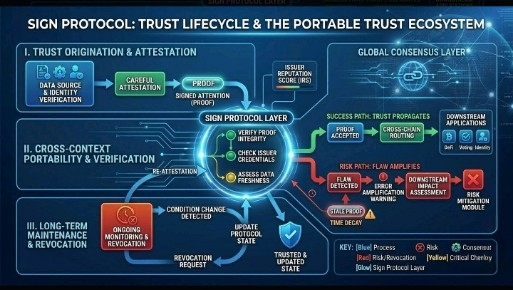
Portable attestations solve one problem—repetitive verification—but introduce another: the rotting timestamp problem. A welfare entitlement attested on Monday may be perfectly valid. By Friday, the recipient’s status could change. Yet the cryptographic signature remains pristine. The proof does not scream “I am old.” It simply travels further, appearing more legitimate with each hop.
For sovereign capital markets, stale trust is not a technical nuisance. It is a fiscal liability. Imagine an investor buying a tokenized infrastructure bond based on an attestation of government collateral that expired three days ago. The signature checks out. The bond price does not.
Sign protocol changes this by making revocation urgent and freshness measurable. Issuer reputation becomes critical infrastructure. Every attestation carries not just a claim but a lifecycle—issued, verifiable, and, when necessary, terminable.
## Programmable Money as the Settlement Layer
Portable trust alone does not close a capital market. You need settlement. This is where Sign’s framework for CBDCs and stablecoins enters. Governments issuing national digital currencies require full oversight, programmable compliance, and real-time auditability. Sign provides the attestation layer that connects sovereign currencies to global liquidity without surrendering control.
Consider instant welfare payments. A government issues a stablecoin voucher attested with Sign. The attestation includes spending rules, expiry, and merchant whitelists. The recipient spends it across participating vendors. Every step is verifiable on-chain, yet the state retains the ability to revoke unspent balances if fraud is detected. Cross-border settlements follow the same logic: two central banks exchange attested stablecoins, with compliance rules attached to every unit.
This is not theoretical. Major institutions are already exploring how attestations reduce counterparty risk in institutional DeFi. Extending that to sovereign issuers is a natural, necessary step.
## The New Discipline for Verifiable Finance
Sign does not erase risk—it relocates and exposes it. Builders and policymakers must adopt three new reflexes:
1. Issuer reputation as infrastructure – Not every attester is equal. Sovereign attestations require legal finality.
2. Revocation as a first-class operation – Not optional. Not an afterthought. Urgent and auditable.
3. Freshness over archival correctness – A proof from last year is worthless if the underlying fact changed yesterday.
When these disciplines are enforced, national assets and public programs become programmable, investable digital capital. The highway works because trust travels fast, but revocation travels faster.
That tension—between openness and accountability—is exactly why Sign matters for the future of sovereign RWA.
@SignOfficial #SignDigitalSovereignInfra $SIGN
