
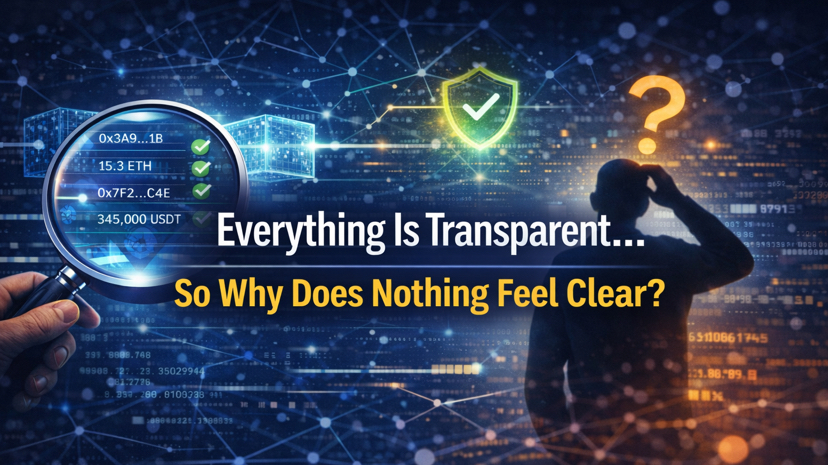
There’s something about crypto that’s been bothering me lately.
We’re supposed to have the most transparent financial system ever built. Every wallet, every transaction, every movement is visible on the blockchain. You can track it all in real time. On paper, it sounds like the ultimate clarity.
But in reality? It often feels anything but clear.
I’ve caught myself doing this way too many times: I open a block explorer, scroll through pages of transactions, zoom in on certain wallets, and convince myself I understand what’s going on. Ten minutes later, I close the tab feeling more confused than when I started.
Why did that big transfer happen? Was it a legitimate move or something sketchy? What triggered it? Who’s actually behind it?
You can see everything… but you still don’t really know anything.
That’s when it hit me: Transparency is not the same as understanding.
Raw data just sits there open, visible, and completely silent. It doesn’t tell you the story. It doesn’t explain intent. It doesn’t show the conditions behind an action or whether something can even be challenged.
So what do we do? We fill in the gaps ourselves. We guess. We assume. We bring our own biases and interpretations into it. And once that happens, subjectivity takes over. Trust becomes shaky. Arguments get messy. And proving anything with real confidence feels almost impossible.
Lately, this limitation has been weighing on me more and more. I started asking myself: Are we focusing on the right things in Web3?
We obsess over visibility, more transparency, more data, more dashboards. But maybe what we actually need is a way to turn all that visible data into something meaningful, structured, and verifiable.
That’s exactly why I’ve been paying close attention to Sign (@SignOfficial ) and $SIGN
Sign isn’t trying to give us yet another layer of raw information. Instead, it’s building the missing infrastructure that adds real context and proof to on-chain activity.
It’s about creating verifiable credentials, attestations, and reputation that actually travel with you things you can prove without having to convince someone with screenshots and stories. It moves us from “I see a transaction” to “I can actually verify the truth behind it.”
In a space where disputes, trust, and legitimacy matter more every day, this feels like a much-needed evolution.
I’m not here to say Sign is perfect or will definitely win. No one knows how things will play out.
But what I can say is this: it made me realize I’ve been paying attention to the wrong layer all along. I was focused on what’s happening instead of what can actually be proven.
And that mental shift feels important.
Maybe the next chapter of Web3 isn’t about making everything even more transparent.
Maybe it’s about finally making what’s transparent actually understandable.
We don’t have a visibility problem anymore.
We have a meaning problem.
Curious to know — do you feel this too? Or am I overthinking it?
Would love to hear your honest thoughts.

Just my personal reflection. Always do your own research.