
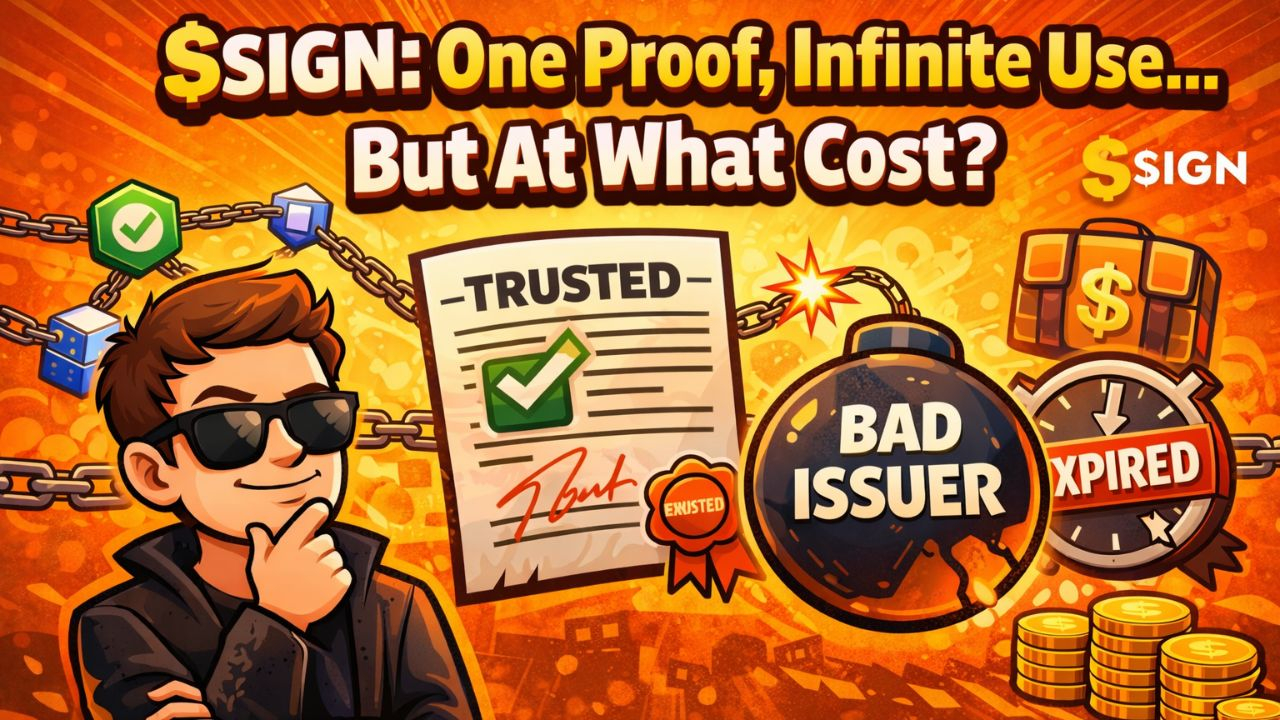

A few days ago, I was reading through a long take on Sign Protocol, and one idea stayed with me long after I closed it. It wasn’t about “attestations” or “registries.” It was about how broken our current idea of trust really is.
Every system today behaves like it has no memory. You prove who you are, what you’ve done, what you’re eligible for — and then you do it all over again somewhere else. Different app, same questions, same friction. We’ve normalized repetition and called it security.
That’s where $SIGN quietly changes the game.
What Sign introduces isn’t just storage. It’s continuity. A proof created once doesn’t die in the system that verified it. It moves. It carries meaning across apps and chains. Suddenly, trust is no longer something rebuilt every time you cross a boundary — it becomes something reusable, something portable. And that small shift removes a massive amount of invisible friction across Web3.
But the deeper I think about it, the more I realize this isn’t just an upgrade — it’s a redistribution of responsibility.
When trust starts moving, risk moves with it.
Now the question isn’t just whether a proof exists. It’s who issued it, and whether it still deserves to be trusted today. A strong issuer makes the system feel seamless. A weak one doesn’t just fail locally — it scales that failure across every system that accepts its signature. That’s the hidden edge of $SIGN. Efficiency doesn’t discriminate between good trust and bad trust.
And then there’s time — the most overlooked variable in all of this.
A proof can be perfectly valid when it’s created and quietly become misleading later. But signatures don’t age visibly. They still look clean, still verify correctly, still feel authoritative. That’s where stale trust becomes dangerous. Because SIGN oesn’t just move trust across systems — it can carry outdated assumptions forward if nothing checks their freshness.
So when people reduce Sign to “just a registry,” they’re missing the real shift. This is infrastructure for reusable trust, not storage for static data. It makes systems less repetitive, less fragmented, and far more efficient.
But it also raises the stakes.
In a world where trust travels, source quality matters more than ever. Timing matters more than ever. And the difference between “was true” and “is still true” becomes the line between efficiency and risk.
That’s the real story behind $SIGN not just making trust portable, but forcing the ecosystem to take responsibility for where that trust comes from, and how long it should last.
@SignOfficial #SIGN #SignDigitalSovereignInfra $SIGN
