
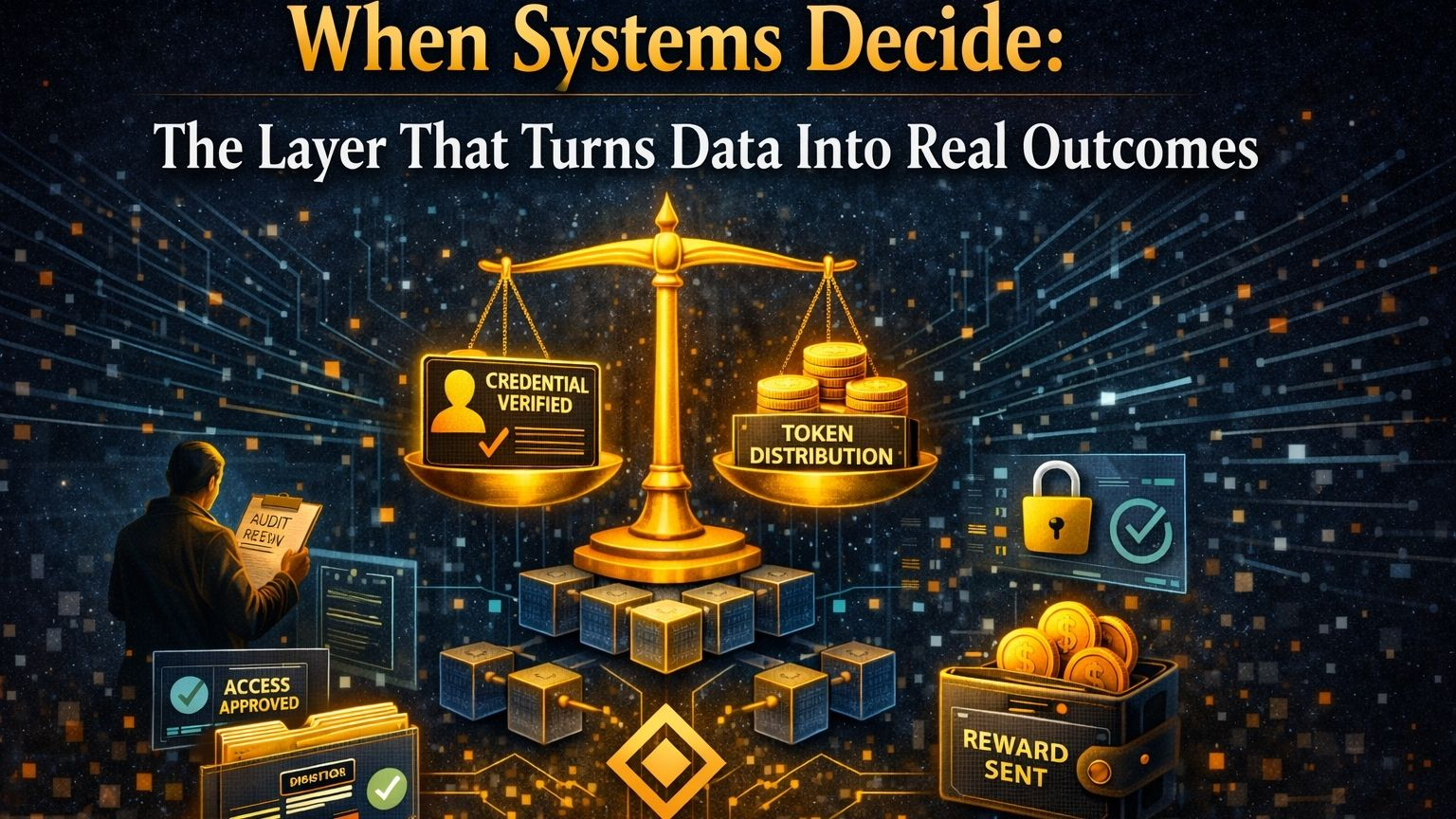

The part that keeps pulling me back is not the surface layer of technology. It is the quiet machinery underneath it… administration.
Most digital systems today are very good at recording activity. They track everything. Who joined, who traded, who held, who contributed. The data is there. The history is clean. On-chain records don’t lie.
But the moment a system has to turn that history into a decision, everything changes.
Who qualifies. Who gets access. Who receives rewards. Who gets excluded.
That is where friction begins.
Because now the system is not just recording anymore… it is judging.
And most systems are not built well for that part.
They look smooth until a real rule has to be enforced. Then suddenly everything depends on edge cases, exceptions, manual reviews, and hidden logic that was never properly structured in the first place.
That is exactly where SIGN PROTOCOL starts to matter.
Sign Protocol introduces something most systems are missing: structured, verifiable attestations. Not just data, but claims that can be proven, reused, and trusted across different contexts.
A credential is not just a digital object. It is an administrative claim.
It says:
This person did something
This wallet qualifies
This action meets a condition
And with Sign, that claim is not locked inside one system. It becomes portable, verifiable, and reusable.
That changes everything.
Because token distribution is not just sending value. It is a decision.
Why did this wallet receive tokens
What made it eligible
What proof supports that outcome
Without strong verification, distribution becomes guesswork. Or worse… manual correction behind the scenes.
Sign connects these two layers properly.
Verification defines the condition.
Distribution executes the outcome.
No disconnect. No hidden logic.
And that is where most systems fail today.
Identity sits in one place. Verification in another. Distribution logic somewhere else. Compliance comes later. Humans step in to fix gaps.
It works… until someone questions a decision.
Then everything breaks.
Because the real problem is not creating data. It is creating decisions that can survive disagreement.
A system might know you contributed.
But can another system trust that proof?
Can it verify it instantly?
Can it act on it without rechecking everything manually?
That is what Sign Protocol is solving.
It turns credentials into verifiable infrastructure, not isolated records. It allows systems to make decisions that are consistent, explainable, and repeatable across platforms.
And there is a human side to this too.
People feel friction when they:
Keep proving the same thing again
Qualify in one place but not another
Get rewards without clarity
Or get excluded without explanation
That kind of experience breaks trust slowly.
Better infrastructure does not remove judgment.
But it makes judgment feel consistent.
That is why Sign does not feel like hype to me. It feels like a structural upgrade.
Not louder systems.
Smarter ones.
Systems that can actually justify their decisions.
Because in the end, systems do not fail when they store information.
They fail when they have to decide something that someone else depends on.
And Sign Protocol is quietly fixing that layer.