
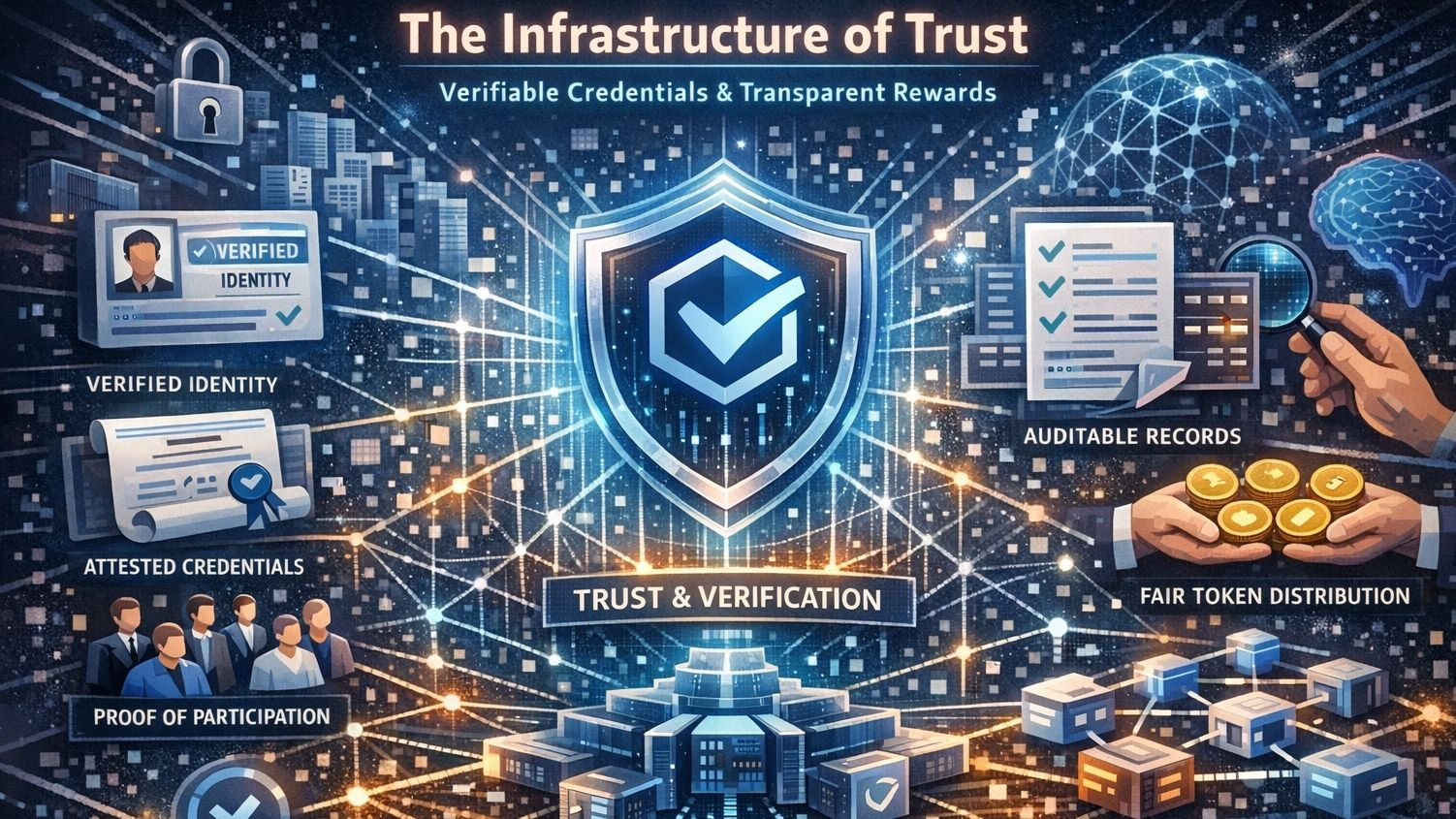
I’ve spent a lot of time thinking about what the next internet actually needs, and honestly, I keep coming back to the same thing: trust can’t stay this vague, improvised, half-broken layer that everybody depends on but nobody properly fixes. That’s the issue. We’ve built an internet that can move content instantly, transfer value globally, and connect millions of people across systems, but when it comes to proving whether something is true, earned, valid, or fairly distributed, things still get messy fast. That’s exactly why SIGN feels so important to me. It isn’t just another project trying to add features to the digital world. It’s dealing with a much deeper problem. It’s working on the infrastructure of trust itself.
When I look at where the internet is heading, I don’t see a future shaped only by speed, or smarter applications. I see a future where proof matters more than presentation. A person won’t just say they contributed. A platform won’t just claim it distributed rewards fairly. A community won’t just assume someone belongs, qualifies, or deserves access. Those things will need to be verified cleanly, quickly, and credibly. That’s where SIGN enters the picture in a serious way. Its value, to me, is that it helps transform trust from something informal and easily manipulated into something structured, usable, and portable across digital environments.
The internet right now runs on claims. That’s the blunt truth. People claim identity, contribution, membership, ownership, participation, and eligibility every single day. Projects claim fairness. Protocols claim transparency. Communities claim legitimacy. But most of these claims still depend on closed databases, screenshots, spreadsheets, social reputation, or centralized approval systems. And let’s be real, that setup just doesn’t scale well when the internet becomes more open, more tokenized, and more interconnected. The bigger the system gets, the more dangerous weak verification becomes. I think that’s one of the clearest reasons SIGN matters. It’s trying to make digital claims verifiable in a way that doesn’t collapse into pure platform dependence.
That matters a lot in the area of credential verification. I think people sometimes hear the word “credential” and instantly reduce it to diplomas or formal certificates, but in the next internet, credentials are way broader than that. They can represent proof of contribution, participation in governance, access rights, onchain activity, event attendance, contributor status, ecosystem membership, role-based eligibility, or grant-related recognition. These are not small details. In many digital systems, they decide who gets resources, who gets authority, who gets rewards, and who gets in. So I don’t see credential verification as some side utility. I see it as one of the central building blocks of digital coordination.
What I find compelling about $SIGN is that it gives those credentials structure. Not just labels. Not just community vibes. Not just a line in somebody’s backend dashboard. Real attestable structure. That changes the internet because now a claim can exist beyond the app that issued it. It can be checked, reused, trusted, and integrated into other systems. That portability is huge. Without portability, trust stays trapped. Without verification, portability becomes dangerous. SIGN sits right in that tension and makes the whole thing more workable.
I think this is where identity itself starts to shift. In the older internet model, identity is mostly account-based. You log in, you get a profile, the platform stores your data, and that platform becomes the ultimate judge of what you’ve done there. But that model feels too narrow for what’s coming next. In the next internet, identity becomes a network of verifiable claims. It’s not just who you are in a static sense. It’s what you’ve done, what you’ve earned, what roles you hold, what communities recognize you, and what systems can verify about your participation. That’s a much richer model. And honestly, it feels more honest too.
I keep thinking about how often digital systems confuse visibility with credibility. Just because something is displayed on a dashboard doesn’t mean it’s trustworthy. Just because a platform says a user qualifies doesn’t mean other systems can rely on that judgment. What SIGN seems to do is create a way for trust to move with integrity. That matters because the next internet won’t be one giant app. It’ll be fragmented, layered, interoperable, and constantly interacting across ecosystems. So if trust can’t move across those boundaries, the entire experience stays broken underneath the shiny surface.
Then there’s token distribution, which is honestly one of the clearest stress tests for whether a project’s trust model is real or fake. I’ve noticed that token distribution always sounds simple when people talk about it casually, but it’s actually one of the most politically and structurally sensitive parts of any digital ecosystem. The moment tokens are involved, you’re not just talking about rewards. You’re talking about value, recognition, power, inclusion, and legitimacy. Who gets tokens? Why do they get them? How was eligibility defined? Was the process fair? Could it be manipulated? Was the data reliable? These questions hit hard because bad token distribution doesn’t just create inconvenience. It damages credibility.
That’s why I think SIGN’s role in token distribution is so critical. It gives projects a way to connect distribution decisions to verifiable records rather than loose internal assumptions. That’s a major upgrade. Instead of relying on one private spreadsheet, one backend export, or one internal team’s interpretation of contribution, a project can ground eligibility in attestations and structured proofs. That makes the distribution process more transparent, more auditable, and frankly, more defensible. I think that’s where infrastructure starts to reveal itself. Infrastructure isn’t flashy by default. It proves its worth when people realize essential processes would become chaotic without it.
And token distribution really does become chaotic without trusted infrastructure. I’ve seen how quickly users lose confidence when reward systems feel vague or inconsistent. One person says they contributed but got ignored. Another gets included without clear justification. A team changes criteria mid-process. Nobody can independently verify what happened. At that point, the issue is no longer just logistics. It becomes a trust failure. What SIGN offers, in my view, is a way to reduce that failure by making the logic behind reward flows more legible and more grounded in verifiable data.
What makes this especially powerful is that token distribution in the next internet won’t always be based on simple metrics. It won’t just be “wallet did X, therefore wallet gets Y.” Real ecosystems are more complicated than that. Contribution can be social, technical, strategic, creative, operational, or governance-related. Value can accumulate over time in very different forms. A good trust system has to handle nuance. It has to support layered qualification, not crude sorting. SIGN fits that need because it enables attestations that can carry structured meaning. It helps projects represent more than just raw activity. It helps them represent recognized contribution.
To me, that’s a huge shift. It means digital systems can start rewarding not just visible transactions, but verified participation. That makes the internet more human without making it less rigorous. And I think that balance is crucial. Too many systems either become overly rigid and mechanical, or so informal that they turn arbitrary. SIGN points toward something better: a model where social and institutional judgments can still exist, but they’re anchored in verifiable records.
That brings me to what I think is the deepest part of this whole topic: the infrastructure of trust. I’m not using that phrase loosely. Trust infrastructure is what determines whether the next internet becomes genuinely interoperable or just a bunch of disconnected systems pretending to be open. It’s easy to talk about decentralization, openness, and ownership. It’s harder to build the trust rails that make those ideals functional. If systems can’t verify credentials, validate eligibility, recognize contribution, or rely on shared attestations, then a lot of digital openness stays superficial.
SIGN matters because it helps create those rails. It turns trust into something systems can actually use. That doesn’t mean trust becomes cold or purely technical. It means trust gains form. It becomes issuable, checkable, and composable. I think composability is one of the most underrated parts of this conversation. In crypto and internet-native ecosystems, we’ve already seen composability applied to assets and smart contracts. But trust itself has remained weirdly uncomposable. Reputation is fragmented. Credentials are siloed. Eligibility is local. Proof is often non-transferable. That’s a huge bottleneck. SIGN helps remove that bottleneck by giving trust-related claims a structure that other systems can read and verify.
And once trust becomes composable, the next internet changes in a big way. Communities can coordinate more effectively. Protocols can distribute rewards with more confidence. Access systems can become more intelligent. Governance can become more credible. Contributors can carry verified recognition across contexts instead of rebuilding reputation from scratch inside every new environment. That makes digital participation feel more continuous and less wasteful.
I also think SIGN’s relevance grows because the internet is becoming more multi-layered. People now move across wallets, platforms, communities, protocols, identities, and roles all the time. A single person can be a builder in one ecosystem, a voter in another, a contributor somewhere else, and a recipient of rewards in yet another network. Without strong trust infrastructure, all of that becomes fragmented noise. With something like SIGN, those roles and contributions can be expressed through attestations that preserve meaning across systems. That’s a pretty big deal. It reduces friction, but more importantly, it reduces ambiguity.
Another thing I find valuable is that this kind of system can support accountability without forcing total exposure. That matters to me because the future of digital trust shouldn’t depend on surveillance. It shouldn’t require everybody to reveal every detail about themselves just to prove one relevant fact. Good trust infrastructure should let users prove what matters in a specific context and avoid unnecessary disclosure. That’s a healthier model. It keeps verification precise rather than invasive. And I think the next internet desperately needs that distinction, because too many current systems confuse trust with data extraction.
The more I examine SIGN’s position, the more I see it not as an accessory to internet evolution, but as one of the quiet foundations underneath it. It supports the move from informal recognition to verifiable recognition. From guesswork to proof. From one-off distributions to structured allocation. From siloed records to interoperable trust. That’s not small. That’s foundational.
What really sticks with me is this: the next internet won’t be defined only by what it allows people to do. It’ll be defined by what it allows people to prove. That’s where credibility lives. That’s where fairness becomes visible. That’s where coordination stops depending on blind trust and starts depending on verifiable relationships. SIGN belongs in that exact layer. It strengthens credential verification, gives token distribution more integrity, and helps build the infrastructure through which digital trust can finally operate like a serious public utility instead of a weak private assumption.
So when I think about SIGN’s place in the next internet, I don’t see it as peripheral at all. I see it as part of the deeper architecture that makes everything else more believable, more portable, and more fair. It helps the internet mature. It helps digital systems recognize people and actions with more precision. It helps value move with accountability. It helps trust become something you can inspect instead of something you’re pressured to accept. And to me, that’s the real shift. $SIGN is not just participating in the future internet. It’s helping define the conditions under which that future can actually be trusted.