
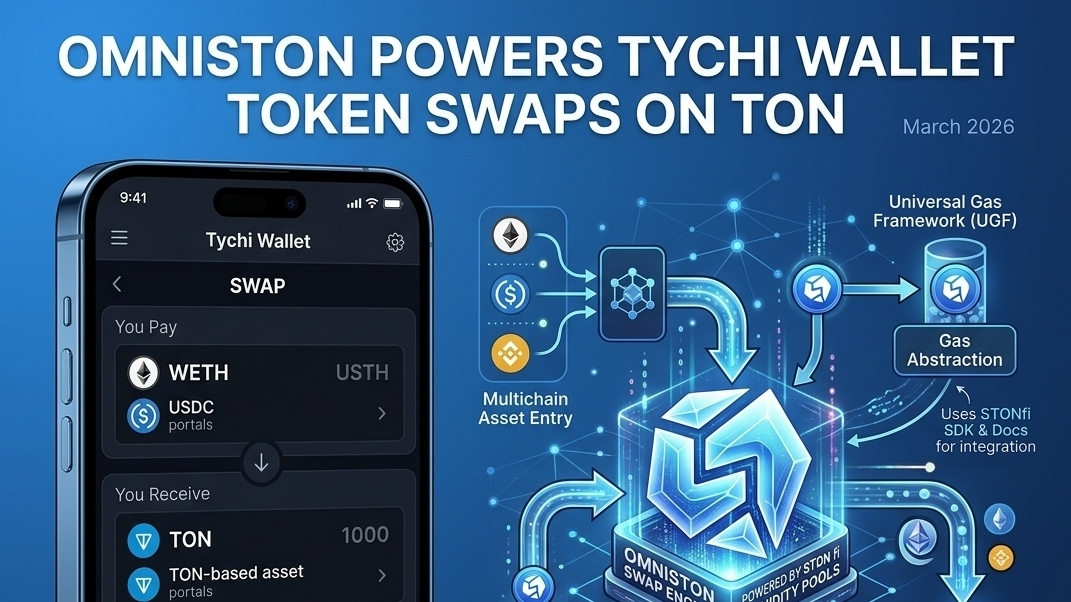
Omniston Powers Token Swaps in Tychi Wallet: A Stronger Step Toward Frictionless Multichain DeFi
March 2026 represents an important moment for multichain DeFi. With the integration of Omniston into Tychi Wallet, users now gain a smoother way to swap tokens on the TON network directly inside a self-custody wallet built for cross-chain simplicity. More than just a technical upgrade, this integration reflects a broader shift in Web3: the move toward infrastructure that is composable, efficient, and easier for everyday users to understand.
At its core, the collaboration between Tychi Labs and STON.fi demonstrates how DeFi can become more accessible without sacrificing control, liquidity, or decentralization. It shows that the next phase of blockchain growth will not only depend on new products, but on better connections between the tools people already use.
A Wallet Built for Multichain Simplicity
Tychi Wallet is designed around one clear idea: cross-chain interactions should feel natural, not complicated. For many users, moving across blockchains still comes with unnecessary friction. They must manage multiple assets, understand different networks, and keep track of gas requirements that vary from chain to chain. Tychi Wallet addresses this challenge by offering a self-custody experience that simplifies the process while leaving users in full control of their private keys.
This matters because self-custody remains one of the most important principles in Web3. Users want convenience, but they also want ownership. Tychi Wallet attempts to balance both by reducing the operational burden of blockchain usage without taking control away from the user.
Solving One of Web3’s Oldest Problems: Gas Fees
One of the most persistent problems in blockchain adoption is gas. New users often find it confusing to hold native tokens just to interact with a network. Even experienced users are sometimes forced to keep multiple gas assets across different chains, creating extra steps, extra cost, and extra confusion.
Tychi Labs addresses this through its Universal Gas Framework (UGF). The framework allows users and applications to transact across blockchains without always needing to hold native gas tokens. Instead, supported assets can be used to power transactions, making the experience more flexible and user-friendly.
This kind of abstraction is important because it removes one of the biggest barriers to mainstream adoption. When users no longer need to worry about which token pays for which action, the blockchain experience becomes much closer to the simplicity people expect from modern digital apps.
Omniston Brings Liquidity Into the Wallet Experience
The integration of Omniston into Tychi Wallet adds another major layer of value. By connecting directly to @ston_fi liquidity, the wallet can now support token swaps in a way that feels embedded rather than patched together.
This is what makes the collaboration especially powerful: users do not need to leave the wallet or rely on external tools to access liquidity. Swaps happen where the user already is, which reduces friction and improves the overall experience.
In practice, this means the wallet becomes more than a storage tool. It becomes a transaction layer, a liquidity access point, and a gateway to TON-based DeFi activity.
STON Token as the Gas Token for TON Swaps
A particularly important detail in this integration is the role of the STON token. Within TON swaps in Tychi Wallet, STON now functions as the gas token, helping reduce friction and making transactions smoother.
That shift is significant because it streamlines the user journey. Instead of forcing users to manage an additional native gas asset just to complete a swap, the ecosystem can operate in a more unified way. This creates a cleaner experience for users and a more efficient workflow for applications built on top of the infrastructure.
For DeFi, this kind of simplification is not cosmetic. It directly affects usage, retention, and adoption. The easier it becomes to complete a transaction, the more likely users are to stay engaged.
Why This Matters for Developers
The collaboration is not only useful for users. It also presents a strong signal for builders.
For developers, Tychi Wallet’s integration with Omniston shows how liquidity and cross-chain functionality can be embedded without rebuilding core infrastructure from the ground up. Using the STONfi SDK and Omniston docs, wallets, apps, and cross-chain platforms can access deep TON liquidity in a more efficient and modular way.
That is the real value of composable infrastructure. Instead of every team building the same liquidity layer, developers can plug into existing systems and focus on the product experience. This reduces duplication, speeds up development, and makes innovation more practical.
In a fast-moving space like DeFi, that advantage matters. Teams that can build faster and integrate smarter are more likely to deliver products users actually adopt.
Composable DeFi in Practice
The Tychi Wallet and Omniston integration is a strong example of composable DeFi working as intended. Each layer contributes a specific function:
Tychi Wallet provides the self-custody user experience.
Tychi Labs’ UGF reduces gas complexity across chains.
Omniston connects swap access to TON liquidity.
STON.fi supplies the liquidity backbone supporting the swaps.
Together, these components create a more seamless ecosystem than any of them could provide alone. This is the promise of composability: systems designed to interoperate, rather than operate in isolation.
That approach is especially important in multichain environments. As blockchain ecosystems expand, users increasingly expect solutions that can move with them. They do not want to manually assemble every interaction. They want tools that simply work.
A Step Toward More Accessible Blockchain Use
This integration also reflects a broader trend in Web3 product design: accessibility is becoming as important as functionality. In earlier phases of blockchain development, the focus was often on what was technically possible. Today, the focus is shifting toward what is practical, intuitive, and sustainable for regular users.
Tychi Wallet’s integration with Omniston is a good example of this shift. It reduces friction, expands liquidity access, and keeps the experience centered on the user. At the same time, it preserves the core principles that make Web3 valuable: self-custody, decentralization, and direct access to on-chain infrastructure.
That balance is difficult to achieve, which is why integrations like this matter. They show how DeFi can evolve without losing the features that define it.
Conclusion
The integration of Omniston into Tychi Wallet is more than a product update. It is a clear demonstration of how composable DeFi, liquidity infrastructure, and gas abstraction can work together to improve the user experience on TON.
By combining Tychi Wallet’s self-custody design, Tychi Labs’ Universal Gas Framework, and STON.fi liquidity through Omniston, the ecosystem is making token swaps more accessible, efficient, and secure. For users, that means fewer hurdles. For developers, it means better tools. For the broader DeFi space, it signals a future where blockchain interactions feel less technical and more natural.
Explore swaps in Tychi Wallet here: tychiwallet.com/
Read more about STONfi here: blog.ston.fi/