
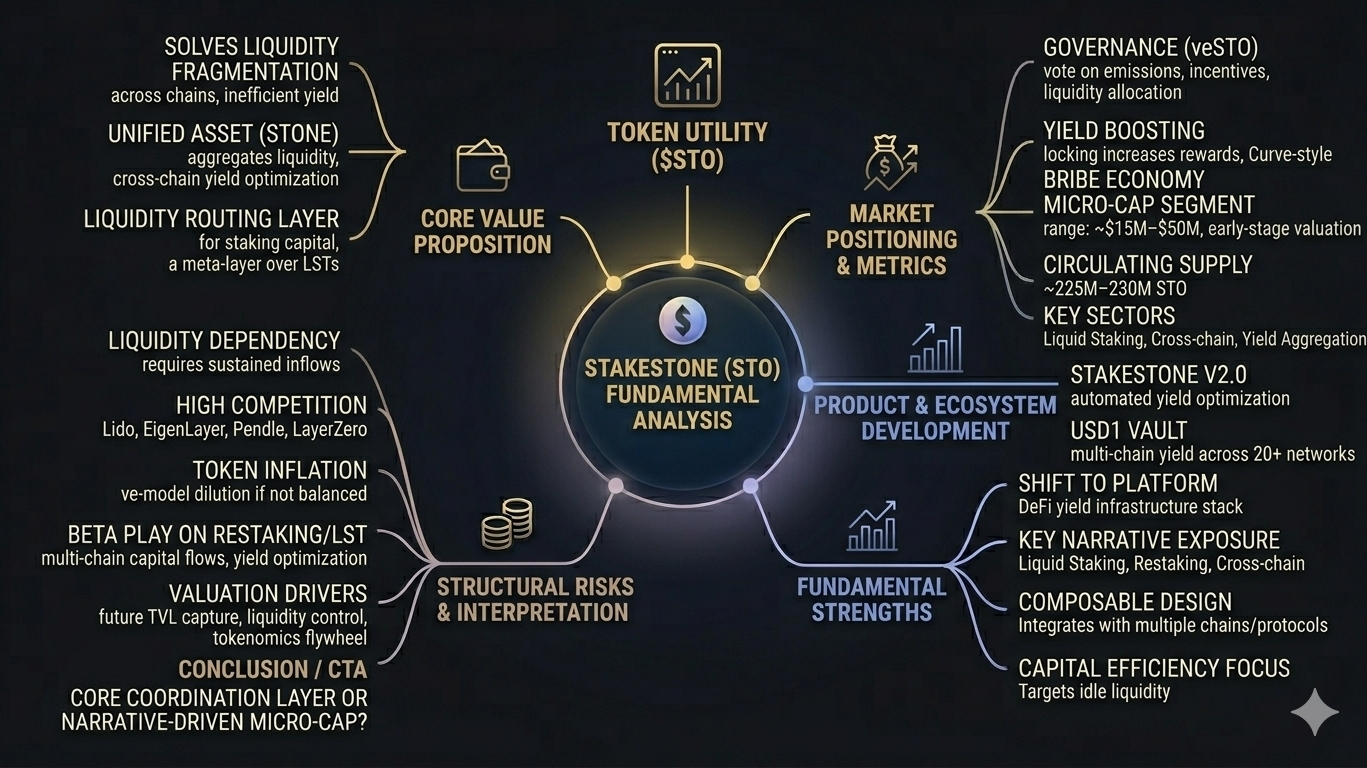
$STO is the native token of StakeStone, a protocol positioned in the Liquid Staking + Omnichain Liquidity narrative—one of the fastest-growing sectors within DeFi.
1. Core Value Proposition
StakeStone aims to solve a structural inefficiency in DeFi:
Fragmented liquidity across chains
Inefficient yield distribution between LSTs and restaking ecosystems
Its solution:
Aggregates liquidity into a unified asset (STONE)
Enables cross-chain yield optimization
Functions as a liquidity routing layer for staking capital
➡️ Positioning: Comparable to a meta-layer over LST ecosystems, not just another staking protocol.
2. Token Utility ($STO)
$STO is not purely speculative; it has embedded economic functions:
Governance (veSTO model)
→ Vote on emissions, incentives, and liquidity allocation
Yield Boosting Mechanism
→ Locking increases rewards (similar to Curve-style tokenomics)
Bribe Economy Integration
→ External protocols can incentivize liquidity direction
➡️ This creates a reflexive token demand loop tied to TVL and yield competition
3. Market Positioning & Metrics
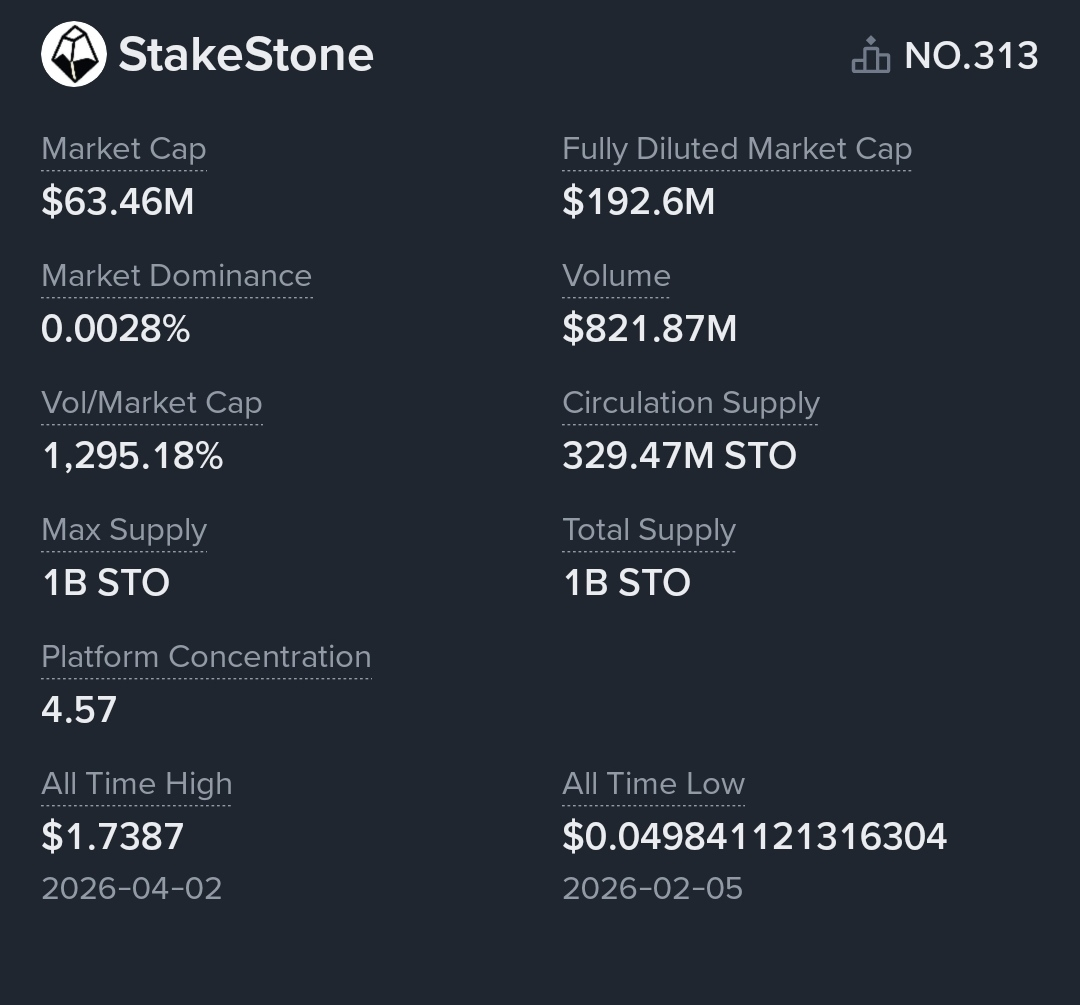
Market Cap: ~$40M–$60M range (micro-cap segment)
Circulating Supply: ~329M STO
Sector:
Liquid Staking
Cross-chain infrastructure
Yield aggregation
➡️ Interpretation:
Still early-stage valuation
High sensitivity to TVL growth and narrative rotation
4. Product & Ecosystem Development
Recent developments indicate expansion beyond a single use case:
StakeStone V2.0:
→ Focus on automated yield optimization
USD1 Vault:
→ Multi-chain yield strategies across 20+ networksExpansion into a broader DeFi yield infrastructure stack
➡️ Shift from “product” → “platform”
5. Fundamental Strengths
Exposure to key narratives:
Liquid staking (ETH, BTC derivatives)
Restaking (EigenLayer ecosystem)
Cross-chain liquidity
Composable design:
→ Integrates with multiple chains and protocols
Capital efficiency focus:
→ Targets one of DeFi’s main inefficiencies (idle liquidity)
6. Structural Risks
Liquidity dependency:
→ Requires sustained inflows to maintain yield competitiveness
High competition:
→ Lido, EigenLayer, Pendle, LayerZero ecosystem
Token inflation / emissions risk:
→ ve-models can dilute if not balanced
Micro-cap volatility:
→ Prone to sharp drawdowns and low liquidity distortions
7. Fundamental Interpretation
$STO is essentially a beta play on:
Growth of restaking + LST ecosystems
Expansion of multi-chain capital flows
Increasing demand for yield optimization layers
Its valuation is not driven by current cash flow, but by:
Future TVL capture
Control over liquidity routing
Strength of tokenomics flywheel
Is STO evolving into a core liquidity coordination layer in DeFi, or will it remain a narrative-driven micro-cap dependent on short-term yield flows?
#DeFi #LiquidStaking #OnChainAnalysis #CryptoFundamentals $STO $ETH $BTC