
In early 2026, the conversation around quantum computing has shifted from "science fiction" to a "migration deadline." With recent breakthroughs in quantum error correction and scaling, major tech players like Google have now established a 2029 timeline for full post-quantum cryptography (PQC) migration.
For the crypto world, this isn't just a technical upgrade—it’s an existential race.
What is Quantum Computing?
Unlike classical computers that use bits (0 or 1), quantum computers use qubits. Thanks to two core principles of quantum mechanics, they process information in a fundamentally different way:
Superposition: A qubit can exist in a state representing both 0 and 1 simultaneously.
Entanglement: Qubits can be linked such that the state of one instantly influences the state of another, regardless of distance.
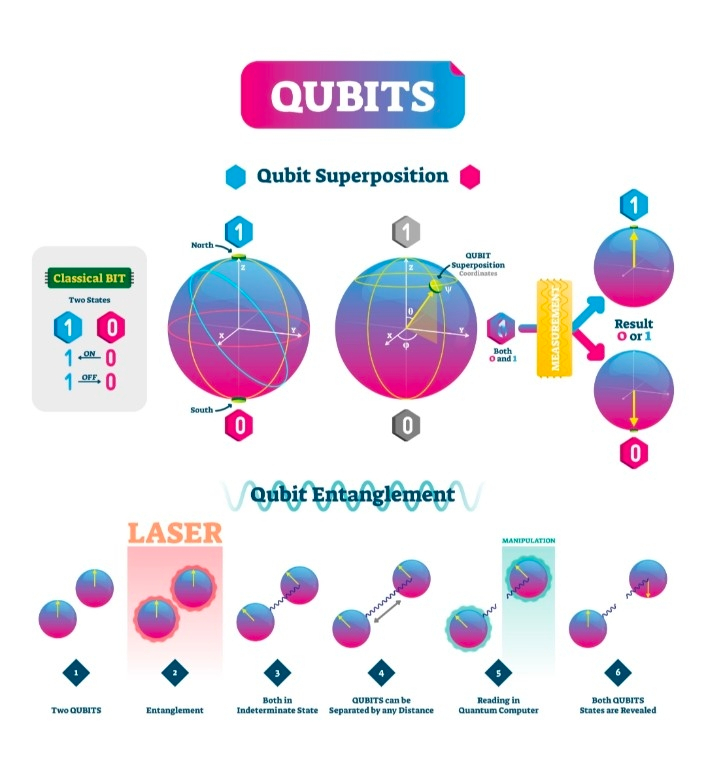
This allows quantum computers to perform certain calculations—specifically those involving massive search spaces or factoring large numbers—exponentially faster than any supercomputer on Earth.
The Threat to Bitcoin and Crypto
The primary "lock" on your crypto wallet is Elliptic Curve Cryptography (ECC), specifically the ECDSA algorithm. This algorithm ensures that only the person with the private key can authorize a transaction.
The Shor’s Algorithm Threat: A sufficiently powerful quantum computer could use Shor’s Algorithm to reverse-engineer a private key from a public key. In 2026, researchers have warned that future quantum machines might require significantly fewer qubits than previously estimated to crack these codes.
Targeting "Used" Addresses: Currently, Bitcoin is most vulnerable when a transaction is broadcast but not yet confirmed. During this window, your public key is visible. A "Quantum Attacker" could theoretically see your transaction, calculate your private key instantly, and outbid your transaction with a higher fee to steal the funds.
The "Store-Now, Decrypt-Later" Attack: This is a 2026 reality. Bad actors are currently harvesting encrypted data and blockchain histories. Even if they can't break the code today, they are saving the data to unlock it once quantum hardware matures.
How the Industry is Fighting Back
The good news? The "Quantum Doomsday" isn't here yet, and the crypto industry is already building the shield.
1. Post-Quantum Cryptography (PQC)
In late 2025 and early 2026, NIST (the National Institute of Standards and Technology) finalized standards for quantum-resistant algorithms. These are mathematical problems that are just as hard for a quantum computer to solve as they are for a classical one.
2. Quantum-Resistant Sidechains
In March 2026, Blockstream successfully demonstrated quantum-resistant transaction signing on the Liquid Network (a Bitcoin sidechain). This marked the first real-world deployment of PQC on a production-level Bitcoin environment.
3. Ethereum’s Strategy
Vitalik Buterin and the Ethereum Foundation have outlined a "hard fork" plan that would allow users to migrate their funds to new, quantum-safe addresses (using Lamport signatures or STARKs) if a sudden quantum threat were detected.
The Bottom Line for Investors
While the threat to Bitcoin's core security is unlikely to materialize before 2029, the transition phase has begun. For the average user, the best defense in 2026 remains simple:
Avoid Address Reuse: Don't use the same Bitcoin address twice. When you send funds, the "change" should go to a new, unexposed address.
Watch the Migration: Ensure the wallets and exchanges you use are actively discussing their PQC (Post-Quantum Cryptography) roadmap.
Quantum computing is the ultimate test of blockchain's adaptability. If Bitcoin can successfully migrate its "locks" before the "key-breaker" arrives, it will prove itself as the most resilient financial system ever created.