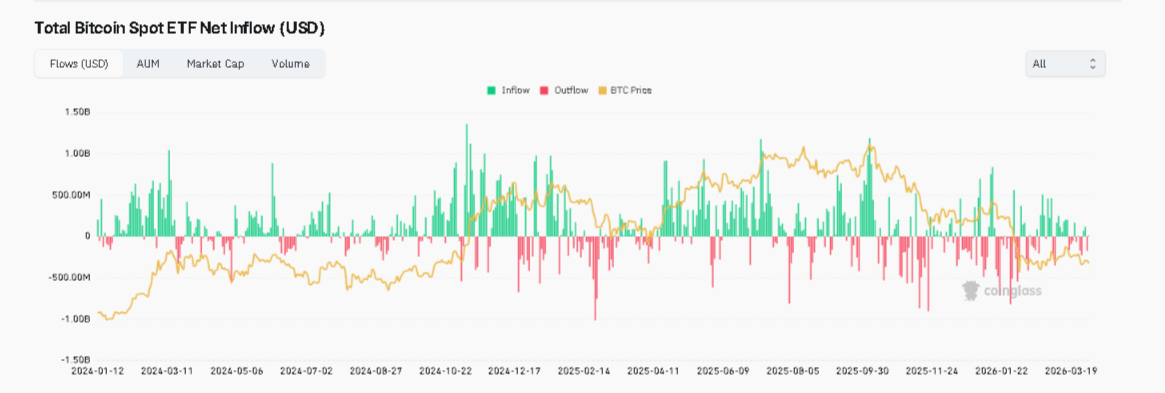

Bitcoin is consolidating just below $70,000 with one scheduled event
this week capable of breaking the pattern in either direction: the March
CPI print dropping April 10 at 8:30 AM ET. The binary is clean, if U.S.
inflation data comes in soft enough to shift Federal Reserve language
toward cuts, BTC $75K becomes an immediate technical target; if core CPI
stays sticky above 0.3% month-over-month, the “higher for longer”
scenario reasserts itself, and the path of least resistance points back
toward $60,000–$62,000.
The Cleveland Fed’s nowcast – built on
late-March data – projects a 0.84% monthly headline surge driven by
gasoline prices up 26.2% year-over-year and diesel up 50.4%. That
reading, if confirmed, would mark a sharp acceleration from February’s
0.27% headline and would effectively freeze any Federal Reserve pivot
conversation through at least mid-summer. Macro crypto trading desks are
already pricing two radically different worlds into options flow.
Thursday’s print decides which one we’re in.
Bitcoin’s $75K Level: Full Technical Breakdown and Price Scenarios
Bitcoin Price Prediction: Reclaim $75,000 or Retreat to $60,000
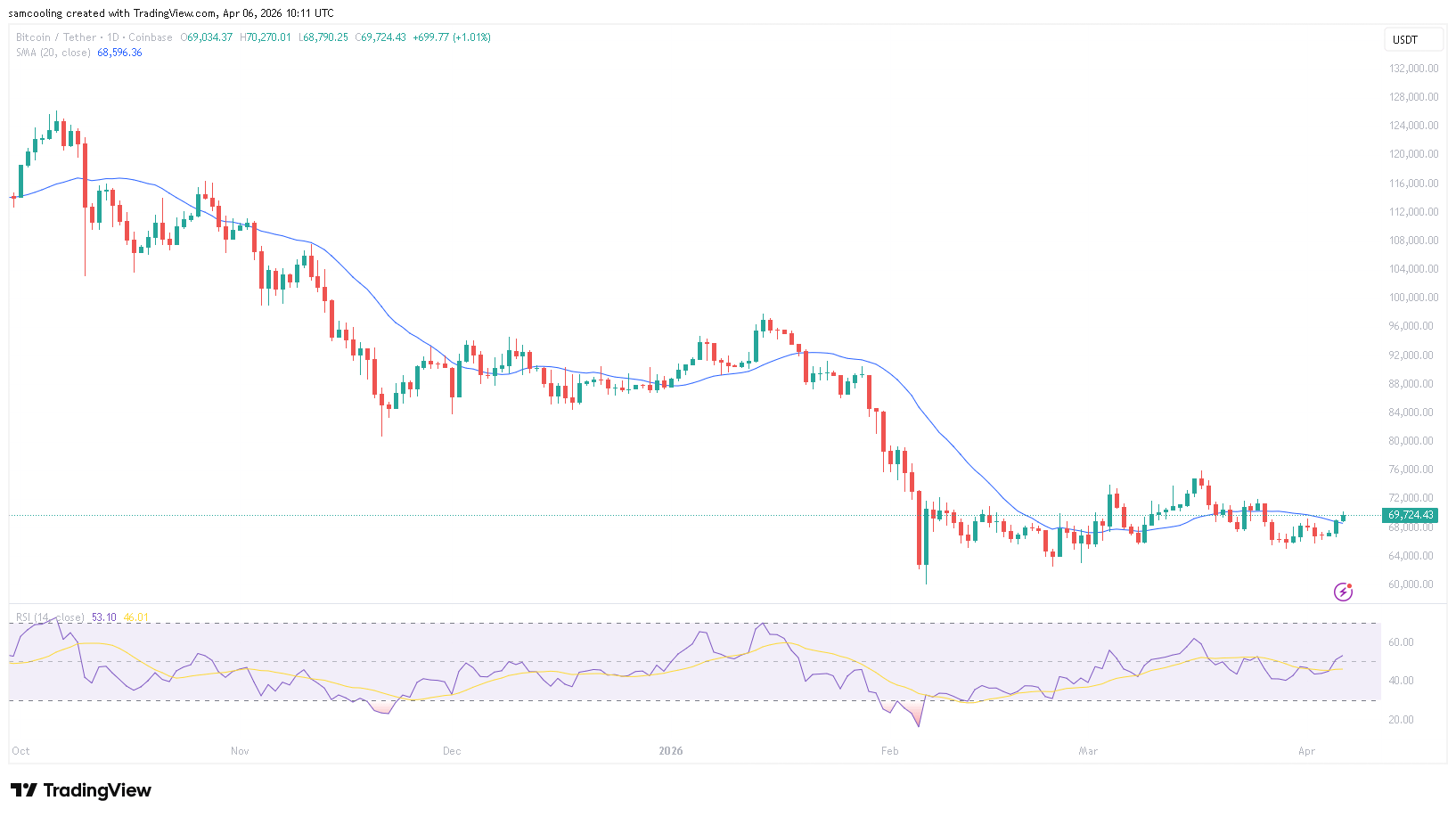 Bitcoin is currently rangebound between $65,000 and $71,000, a
compression zone that has held for several weeks and is coiling into
what chart structure suggests is a decision point. The $73,700 level
above is the immediate overhead resistance; above that is the $75,000
psychological ceiling, which has acted as a load-bearing level since
BTC’s last failed breakout attempt.
A weekly close above $75,000 on CPI-driven volume would be the first structural confirmation that the bull case is intact.
RSI
on the daily is sitting near 53 – neutral, not oversold, which means
there’s no technical floor being built from momentum exhaustion alone.
The 200-day EMA is converging with the $67,500 support zone, making that
level load-bearing in the near term. A daily close below $67,500 opens
the door to $62,000, where significant order book depth and prior
accumulation structure sit. MVRV ratio remains below 1.5, suggesting the
market hasn’t reached the euphoria zone – but that also means on-chain
buying pressure isn’t yet dominant enough to generate self-sustaining
momentum.
The bull case requires a CPI-triggered risk-on move
through $71,000, then a reclaim of $73,700 on sustained volume, with
$75,000 as the confirming close. The bear case activates on a hot print:
a rejection at $71,000 that cascades back through the 200-day EMA and
targets the $60,000–$62,000 whale accumulation zone. For traders already
holding, the downside scenario below $66,000
deserves serious risk modeling before Thursday. The single most
important level: $71,000. Hold it post-print and the bull case lives.
Lose it and $62,000 becomes the next anchor.
Why the April 10 CPI Print Resets the Fed Timeline – and Bitcoin’s Ceiling
The
Bitcoin CPI relationship isn’t incidental – it’s mechanical. CPI drives
Fed rate expectations, rate expectations drive the dollar and treasury
yields, and dollar strength directly compresses institutional appetite
for risk assets, including BTC. February’s CPI landed at 2.4% year-over-year
with core holding at 2.5% annually for the second consecutive month,
driven by shelter costs rising 0.2%. That stickiness kept “higher for
longer” as the dominant Fed posture heading into April’s data cycle.
The
threshold that matters for a Federal Reserve pivot signal is a core
monthly reading at or below 0.2% – anything above 0.3% entrenches
current policy and delays the first cut. CME FedWatch
currently prices fewer than two cuts for 2025, a dramatic repricing
from the four-cut consensus that opened the year. Energy is the wild
card: the Cleveland Fed’s nowcast is being driven almost entirely by
gasoline and diesel spikes, and the Fed has historically looked through
volatile energy components when assessing underlying inflation trends.
If headline runs hot but core stays controlled, traders may interpret
that as a conditional green light.
March payrolls
added 178,000 jobs, with unemployment holding at 4.3% – a labor market
that doesn’t scream imminent recession and therefore gives the Fed cover
to hold. The April 10 U.S. inflation data release won’t just move
Bitcoin on the day; it will recalibrate the entire rate-cut timeline
that institutional crypto positioning is built on.