
In the world of digital finance, few names carry as much weight as Bitcoin. Born in 2009 out of a vision for decentralized money, Bitcoin has grown from an obscure experiment into a global financial asset that institutions, governments, and everyday investors now take seriously. But what does the future hold for Bitcoin over the next five years?
Let’s break it down in a way that’s not just informative—but genuinely worth your time.
🚀 The Journey So Far
Bitcoin was created by the mysterious Satoshi Nakamoto with a simple idea: remove the middleman from money. No banks. No central authority. Just pure peer-to-peer transactions.
Over the years, Bitcoin has:
Survived multiple crashes (“crypto winters”)
Been declared “dead” countless times
Reached new all-time highs repeatedly
Attracted institutional giants like BlackRock and MicroStrategy
This resilience is a key reason many believe its future is still bright.
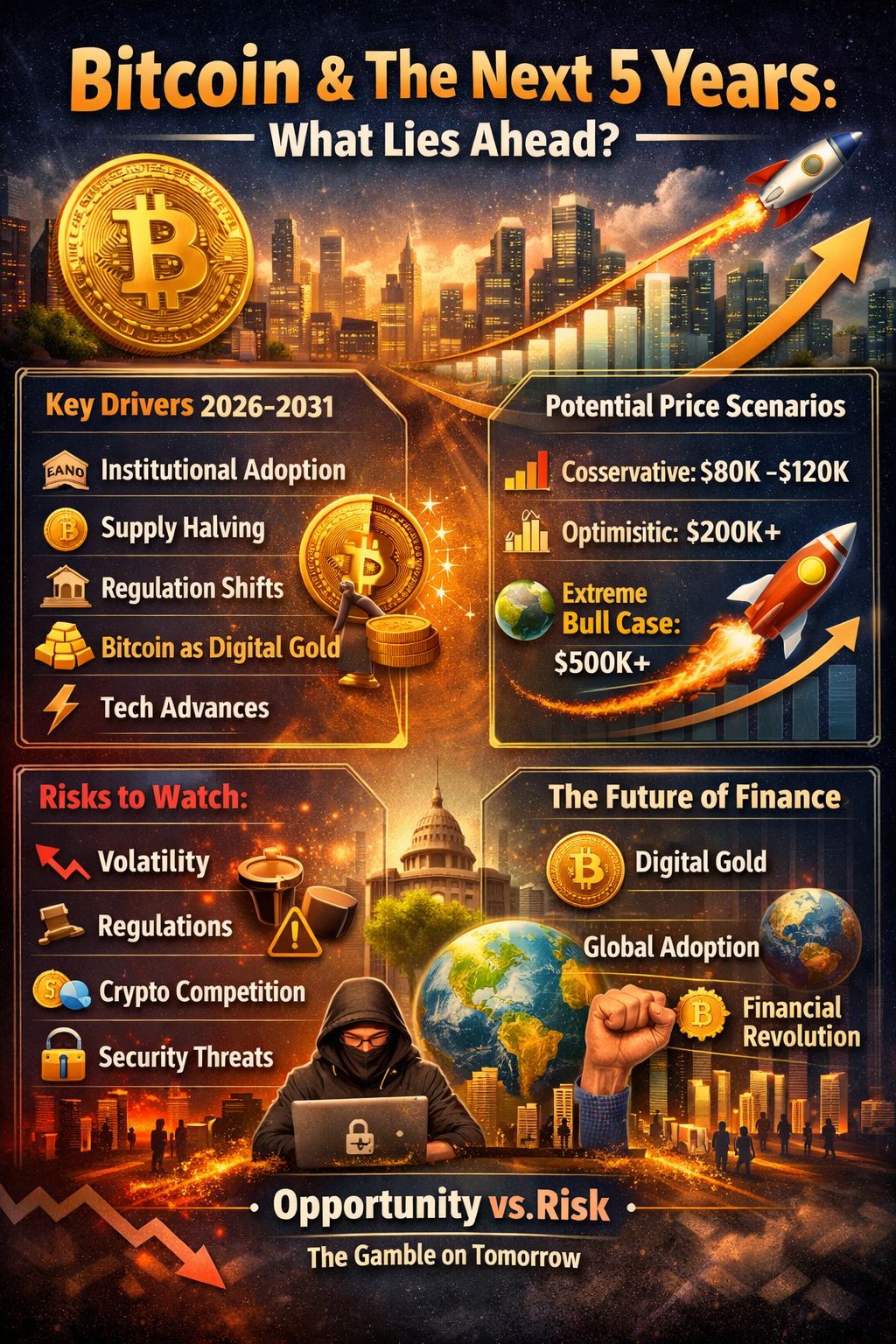
📈 Key Drivers of Bitcoin’s Future (2026–2031)
1. Institutional Adoption Will Expand
Large financial institutions are no longer ignoring Bitcoin—they’re embracing it. The introduction of Bitcoin ETFs has made it easier for traditional investors to enter the market.
Expect:
More pension funds and hedge funds buying BTC
Increased legitimacy in global finance
Reduced volatility (gradually)
2. The Supply Shock Effect
Bitcoin has a fixed supply of 21 million coins. This scarcity is enforced by its underlying technology, the Blockchain.
Every four years, a “halving” event reduces mining rewards. The next cycles will:
Decrease new BTC entering the market
Increase scarcity
Potentially push prices higher if demand rises
3. Government Regulation: Threat or Boost?
Regulation is a double-edged sword.
Countries like United States are moving toward clearer crypto policies, while others like India remain cautious.
Possible outcomes:
Positive: Clear laws → more investors enter safely
Negative: Heavy restrictions → reduced adoption
4. Bitcoin as “Digital Gold”
Bitcoin is increasingly compared to Gold.
Why?
Limited supply
Store of value
Hedge against inflation
In the next five years, Bitcoin could solidify its role as a global “safe-haven asset,” especially during economic uncertainty.
5. Technological Improvements
Bitcoin is often criticized for being slow and expensive. However, solutions like the Lightning Network aim to fix this by enabling faster and cheaper transactions.
Future improvements may include:
Better scalability
Lower fees
Increased usability for everyday payments
⚠️ Risks You Can’t Ignore
Bitcoin isn’t risk-free. Here are the major concerns:
🔻 Volatility
Prices can swing dramatically within days.
🔻 Regulation Crackdowns
Governments could impose strict rules or taxes.
🔻 Competition
Other cryptocurrencies like Ethereum offer more functionality (smart contracts, apps).
🔻 Security & Sentiment
Market sentiment still drives price heavily, and hacks or negative news can cause panic selling.
🔮 Price Predictions: Realistic vs Hype
Let’s keep it honest—no one can predict exact prices. But based on trends:
Conservative Scenario:
BTC reaches $80,000–$120,000
Slow but steady institutional growth
Optimistic Scenario:
BTC crosses $200,000+
Mass adoption + strong global demand
Extreme Bull Case:
BTC becomes a major global reserve asset
Prices exceed $500,000
🌍 The Bigger Picture
Bitcoin is no longer just a currency—it’s becoming an entire financial movement. It challenges traditional banking, questions government control over money, and introduces a new way of thinking about value.
In countries facing inflation or currency instability, Bitcoin is already acting as a financial lifeline.
🧠 Final Thoughts
The next five years for Bitcoin won’t be smooth—but they could be transformative.
If adoption continues, regulations become clearer, and technology improves, Bitcoin may:
Cement itself as digital gold
Become a core part of investment portfolios
Play a major role in the future global economy
But remember: Bitcoin thrives on uncertainty. That’s both its greatest strength—and its biggest risk.
💬 Bottom Line
Bitcoin isn’t just an investment—it’s a bet on the future of money itself. $BTC
#freedomofmoney #IranClosesHormuzAgain #CZLiveAMA #IranHormuzCryptoFees #MorganStanley'sBTCETFSetToLaunch