
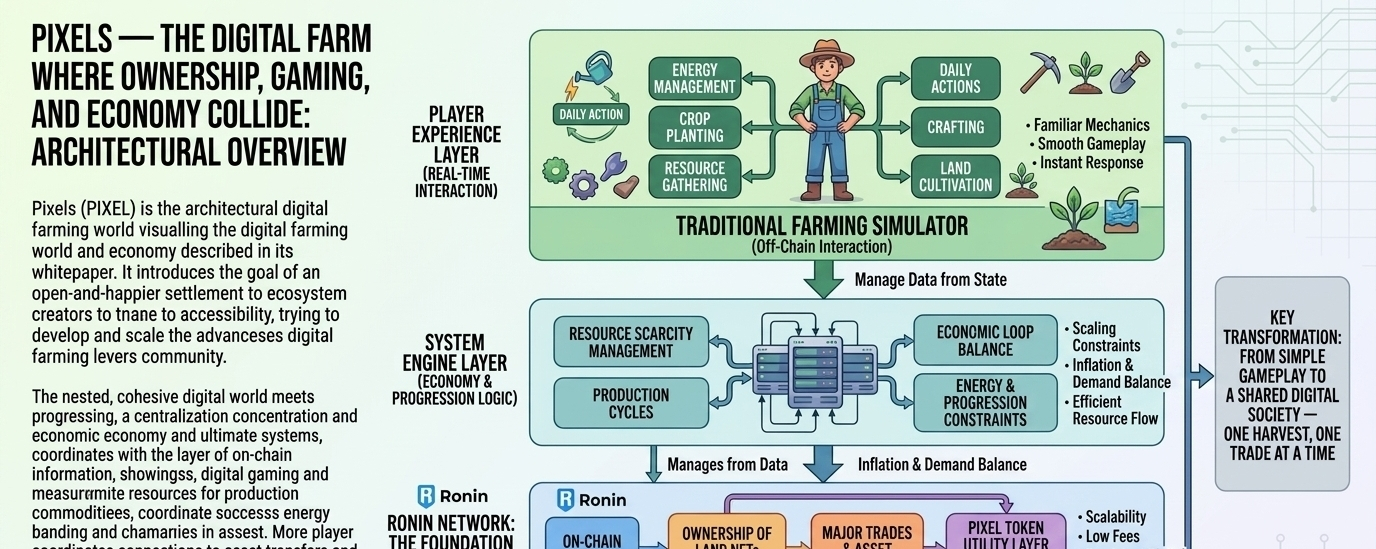
There are moments in internet history when a simple game stops feeling like just a game and starts behaving like a living system and Pixels (PIXEL) is one of those quiet experiments that slowly transforms from a farming simulator into a full scale digital economy running on the Ronin Network where every action planting crops gathering resources crafting items trading goods starts to resemble a reflection of real world economic behavior. It is built not only for entertainment but for interaction ownership and persistence where players are not just users pressing buttons but participants inside a shared digital society that continues evolving even when they log out.
Pixels did not begin as a complex financial ecosystem it started as a simple Web3 farming game inspired by traditional simulation titles but with one major difference hidden beneath its surface ownership. The early vision was to shift control away from centralized game servers and place value directly into the hands of players through blockchain infrastructure. At first the gameplay was simple planting harvesting completing tasks and upgrading tools but slowly land ownership became the turning point where certain digital plots were minted as NFTs turning virtual space into real tradable assets that existed beyond the game itself. This small idea created a deeper psychological shift players were no longer just playing in a world they were building inside it.
As the project evolved it found its true foundation on the Ronin Network a blockchain designed specifically for gaming scalability allowing Pixels to process large volumes of in game interactions without slow confirmations or high fees. This mattered because the game was not trying to be a financial dashboard it was trying to remain playable smooth and familiar like traditional games while still preserving blockchain ownership in the background. Over time Pixels expanded into a layered economy where off chain gameplay systems handled speed and responsiveness while on chain systems handled ownership and major trades. This separation was not accidental it was necessary to solve a core contradiction in Web3 gaming blockchains are slow but games must feel instant.
Today Pixels operates as a living digital economy disguised as a casual farming world. Players log in daily to manage energy grow crops refine resources and craft items but underneath this simplicity lies a structured economic loop driven by resource scarcity production cycles and reward systems. The PIXEL token sits at the center of this structure acting as a utility layer for upgrades ecosystem participation NFT interactions and governance related mechanics. But unlike earlier play to earn models that often collapsed under inflation and speculation Pixels is attempting to shift toward a play and own philosophy where engagement and progression matter more than pure reward extraction.
Internally the system behaves like a multi layer simulation engine. The game client handles real time interaction so that movement and farming feels instant and responsive. The server layer manages economy logic balancing energy consumption resource generation crafting systems and progression constraints so that no single player can scale endlessly without effort. Meanwhile the blockchain layer on Ronin records ownership of land assets and major transactions ensuring that what players earn or own is not just a database entry but a persistent digital property that can exist independently of the game servers. This hybrid design allows Pixels to feel like a traditional online game while still carrying the permanence of blockchain systems.
The success of Pixels is not only technical but behavioral. It has managed to attract large waves of users during peak cycles becoming one of the more recognizable names in Web3 gaming because it lowered the barrier to entry. Unlike many blockchain games that overwhelm users with financial complexity Pixels uses familiar mechanics farming crafting exploration which makes it accessible even to non crypto players. Its migration and growth within the Ronin ecosystem also helped it scale efficiently while token visibility and liquidity on Binance increased its exposure and market participation bringing both attention and speculation into the same ecosystem.
However beneath this success lies a set of structural risks that cannot be ignored. The first is economic stability because any system that continuously generates in game resources must carefully balance inflation and demand or risk long term devaluation of effort. The second is dependency on incentives since many players initially arrive for rewards and retaining them requires the game itself to remain genuinely engaging even after rewards stabilize. The third is speculative distortion where token trading activity can sometimes overshadow actual gameplay health creating narratives driven more by markets than by user experience. These tensions are not unique to Pixels but they define the entire Web3 gaming category.
Still the long term vision of Pixels is not limited to farming or token cycles. The deeper ambition is to evolve into a persistent digital society where ownership creativity and interaction form a self sustaining ecosystem. Future expansions could introduce more advanced social systems deeper governance structures player driven economies and possibly even AI driven world events that make the environment feel alive and reactive. In that vision Pixels is not just a game but a platform where multiple experiences coexist connected through shared ownership and economy.
In the end Pixels is not really about tokens farming loops or even blockchain infrastructure. It is about a question that sits quietly underneath everything what happens when a digital world starts holding real value and people begin treating virtual land labor and time with the same seriousness as real life. Whether it succeeds or fails in the long run it represents a shift in thinking from games as temporary entertainment to games as persistent digital spaces where people build trade and return every day.
And maybe that is the real story here not a rise in charts or a listing on Binance but the slow construction of a world made of pixels that starts to feel less like simulation and more like somewhere people genuinely live one harvest one trade and one moment at a time.